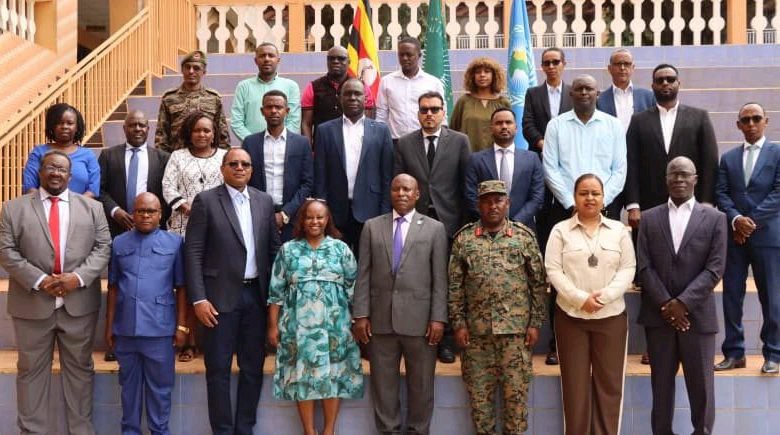
Uganda is spearheading a three-day Open Source Intelligence (OSINT) and Conflict Analysis Workshop designed to enhance the region’s ability to anticipate, prevent, and manage emerging security threats. Launched on Monday, 27th October 2025, in Kampala, the training brings together participants from Uganda, Kenya, Ethiopia, Somalia, Sudan, Comoros, Burundi, as well as representatives from regional and continental bodies including IGAD, the African Union (AU), COMESA, ECOWAS, and the Eastern Africa Standby Force (EASF).
At the opening ceremony, Brigadier General Abdul Rugumayo, Deputy Chief of Defence Intelligence and Security representing the Chief of Joint Staff, underscored the critical role of coordinated intelligence in early warning and conflict prevention. “Operating in isolation is no longer effective. Collective analysis improves decision-making in situation rooms,” he said, encouraging participants to exchange knowledge for the benefit of the wider regional security community.
Brigadier General Rugumayo further highlighted Uganda’s active involvement in regional security efforts through the AU and Regional Economic Communities, noting that delayed or inaccurate intelligence has historically prolonged conflicts. Supporting this view, Brigadier General Domitien Kabisa, Head of Peace Operations at the EASF Secretariat, described the training as a key step toward enhancing conflict detection and response, in line with operationalizing the AU’s conflict prevention framework.
Ms. Orit Ibrahim, Situation Room Coordinator of the AU’s Continental Early Warning System, emphasized the increasing relevance of OSINT in tackling complex security challenges such as cross-border insurgencies, climate-driven instability, and disinformation campaigns. She praised the leadership of EASF Peace Operations and the active engagement of national early warning focal points, highlighting that their cooperation embodies African-led solutions to African security challenges.
The three-day workshop is focused on practical OSINT training, including open-source verification, geolocation, horizon scanning, misinformation tracking, and situation room alerts. It also aims to build trust and interoperability among early warning units across the AU, RECs, and EASF, ensuring that intelligence is effectively integrated into regional response mechanisms.
Through this initiative, Uganda is positioning itself as a regional hub for intelligence and conflict management, showcasing its commitment to peace, stability, and collaborative security solutions across Eastern Africa and the continent at large.