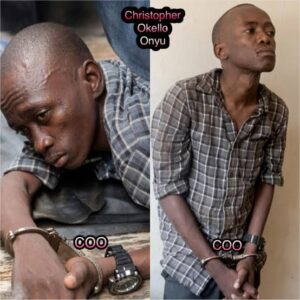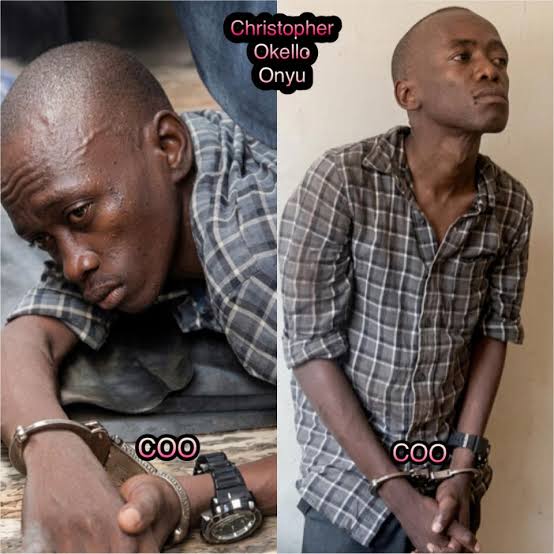
The case surrounding Christopher Okello, a Ugandan-American citizen accused of murder, has become increasingly complicated for government prosecutors. According to recent reports, the prosecution is facing significant hurdles in finding key evidence that could directly link Okello to the crime. Without critical pieces of evidence, the legal battle appears to be moving toward uncertainty.
To begin with, the absence of visual documentation is one of the most glaring issues in this case. No videos were recorded of the alleged murder in action. In today’s age of smartphones and security cameras, video footage is often the most compelling form of evidence, and the lack of such footage raises serious questions.
A video could have helped establish a clear narrative of the events that transpired, yet none was found. This absence of concrete visual evidence leaves the prosecution in a difficult position.
Similarly, there are no photos to support the allegations. A photograph could have captured important details—whether it be the crime scene, the suspect at the location, or even any potential injuries sustained during the altercation.
Without photographs, the case against Okello is reliant on verbal testimony and circumstantial evidence, both of which can be easily disputed in a court of law.
Another significant issue arises from the absence of a watchman at the school where the incident reportedly occurred. If a watchman had been present, they could have provided crucial information about the movements of Okello or other individuals on the school grounds at the time of the murder.

The fact that no such witness was available adds another layer of doubt to the prosecution’s case. A watchman could have potentially seen something critical, but unfortunately, there is no one to fill that role.
Moreover, when Okello was arrested, no blood spots were found on his shirt or hands. Blood evidence is one of the most direct and incriminating forms of proof in a murder case. Had Okello been involved in a violent altercation that led to the death of the victim, it would have been highly likely that traces of blood would have been found on his clothing or hands at the time of his arrest.
The absence of blood stains on his person raises questions about his involvement in the crime. This missing evidence could be a major point of contention during the trial.
Additionally, there was no visitors’ book signed by Okello when he arrived at the school. A visitors’ log is a standard security measure at many institutions, especially schools. It helps track who enters and exits the premises.
If Okello had signed in, it would have served as a critical piece of evidence establishing his presence at the scene. The fact that no such record exists raises doubts about the accuracy of the timeline and Okello’s movements.
While the prosecution is struggling to find the key evidence needed to solidify their case, there are some pieces of minor evidence that have been presented.
These include verbal accusations made against Okello, a knife found at the scene of the crime, and his arrest at the school compound. While these pieces of evidence may appear to be significant, they are still not enough to firmly establish Okello’s guilt beyond a reasonable doubt.
Verbal accusations, while they may be emotionally charged, are often seen as unreliable in a court of law. Anyone can make an accusation, and without corroborating evidence, these accusations may not hold much weight in the eyes of a judge or jury.
Although the victim’s family or witnesses may have pointed fingers at Okello, accusations alone are rarely sufficient to secure a conviction.
The knife found at the scene could certainly be important. It is a weapon that could have been used in the alleged crime, but there is still the issue of proving that Okello was the one who wielded it. Without physical evidence linking Okello to the knife, such as fingerprints or DNA, its presence at the scene does not conclusively prove that he was the one who committed the murder.
Additionally, Okello’s arrest at the school compound is noteworthy, but it is not necessarily definitive evidence of his involvement in the crime. Being arrested at a crime scene does not automatically imply guilt. Many people are arrested at crime scenes without being directly involved in the crime itself. The mere fact of his arrest does not prove that Okello was responsible for the death.
One piece of evidence that could play a more significant role in this case is the mobile money transaction made by Okello to pay the school’s admission fees. The payment of 195,000 UGX may seem like a routine transaction, but it places Okello at the school on the day of the crime. It is essential to determine whether he had any interaction with the victim or whether his presence at the school was connected to the alleged murder. However, the payment alone does not prove he was involved in the crime.

Perhaps the most important piece of evidence in the case is the postmortem report, which indicates that the victim died from internal bleeding caused by stabbing. This medical report provides a cause of death, but again, it does not specifically link Okello to the act of stabbing. A postmortem report can help confirm that a crime occurred, but it does not always clarify who was responsible.
With all of this in mind, the question remains whether Okello will be released by the high court due to the lack of solid evidence. The charge against him is a capital offense, which means that it is a crime punishable by death or life imprisonment. For such serious charges, the court requires a high standard of proof, and circumstantial evidence may not be enough to secure a conviction.
If the complainants cannot come up with the key pieces of evidence—such as video footage, photos, or eyewitness testimony—it is possible that Okello could be released on bail after six months. Bail is often granted in cases where the evidence is weak or inconclusive, especially if the defendant is not considered a flight risk. However, this would not mean that Okello is cleared of the charges. It would simply be a result of the prosecution’s inability to meet the burden of proof.
Given the lack of solid evidence, it is clear that the case against Okello is far from certain. The absence of crucial pieces of evidence leaves the prosecution with little room to prove its case beyond a reasonable doubt.
In such a high-profile case, the pressure on both the prosecution and the defense is immense. Without the right evidence, it may be difficult to secure a conviction, and the court could decide to release Okello on bail.
As the legal process continues, it will be interesting to see how the case develops. Can the prosecution come up with the missing evidence, or will they struggle to prove their case? For now, the future of Christopher Okello remains uncertain, and the court will have to carefully consider all the available evidence before making a final decision.