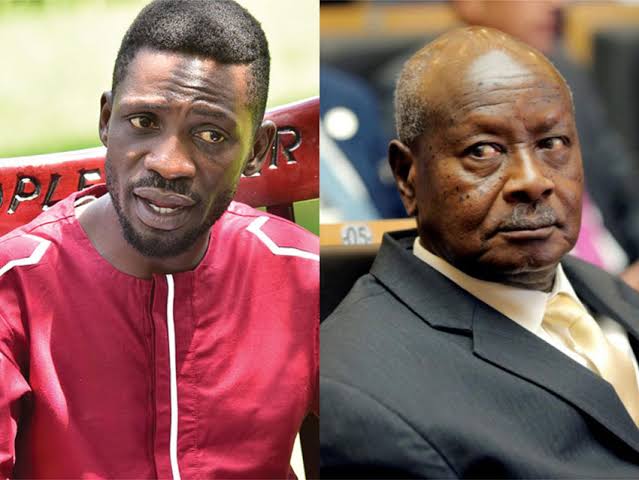
In a recent statement, President Yoweri Museveni of Uganda made an interesting comment about the age and political standing of opposition leader Bobi Wine. During a public address, Museveni remarked, “I see Bobi Wine; he is in his late 30s or 40s, but he says he is a young man also. Are you still young at 40?” This remark raised eyebrows as it seemed to question Bobi Wine’s self-perception and his portrayal as a youthful political figure in Uganda.
Museveni, who has been in power for over three decades, appears to be poking fun at Bobi Wine’s positioning as a representative of the younger generation in Ugandan politics.
Bobi Wine, born Robert Kyagulanyi Ssentamu, has become a prominent figure in Uganda’s political landscape, especially among the country’s youth. With his rise from a successful music career to an influential opposition leader, Bobi Wine has aligned himself with young people, championing their voices and concerns.
His frequent criticism of President Museveni’s long-standing rule has earned him considerable support from those seeking political change in Uganda.
At the heart of Museveni’s comment lies the idea of what constitutes youth in politics. To Museveni, someone in their late 30s or early 40s might not be categorized as “young.” This remark highlights the generational gap between the two leaders, with Museveni representing a more seasoned, experienced leadership, and Bobi Wine appealing to those who are looking for fresh ideas and change. Museveni’s question seems to challenge Bobi Wine’s narrative of being a young, dynamic force in Ugandan politics.
For Bobi Wine, his identity as a youthful and progressive leader has been central to his political messaging. He has presented himself as a voice for the younger generation, someone who understands their struggles with unemployment, lack of political freedoms, and corruption.
His campaigns often focus on the desire for a new Uganda, one where the younger generation is empowered and given more opportunities to shape the country’s future.
Museveni’s comment also underscores the broader political tension between the two figures. Bobi Wine’s political ascent has been seen by many as a direct challenge to Museveni’s rule, which has lasted for more than 30 years. As Museveni continues to hold power, his remarks about Bobi Wine’s age and youthfulness could be seen as an attempt to undermine the opposition leader’s image.

By questioning Bobi Wine’s self-designation as “young,” Museveni is subtly suggesting that experience and longevity in politics hold more value than youthful energy and ideas.
Additionally, Museveni’s remarks could be interpreted as a reflection of his view on Uganda’s political leadership. The president has often emphasized his long-term experience in government and his role in stabilizing Uganda after years of conflict.
For Museveni, leadership may be less about age and more about experience and the ability to manage the complexities of governance. His comments may reflect a belief that political experience, not just youthful enthusiasm, is the key to running a country successfully.
The generational divide between Museveni and Bobi Wine is not just about age but also about political philosophy. Museveni has repeatedly stated that Uganda’s progress and stability have been built over time, under his leadership.
In contrast, Bobi Wine advocates for a political shift that would break away from the long-standing regime.
He calls for a government that is more transparent, less corrupt, and more accountable to the people, especially the youth.
Bobi Wine’s political platform has been largely centered around empowering the youth of Uganda, addressing their needs, and giving them a voice in the country’s future. His appeal to younger generations is rooted in his own life story, where he transitioned from being a popular musician to becoming an influential political figure. Many of his supporters, particularly the youth, see Bobi Wine as someone who represents their dreams of a more democratic and progressive Uganda.
Despite the challenges he has faced, including allegations of vote-rigging and intimidation during the presidential elections, Bobi Wine continues to gain traction among those disillusioned with the current regime. His supporters view him as a symbol of hope for a better Uganda, one where political freedom is respected and citizens are allowed to express their opinions without fear of retribution. To them, Bobi Wine’s age is irrelevant—what matters is his message and his ability to mobilize a new generation of Ugandans.
In contrast, Museveni’s remarks could be viewed as an attempt to remind the public of the stability and continuity that his leadership has provided. By questioning the relevance of being “young” in politics, Museveni might be signaling that his experience and track record outweigh the need for youthful enthusiasm.

This highlights the tension between the old guard of Ugandan politics, represented by Museveni, and the new wave of change that Bobi Wine embodies.
The question of what it means to be “young” in politics also brings up important conversations about political ageism and how societies view leadership. In many countries, youth is often equated with energy, progress, and innovation, while older leaders are seen as being out of touch with the needs and desires of younger generations. Museveni’s questioning of Bobi Wine’s youthfulness suggests that he may view the energy associated with youth as insufficient for the serious work of governance.
However, Bobi Wine’s supporters argue that being young in politics is not just about age but about bringing new perspectives, fresh ideas, and a desire for change. In many parts of the world, young leaders are challenging the status quo and pushing for reforms in governance, social policy, and economics. Bobi Wine’s message resonates with those who believe Uganda needs a break from its long history of political stagnation and authoritarianism.
Museveni’s comments also draw attention to the broader political culture in Uganda. Despite the challenges faced by the opposition, including censorship, harassment, and the use of the military to suppress dissent, Bobi Wine’s continued popularity among Ugandans suggests that there is a growing demand for political change. Whether or not Bobi Wine is considered “young” by Museveni’s standards, the fact that he has garnered such significant support highlights the thirst for a more representative and participatory political system in Uganda.
In conclusion, President Museveni’s question about Bobi Wine’s age serves as a subtle jab at the opposition leader’s narrative of being a young, dynamic force for change. However, it also highlights the deep generational divide in Ugandan politics, where the old guard led by Museveni clashes with a new generation seeking reform. Whether age or experience matters more in politics is a question that will continue to shape the political discourse in Uganda as the country grapples with its future leadership.
Bobi Wine’s rise to prominence proves that political change is often driven not just by age, but by the desire for a new direction and vision for the nation.