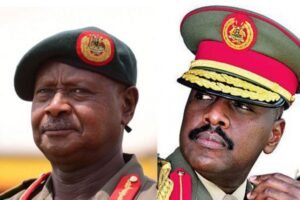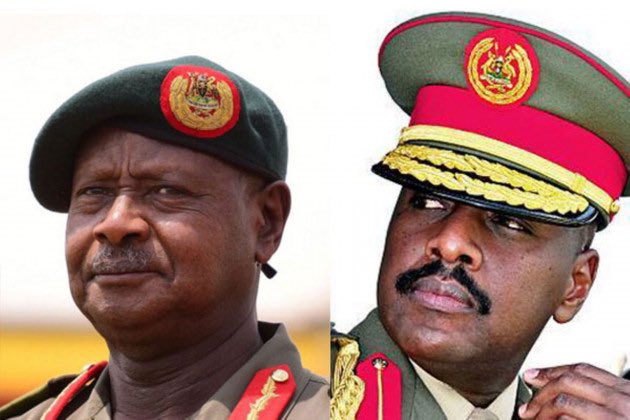
During a recent Cabinet session, President Yoweri Museveni addressed ongoing tensions within his government, notably between key figures such as Gen. Kahinda Otafiire, Chris Baryomunsi, and his son, Gen. Muhoozi Kainerugaba. The President, who follows events closely, revealed that he had become aware of the heated online quarrels and disputes within his team, particularly between these Ministers and individuals associated with Gen. Muhoozi’s circle.
Rather than diving into who was right or wrong in the situation, Museveni called for a more mature and reconciliatory approach moving forward.
Museveni emphasized that while Gen. Muhoozi may not be perfect, he has made significant contributions to Uganda’s security and pacification, including playing an important role in anti-Kony operations.
He urged his ministers to understand and appreciate these positive aspects of Muhoozi’s character, urging that they not let social media conflicts overshadow his commendable efforts in the nation’s defense.
“I’m not comfortable passing judgment on who is right or wrong in this situation, but we must recognize Gen. Muhoozi’s contributions to Uganda’s peace,” Museveni remarked during the session. His comments appeared to calm tensions in the room as most of his ministers listened attentively.
Following his comments, Museveni called for de-escalation, requesting that Gen. Otafiire and Baryomunsi take steps to resolve their differences with Gen. Muhoozi. He also promised to organize a harmonization meeting in the near future, where he would mediate between the three men to foster understanding and unity.
“We shall sit on the table, talk through our differences as men, and I am sure we will resolve them,” Museveni assured the Cabinet members.
The President’s remarks were significant not just because of the tensions at hand but also due to the authority he carries in the political landscape of Uganda. Gen. Museveni has long been seen as a guiding figure in the country’s political and military affairs, and his stance on the matter likely carries great weight within his party and the wider government.
The room reportedly remained silent, a reflection of the respect and authority Museveni commands when speaking on issues related to his family, particularly his son.
Before wrapping up his remarks, Museveni urged both Gen. Otafiire and Baryomunsi to approach the reconciliation process with an open mind. He further stated that Gen. Muhoozi was not the monstrous figure that some may perceive based solely on his provocative social media posts.
He added that recent tweets from Gen. Muhoozi towards Gen. Otafiire had become more positive, indicating a possible shift in the tone of the conflict.
The ongoing tension between the key figures in Uganda’s leadership has raised eyebrows both within the political elite and among the public. While Muhoozi’s social media presence has often made headlines, his involvement in national security matters has positioned him as a key player in Uganda’s military establishment.
Gen. Muhoozi’s influence in the country has been further highlighted by his public remarks on military matters and his interactions with his father, President Museveni.
Despite the public disagreements, the President’s call for unity was seen as a step toward restoring harmony within the government. By positioning himself as a mediator, Museveni signaled that he would take responsibility for addressing internal disputes and that such issues should be handled in a private, constructive manner rather than being aired publicly.
This dispute is also seen as part of a broader challenge that the Museveni family faces in balancing personal relationships with political power. Gen. Muhoozi, as a key military figure and the President’s son, has often been the subject of both praise and criticism.

His comments on social media have sparked political debates and occasionally caused friction between him and other senior government officials. The President’s intervention may be aimed at preventing further divisions within the ruling party and at ensuring that the country’s leadership remains cohesive as Uganda continues to face internal and external challenges.
Additionally, Museveni’s assurance that he will mediate a meeting between the involved parties shows his willingness to engage in personal intervention to resolve tensions within his Cabinet. This approach reflects his leadership style, where he often seeks to find internal solutions to political disputes, fostering a sense of unity even among conflicting factions.
In a broader context, the President’s remarks come at a time when Uganda is navigating both political and security challenges. The political climate in Uganda has been dynamic, with key figures jockeying for influence and sometimes engaging in public disagreements.
However, Museveni’s efforts to quell tensions within his government reflect his long-standing focus on maintaining unity and stability within the ruling National Resistance Movement (NRM) party.
As the political drama unfolds, observers will likely continue to watch how the situation between Gen. Muhoozi, Otafiire, and Baryomunsi develops. If the proposed meeting goes ahead as planned, it could serve as a significant moment in Uganda’s political history, particularly in terms of how internal government disputes are handled and resolved.
For now, the ball remains in the court of Gen. Otafiire and Gen. Baryomunsi, who are expected to respond positively to the President’s call for reconciliation. How they choose to engage in this process will undoubtedly have implications for the future of Uganda’s political landscape.
As the Cabinet continues to deliberate on this matter, it remains to be seen whether the promise of a peaceful resolution will materialize or if the tensions will continue to simmer. What is clear, however, is that Gen. Museveni is determined to manage the situation with a focus on unity, understanding, and the long-term stability of Uganda’s government.