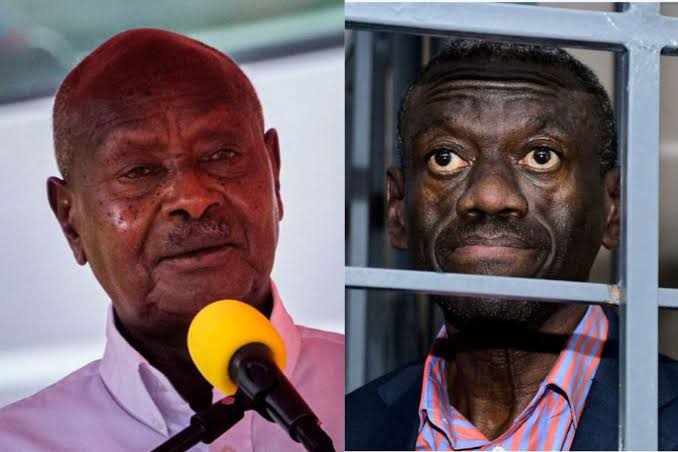
Ugandan President Yoweri Museveni has shared another interesting story from the time of the liberation struggle, revealing how opposition leader Kizza Besigye once helped train fighters on how to safely use chloroform during the early days of the bush war.
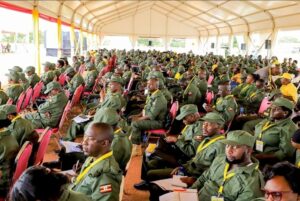
The President made the remarks while speaking at the annual thanksgiving event marking the liberation struggle celebrations known as Tarehe Sita.
The event took place at the UPDF Headquarters Mbuya where military leaders and guests gathered to reflect on the history of the war.
Museveni explained that during preparations for the famous attack on Kabamba Barracks in 1981, the fighters needed reliable intelligence about the weapons stored inside the military facility.
At the time, the rebels of the National Resistance Army were still few in number and lacked enough weapons to launch a full-scale attack without proper information.
Because of this, Museveni said the fighters planned to quietly capture a soldier from the barracks and question him in order to confirm whether the guns they wanted were still there.
The operation was carefully planned as an ambush on a small footpath used by soldiers moving between the barracks and nearby areas rather than on the main road where attention could easily be drawn.

Museveni explained that when they finally captured one individual during the ambush, they needed a way to safely make him unconscious without causing harm.
That is when they called upon Besigye, who at the time was a trained medical doctor and also served as Museveni’s personal physician during the war.
According to Museveni, Besigye had medical knowledge that was very useful to the fighters, especially when treating wounded combatants or handling delicate situations during operations.
Museveni said Besigye trained them on how to properly administer chloroform so that the captured person would not die but instead fall asleep temporarily.
The President explained that the intention was not to harm the captured soldier but to make him sleep long enough so that the fighters could extract information safely.
“We even called Besigye to teach us how to administer chloroform safely so that the man doesn’t die,” Museveni told the audience during the event.
He added that the idea was to make the captured person lose consciousness briefly, after which he would wake up later without serious harm.
However, something unexpected happened during that particular mission. The officer who was captured turned out to be someone known to the rebel fighter who had ambushed him.
Museveni explained that the fighter involved in the ambush was Lt Gen Mugume, who at that moment realized that the officer he had captured was someone he had previously worked with.
Both men had served together in the Uganda National Liberation Army before the liberation struggle intensified.
When the captured officer realized he had been ambushed, he reportedly begged for his life and asked not to be killed.
At that moment, Mugume recognized him and shouted in surprise after realizing that the person was someone he already knew.

The incident became one of the many unusual and dramatic stories from the bush war period that shaped Uganda’s political history.
Museveni noted that during the liberation struggle, many unexpected situations occurred that required quick thinking and cooperation among fighters.
Interestingly, the story also highlights the past relationship between Museveni and Besigye, who worked closely together during the bush war years.
At the time, Besigye played an important role in the rebel movement as a doctor who treated wounded soldiers and advised on medical matters.
Years later, however, Besigye would become one of Museveni’s strongest political opponents in Uganda’s opposition politics.
Despite their political differences today, the story serves as a reminder that the two leaders once worked side by side during the struggle that eventually brought the current government to power.
Museveni said such memories continue to remind him of the sacrifices and unique experiences that shaped the journey of the liberation fighters during the difficult years of the bush war.