Uganda is actively courting investors from the Gulf region with an ambitious $70 billion portfolio of energy and infrastructure projects, aiming to become East Africa’s premier energy hub. The projects include nuclear power development, nationwide electricity network upgrades, and a centralized LPG storage terminal.
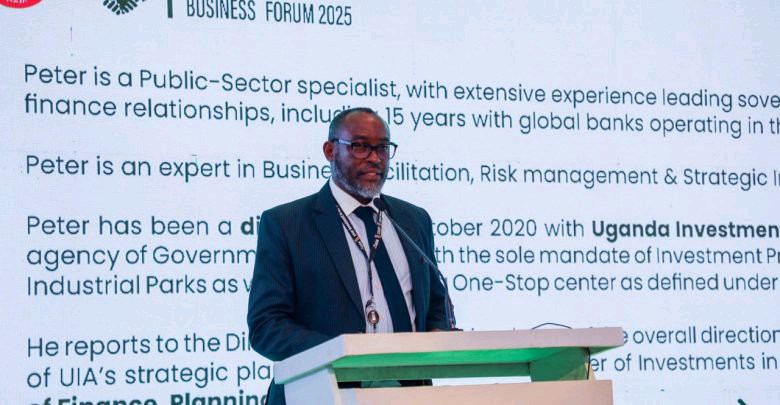
Speaking at the Uganda–UAE Business Forum at Speke Resort Munyonyo, Peter Muramira, Senior Investment Executive at the Uganda Investment Authority (UIA), emphasized that the government is seeking strategic partnerships that blend capital, technology, and operational expertise.
“Uganda is transitioning from an energy-deficit economy to one that is energy-secure,” Muramira said. “We are offering bankable opportunities across electricity, oil and gas, and industrial infrastructure sectors.”
Uganda’s electricity investment pipeline totals over $36 billion, including upgrades to the distribution network, hydroelectric projects, and renewable energy developments. Feasibility studies are underway for the $30 billion Buyende Nuclear Power Plant, alongside ongoing hydro projects such as Ayago (840MW) and Oriang (392MW), with a combined value of $5.1 billion.
Renewable energy initiatives include 550MW of solar projects ($62.4 million) and 70MW of wind power ($18 million), supporting Uganda’s goal of universal electricity access by 2030. “Our energy roadmap emphasizes clean, affordable, and diversified power generation,” Muramira noted. “Investors can participate through public-private partnerships and independent power projects.”
Uganda’s oil and gas agenda features a $275 million LPG terminal, a $5 billion petrochemical industrial park in Hoima, and an $18 million oil jetty and pipeline expansion in Jinja. Muramira confirmed that feasibility studies for the LPG facility are complete, with construction plans for downstream storage and refining infrastructure underway.
“Uganda’s oil strategy focuses on value addition,” he said. “We are building local refining, petrochemical, and clean energy storage capacity, not just exporting crude.” These initiatives complement the East African Crude Oil Pipeline (EACOP) and Uganda’s broader vision of becoming a regional energy and logistics hub.
Uganda has finalized master plans for industrial parks in Namanve, Mbale, Soroti, and Kabalega, designed to support energy-intensive industries and export-oriented manufacturing. The government is also promoting public-private partnership-based road and logistics projects to improve regional connectivity.
“Infrastructure development is central to our investment strategy,” Muramira said. “Every industrial park is being planned with access to reliable power, water, and transport corridors.”
The forum attracted senior policymakers, investors, and business leaders from Uganda and the UAE. Muramira highlighted that 22 UAE companies have already invested $170.6 million in Uganda, creating more than 1,200 jobs, and stressed that the new projects offer even greater opportunities.
“Uganda’s combination of energy diversification, fiscal incentives, and access to regional markets makes it an attractive destination for Gulf investors,” he said.