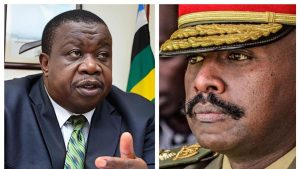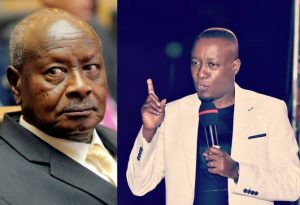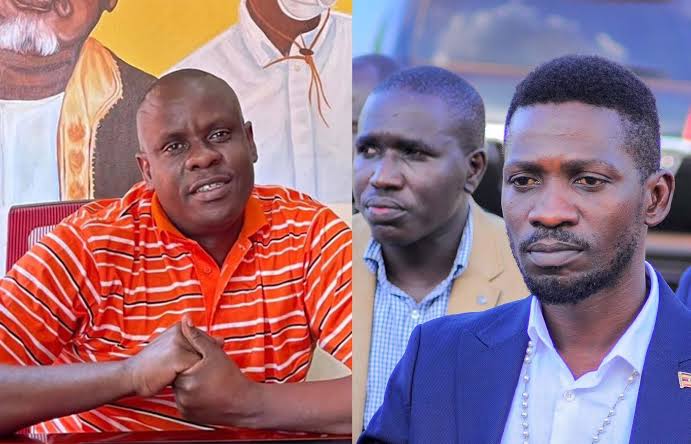
The political clash between Uganda’s ruling government and the opposition continues to intensify, with recent remarks from Minister Balaam Barugahara adding fuel to the fire. Balaam, who is the Youth and Children Affairs Minister and a close ally of President Yoweri Museveni’s son, Gen. Muhoozi Kainerugaba, made bold claims about opposition leader Robert Kyagulanyi Ssentamu, also known as Bobi Wine.
According to Balaam, Bobi Wine left Uganda on the day of the 2026 election, before the official results were even declared by the Electoral Commission.
In an interview with Uganda’s state broadcaster UBC, Balaam Barugahara asserted that Bobi Wine did not wait for the announcement of the election results, and instead fled the country.
“On the day of election, Bobi Wine did not even wait for the declaration of election results. He ran out of Uganda,” Balaam claimed, portraying Bobi Wine’s departure as an act of cowardice rather than a calculated political move.
The minister’s statement implies that Bobi Wine’s decision to leave the country before the results were declared showed a lack of faith in the political process and an abandonment of the people who supported him.
These remarks are the latest in a long-running narrative that has sought to discredit Bobi Wine’s leadership. The opposition leader has long been a thorn in the side of the ruling government, calling for greater political freedoms, democratic reforms, and an end to corruption.
However, with every move Bobi Wine makes, there are those who seek to undermine his credibility. Balaam’s allegations are part of this broader effort to portray Bobi Wine as a leader who is not committed to the Ugandan people.

Balaam also raised questions about the authenticity of videos that Bobi Wine had shared online, particularly those showing him eating jackfruit, known locally as “fene.” According to the minister, the videos that Bobi Wine has been circulating are old and were filmed long before the election.
“He has been lying to you, eating fene. Those are old videos he made… he is a movie star, he is a film star,” Balaam said. This claim suggests that Bobi Wine’s online presence, which has been a key tool in his fight against the government, is staged and manipulated for political gain.
The minister’s comments have sparked a heated debate online, with many Ugandans questioning whether Bobi Wine’s actions during the election were indeed questionable.
However, Bobi Wine’s supporters argue that his decision to leave the country was a necessary move to protect himself from further harassment and violence at the hands of government forces. Bobi Wine has long claimed that the Museveni government used intimidation, violence, and fraudulent elections to maintain its grip on power.
His departure, therefore, is seen by many as a tactical retreat, allowing him to regroup and continue the fight from abroad.
Balaam’s remarks, however, paint a different picture. For him, Bobi Wine’s exit from Uganda is an act of cowardice, one that demonstrates the opposition leader’s lack of commitment to the cause he claims to champion.
By fleeing the country so soon after the election, Balaam suggests, Bobi Wine abandoned his supporters who were left to face the brunt of the government’s crackdown on dissent.
Further adding to the controversy, Balaam made allegations about Bobi Wine’s lifestyle abroad, claiming that the opposition leader has homes in London and Boston. “For him, he’s in London, he got a home, he has been living with Pastor Kyazze in London,” the minister alleged. Balaam then went on to claim that Bobi Wine had moved from London to Boston in the United States, continuing his life abroad while making money.
These allegations aim to paint Bobi Wine as someone who has left his homeland behind to live a luxurious life, rather than continuing to fight for the rights of the Ugandan people.
The accusations of Bobi Wine’s wealth and lifestyle abroad are designed to further discredit the opposition leader in the eyes of the Ugandan public. For many, the idea of a leader living in luxury while his people suffer is deeply problematic.
Balaam’s insinuation that Bobi Wine is using his political position to accumulate wealth only adds to the narrative that the opposition leader is not genuinely invested in the struggle for Uganda’s political freedom.
However, Bobi Wine’s supporters argue that these claims are nothing more than a smear campaign designed to undermine his credibility. Bobi Wine, who has long styled himself as a champion of the poor and oppressed, has consistently emphasized his roots in Uganda’s slums and his commitment to fighting for the rights of ordinary Ugandans.
His supporters reject the idea that Bobi Wine is motivated by personal gain, instead viewing him as a leader who is willing to sacrifice for the greater good.
Bobi Wine’s time abroad, particularly in the United States, has been a subject of considerable controversy. In recent weeks, Bobi Wine has been involved in international engagements, meeting with U.S. lawmakers and human rights organizations to highlight the political repression in Uganda.
His critics, like Balaam, argue that these international trips are an attempt to win favor from foreign powers rather than focusing on the domestic issues at hand. For the ruling government, Bobi Wine’s international outreach is seen as an indication that he is not truly interested in solving Uganda’s problems but rather in using the global stage to further his own ambitions.
Balaam’s comments also highlight the deepening political rivalry between the government and the opposition. For years, Uganda has been a country divided along political lines, with the ruling party and its allies claiming that the opposition is unpatriotic and untrustworthy.

The government has consistently portrayed Bobi Wine and other opposition leaders as pawns in a larger foreign plot to destabilize Uganda, a narrative that resonates with a significant portion of the population.
The idea that Bobi Wine is motivated by personal interests, rather than the welfare of Ugandans, plays into this narrative. By suggesting that Bobi Wine has homes abroad and is making money from his political career, Balaam is reinforcing the image of an opposition leader who is more interested in his own financial success than in fighting for the rights of his people.
However, Bobi Wine’s supporters vehemently deny these allegations, pointing to the significant personal sacrifices he has made throughout his political career. They argue that Bobi Wine has spent years using his celebrity status to highlight the struggles of ordinary Ugandans, and his decision to travel abroad is merely a strategic move to gain international support and pressure the government. For them, Bobi Wine’s actions abroad are a necessary part of the struggle for political change in Uganda.
The ongoing war of words between Minister Balaam and Bobi Wine reflects the deep polarization in Ugandan politics. As the opposition continues to challenge the long-standing rule of President Museveni, the government has shown little tolerance for criticism.
The accusations of corruption, fraud, and political violence that have plagued the Museveni administration have led to a growing divide between the ruling party and the opposition. For many, the battle for Uganda’s future is not just a political struggle but a fight for the country’s very identity.
As Balaam continues to make these accusations against Bobi Wine, the question remains whether they will have any impact on the opposition leader’s standing with the Ugandan public. Despite the government’s efforts to discredit him, Bobi Wine remains a popular figure among many Ugandans who view him as a symbol of hope in a country dominated by a long-ruling political elite. For some, his decision to leave Uganda after the election was a necessary act of self-preservation, while for others, it was a sign of betrayal.
Ultimately, the political future of Uganda will depend on the choices made by both the government and the opposition. The battle for the country’s future is ongoing, and the war of words between Balaam and Bobi Wine is just one small part of a much larger struggle for Uganda’s democracy and sovereignty. How this battle will play out is uncertain, but it is clear that the tension between the ruling party and the opposition is far from over.