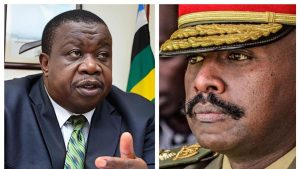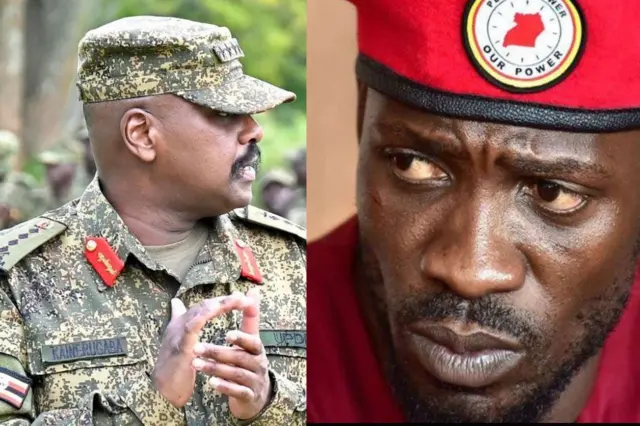
The political rift between Gen. Muhoozi Kainerugaba and opposition leader Robert Kyagulanyi Ssentamu, widely known as Bobi Wine, continues to deepen, with Muhoozi recently attacking the opposition leader over a photo taken during his visit to Capitol Hill in Washington, D.C.
The image, which shows Bobi Wine engaging with U.S. lawmakers, sparked a fiery reaction from Muhoozi, who mocked Bobi Wine’s actions and accused him of being a puppet to foreign powers.
Muhoozi’s reaction to the photo was sharp and unforgiving. In a post shared on social media, he referred to Bobi Wine as “Uncle Tom Kabobi,” a derogatory term implying subservience to foreign interests rather than prioritizing Uganda’s sovereignty.
The phrase “Uncle Tom,” historically used to belittle African-Americans who are seen as subservient to white authority, was meant to paint Bobi Wine as someone who was betraying the Ugandan people by seeking international backing.
“Uganda won its independence in 1962! We are a sovereign nation,” Muhoozi declared in his post, making it clear that he felt Bobi Wine’s actions were a violation of Uganda’s independence.
For Muhoozi and many in the ruling government, the notion of Uganda turning to foreign powers for help is unacceptable. The post was not just about Bobi Wine’s trip to the U.S.; it was a statement about national pride and self-determination, which the ruling party views as essential to preserving the country’s political integrity.
The photo of Bobi Wine, which was taken during his recent visit to Capitol Hill, shows the opposition leader interacting with U.S. lawmakers and discussing the political situation in Uganda. Bobi Wine has framed this as part of his efforts to raise international awareness about the human rights violations and political repression in Uganda under President Yoweri Museveni’s long rule.

However, the image has sparked a political storm, with many seeing it as a symbol of Uganda’s internal struggles being played out on the global stage.
Muhoozi’s reaction, calling Bobi Wine an “Uncle Tom,” reflects the broader criticism that Bobi Wine’s critics have leveled against him since he emerged as a key opposition figure. Many of Bobi Wine’s detractors have accused him of being a puppet of Western interests, suggesting that his political ambitions are not truly rooted in Uganda’s welfare but in gaining support from foreign powers.
By referring to Bobi Wine in this manner, Muhoozi was making it clear that he believes the opposition leader is being manipulated by forces outside of Uganda, rather than representing the interests of the Ugandan people.
For Bobi Wine, the visit to Capitol Hill was an opportunity to engage with international lawmakers and human rights organizations in order to bring attention to the challenges faced by the opposition in Uganda. Bobi’s supporters see his trip as a necessary step in building global recognition for the country’s political struggles.
They argue that in the face of government oppression, international support is essential for the success of the opposition’s cause. However, Muhoozi’s remarks underscore the contrasting view that such international engagements are damaging to Uganda’s sovereignty and undermine the country’s ability to solve its problems without external interference.
The term “Uncle Tom,” which Muhoozi used to describe Bobi Wine, is a loaded one, especially in the context of African politics. Historically, the term has been used to belittle African leaders or activists who are seen as too willing to align with foreign powers at the expense of their own people.
It is a term that evokes images of subservience and betrayal. By calling Bobi Wine this name, Muhoozi was making a strong statement about the opposition leader’s supposed failure to put Uganda’s interests first.
The use of the term “Uncle Tom” is also an indication of the growing polarization within Uganda’s political landscape. While Bobi Wine’s supporters view him as a champion for democracy and human rights, critics like Muhoozi see him as a threat to the country’s sovereignty.
For the ruling government, the idea of a leader from Uganda seeking international support is seen as a sign of weakness, as it suggests that the domestic political system is not strong enough to address its own problems.
Muhoozi’s emphasis on Uganda’s sovereignty, and his criticism of Bobi Wine’s international outreach, highlights a key issue in African politics: the tension between national sovereignty and foreign intervention. For many African leaders, independence and self-reliance are viewed as essential values, and any hint of foreign influence is seen as a threat to national pride.
However, for opposition leaders like Bobi Wine, the search for international support is often seen as a necessary tool for pressuring authoritarian regimes that are resistant to internal reform.
Bobi Wine’s supporters, many of whom are youth-driven and active on social media, argue that his international engagements are vital for securing the future of Uganda. They contend that the government’s disregard for human rights, including the violent suppression of political opposition, requires a response from the international community. By meeting with U.S. lawmakers, Bobi Wine is trying to build a coalition of support to pressure the Ugandan government to make democratic reforms. His critics, however, view these efforts as a betrayal of Uganda’s sovereignty and a sign of Bobi Wine’s reliance on foreign powers.
Muhoozi’s strong reaction also reveals the concerns of the ruling party, which fears losing its grip on power. The Museveni administration has long been in control of Uganda’s political landscape, and the opposition, led by figures like Bobi Wine, has been pushing for democratic reforms and greater freedoms. For the ruling government, Bobi Wine represents a challenge to their authority, and his attempts to engage with foreign governments and organizations are seen as a threat to the established order.

The ruling party’s position on sovereignty is also rooted in a larger ideological debate within Africa. Many African leaders view the continent’s struggle for independence as unfinished business, and they are determined to resist any foreign influence that might undermine their hard-won sovereignty.
This stance often leads to tension between those who advocate for international support in the fight for democracy and those who believe that African nations should solve their own problems without external interference.
Bobi Wine’s visit to Capitol Hill is also part of a larger trend in African politics, where opposition leaders seek international support to challenge long-standing regimes.
Across the continent, many leaders have turned to foreign governments, international organizations, and the media to highlight human rights abuses and build coalitions for democratic change. Bobi Wine’s trip to Washington D.C. is an attempt to follow this path, hoping that by raising the profile of Uganda’s political struggle on the global stage, he can bring about change at home.
However, Muhoozi’s comments reflect the anxiety within the ruling party about the growing international attention to Uganda’s political situation. The government’s response to Bobi Wine’s visit to the U.S. is part of a broader strategy to discredit the opposition and maintain control over the narrative. By portraying Bobi Wine as a leader who seeks foreign intervention, Muhoozi and the ruling government are trying to frame the opposition as unpatriotic and untrustworthy.
The broader implications of Muhoozi’s remarks are significant for Uganda’s political future. If the government continues to frame Bobi Wine’s international engagements as a betrayal of Uganda’s sovereignty, it may galvanize public support for the ruling party’s stance against foreign influence. On the other hand, if Bobi Wine’s supporters continue to argue that international pressure is necessary to force the government to implement democratic reforms, it could lead to a more polarized political climate in the country.
The photo of Bobi Wine at Capitol Hill will likely continue to be a point of contention in the ongoing debate about Uganda’s political future. It symbolizes the battle between the opposition’s efforts to engage with the world and the government’s desire to keep Uganda’s problems within its own borders. In the end, the political struggle between Muhoozi and Bobi Wine will shape the country’s trajectory for years to come, as Uganda grapples with the tensions between sovereignty and international engagement.
Muhoozi’s harsh criticism of Bobi Wine is just the latest chapter in a long-running political drama in Uganda, one that shows no signs of resolution. The battle for Uganda’s future is a battle for its identity: should it remain staunchly independent, as Muhoozi advocates, or should it seek the help of the international community, as Bobi Wine believes is necessary for change? As the struggle continues, the fate of Uganda’s democracy hangs in the balance.