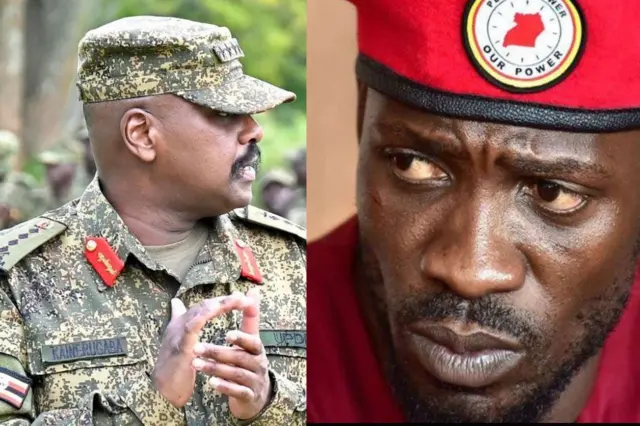
The political tension in Uganda has escalated once again, with a new round of public accusations between Gen. Muhoozi Kainerugaba, Uganda’s Chief of Defence Forces and Senior Presidential Advisor, and opposition leader Robert Kyagulanyi Ssentamu, popularly known as Bobi Wine.
Muhoozi, who is the son of President Yoweri Museveni, recently took to social media to accuse Bobi Wine of abandoning the Ugandan people just days after the elections.
According to Muhoozi, Bobi Wine fled Uganda to the United States on January 26, 2026—just 11 days after the elections that saw Museveni win another controversial term in office.
Muhoozi’s post on Twitter was not just a simple statement of fact; it was an outright criticism of Bobi Wine’s actions. “Bobi Wine has spent 2 months in the United States eating Big Macs while his followers are in jail. Some leader,” Muhoozi wrote.
The message was clear: Muhoozi was accusing the opposition leader of hypocrisy, suggesting that while the Ugandan people continued to suffer under an oppressive government, Bobi Wine had chosen personal comfort over fighting for the cause of freedom and democracy.
Muhoozi’s comments come at a time of heightened political tension in Uganda, where the opposition has been calling for greater political freedoms and human rights reforms. Bobi Wine, who has become the symbol of opposition to the long-standing rule of President Museveni, has faced numerous obstacles, including arrests, intimidation, and violence.
In this context, Muhoozi’s accusations of “eating Big Macs” while his supporters languish in prison strike a nerve. The criticism is likely to add fuel to the fire of the already heated debate over the political situation in Uganda.

While Muhoozi’s words are harsh, they also reflect the broader narrative of the ruling government’s stance against the opposition. The ruling party, led by Museveni and his family, has long painted Bobi Wine as an unreliable leader, unfit to lead Uganda due to his perceived association with foreign powers and his choice to criticize the government from the safety of the United States.
For the ruling elite, Bobi Wine’s actions are not those of a true patriot but of a leader who is more concerned with international fame than with the wellbeing of Ugandans.
For Bobi Wine, however, his decision to leave Uganda and seek international engagement has been framed as a strategic move to gain support for the Ugandan opposition.
Since leaving Uganda, Bobi Wine has emphasized the importance of seeking global attention for the situation in Uganda, where human rights abuses and political repression are rampant.
His trip to the United States was intended to bring international pressure on the Museveni government, particularly through meetings with lawmakers and human rights organizations. In his mind, international solidarity is key to securing Uganda’s future.
Yet, Muhoozi’s scathing remarks raise an important question about the effectiveness of this strategy. Is it wise for Bobi Wine to rely on foreign support to fight for democracy, or does this weaken his position and reduce his credibility at home? For many Ugandans, this question is a matter of national pride.
The ruling government has long stressed the importance of national sovereignty and independence, and Muhoozi’s comments are rooted in this idea. From the government’s perspective, any reliance on foreign powers for political support undermines Uganda’s ability to solve its own problems.
The debate about Bobi Wine’s U.S. trip has stirred mixed reactions both within Uganda and internationally.
Some believe that seeking international support is a necessary move in a country where the opposition faces severe repression, while others argue that foreign involvement will only complicate the political landscape and further divide Ugandans.
Muhoozi’s criticism of Bobi Wine’s actions seems to suggest that the government prefers to address the country’s challenges without outside interference, but this stance has drawn the ire of many who view it as an attempt to silence legitimate opposition voices.
Bobi Wine’s supporters have defended his decision to leave Uganda and pursue international engagement, arguing that he is trying to shine a light on the repression and human rights abuses that have marked Museveni’s rule.
According to them, the international community has a responsibility to intervene when African leaders trample on the rights of their people. They argue that it is not only Bobi Wine’s right but his duty to seek allies who can apply pressure on Museveni’s government.
However, the harsh rhetoric from Muhoozi and others in the ruling government paints Bobi Wine as a coward who abandoned his people at a time when they needed him the most. The government’s stance is clear: Bobi Wine should have stayed in Uganda to lead his supporters, not run off to the United States.
For them, the notion of a political leader leaving their country during a crisis is unacceptable. In their eyes, Bobi Wine’s actions are a betrayal of the very people he claims to represent.
Meanwhile, Bobi Wine’s visit to Washington D.C. has attracted considerable attention. In a series of meetings with U.S. lawmakers and human rights organizations, Bobi Wine discussed the political situation in Uganda and called for international intervention to stop the ongoing abuses.
During his time in the U.S., Bobi Wine made it clear that he was not looking for a simple exchange of pleasantries but rather seeking concrete action to support his cause. His meetings were part of a broader strategy to raise global awareness about Uganda’s political struggles.

The decision to travel to the U.S. has also brought attention to the issue of Western involvement in African politics. Critics of Bobi Wine’s approach, like Kenyan political activist Miguna Miguna, have warned against seeking support from Western powers, describing Washington D.C. as “the headquarters of imperialism, genocide, war crimes, and human rights violations.”
According to Miguna, no true Pan-African or freedom fighter should align themselves with the U.S. government, which he sees as a symbol of global injustice. His criticism has added another layer to the ongoing debate about whether African leaders should look for external support or solve their problems internally.
This debate has broader implications for the future of African politics. On the one hand, many Africans see Western powers as a necessary counterbalance to authoritarian regimes that refuse to relinquish power. On the other hand, there is a growing sentiment that Africa should chart its own course and not rely on foreign intervention. This ideological divide has shaped the political landscape in many African countries, and Uganda is no exception.
Muhoozi’s comments about Bobi Wine’s departure reflect the ruling government’s position on this issue. By attacking Bobi Wine for seeking international help, the government is reinforcing its message that Uganda should stand on its own, without the influence of foreign powers. However, this stance has led to accusations of authoritarianism and repression, particularly as opposition leaders like Bobi Wine continue to face harassment and arrest.
The political rivalry between Muhoozi and Bobi Wine is not just about two men; it is about the future of Uganda and its political system. For the opposition, Bobi Wine represents a beacon of hope for a democratic future, while for the ruling government, Bobi Wine is a threat to the established order. Muhoozi’s comments are just the latest chapter in this ongoing struggle for power and influence in Uganda.
As the political situation in Uganda continues to unfold, one thing is clear: the country’s future is uncertain. Will Bobi Wine’s efforts to gain international support lead to a change in Uganda’s political climate, or will the government succeed in maintaining control? The outcome of this political battle will have a significant impact on the trajectory of Uganda’s democracy and its relationship with the rest of the world.
Muhoozi’s harsh words about Bobi Wine reflect the deepening divide within Ugandan politics. Whether or not Bobi Wine’s strategy of international engagement will succeed remains to be seen. What is certain, however, is that the political fight for Uganda’s future is far from over, and both leaders are committed to their respective causes, each claiming to be fighting for the people of Uganda.