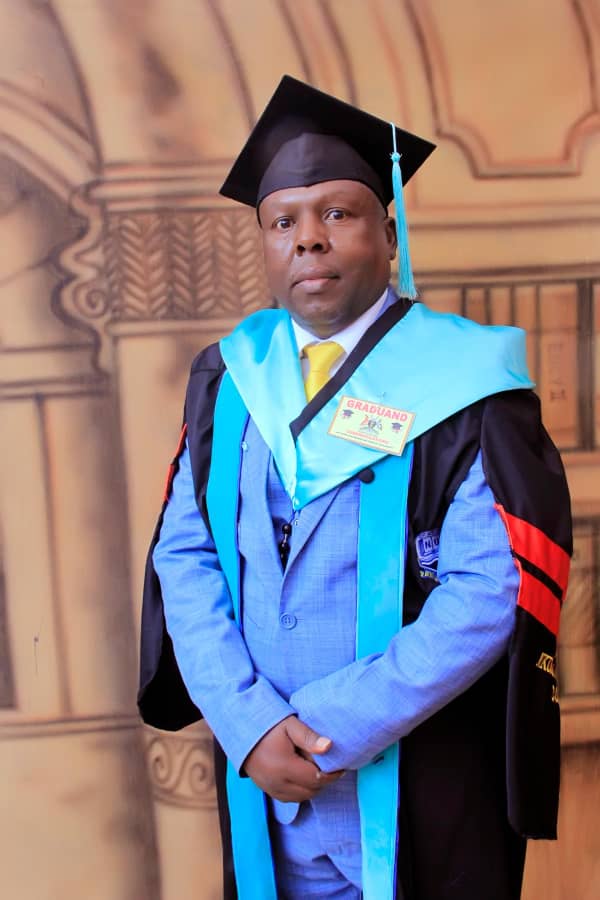
Francis Wangolo, the respected Principal of St. Mary’s College Mayenze, has proudly graduated with a Master of Arts in Public Administration & Management from Nkumba University. This remarkable achievement signifies not only a personal milestone but also a reaffirmation of his dedication to both education and public service.
Wangolo’s research thesis, titled “Assessing the Contributions of the Parish Development Model on Household Incomes: A Case Study of Manafwa Town Council, Manafwa District Local Government,” explored the impact of government programs like the Parish Development Model (PDM) in uplifting the livelihoods of ordinary Ugandans. His work highlighted how such initiatives have positively influenced local communities, enhancing household incomes and overall well-being.
In an emotional dedication, Wangolo paid tribute to his late grandfather, Paul Kalaija Bwendegyere, a fearless politician who opposed the UPC during difficult times in Kabale District. Wangolo recalled his grandfather’s steadfast support for his education, his commitment to democratic values, and his integrity as the qualities that inspired his own journey. “I dedicate this degree to my grandfather, who taught me that true leadership is rooted in integrity, courage, and service to the people,” he said.
Wangolo’s academic foundation goes back several years. Before earning his Master’s degree, he completed a Bachelor of Public Administration (BPA) at the Islamic University in Uganda (IUIU) and a Postgraduate Diploma in Urban Governance and Management (DUGM) from Uganda Management Institute (UMI). These qualifications, combined with his extensive professional experience, have equipped him with a deep understanding of governance, public administration, and management.
Aside from his academic accomplishments, Wangolo currently holds several important leadership roles. He serves as the Principal Township Officer for Butiru Town Council in Manafwa District, Principal of St. Mary’s College Mayenze, and Head of Laity at St. Augustine of Hippo Parish Situmi. He is also an active advocate for the welfare of local government workers through his role as the coordinator of the Uganda Local Government Workers Union (ULGWU) in Eastern Uganda.
Wangolo has also made his mark in political advocacy. He chaired the Forum for Third Term Advocacy, a campaign that supported President Yoweri Kaguta Museveni’s bid for a third term. Despite opposition from the Parliamentary Advocacy Forum (PAFO), the campaign succeeded in securing the president’s continued leadership. Wangolo’s efforts earned recognition, including mention by BBC’s Siraji Kalyango. He also contested the Bubulo West Parliamentary seat in the 2005/2006 elections, finishing third with 14,000 votes.
His advocacy for development programs has been particularly focused on the Parish Development Model, a government initiative that has successfully helped improve household incomes and service delivery at the community level. Wangolo’s involvement in these programs reflects his ongoing commitment to sustainable development and local governance reforms.
Raised in a family with roots in both Eastern and Western Uganda, Wangolo’s education took him across different regions of the country, providing him with a broad perspective on Uganda’s social, political, and economic landscape. This diverse upbringing has greatly influenced his approach to governance and public service.
Now armed with a Master’s degree, Wangolo has vowed to continue advocating for better pay and working conditions for local government employees and supporting sustainable programs like the Parish Development Model. “This graduation is not just a personal achievement. It’s a promise to continue serving my community, advocating for better governance, and contributing to the development of Uganda,” he stated.
Francis Wangolo’s journey from his roots in Eastern Uganda to his accomplishments in education, governance, and political advocacy is a story of resilience, leadership, and dedication to public service. His graduation not only marks a personal victory but also serves as an inspiration for others in Uganda’s education and political spheres.