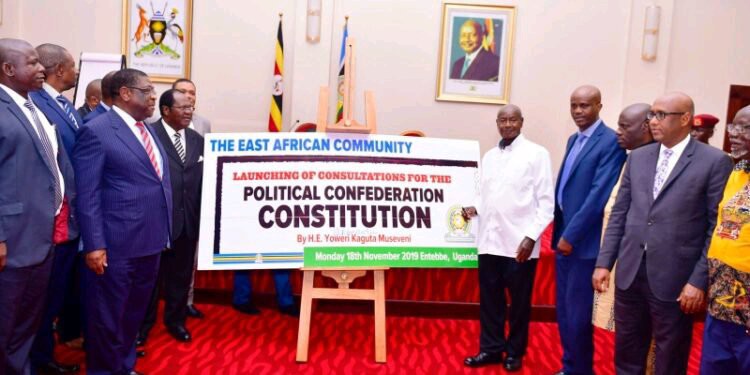
President Yoweri Kaguta Museveni has made East African integration the foundation of Uganda’s development strategy for the next decade, emphasizing regional unity, economic transformation, and collective security. His vision seeks to turn the East African Community (EAC) into a politically federated bloc with a single currency and constitution by 2031 — a move he believes will redefine Africa’s position in global economics and politics.
This agenda is a central feature of Museveni’s 2026–2031 reelection manifesto, outlining steps toward achieving “one constitution, one currency, and one destiny” for East Africa. He argues that Africa’s division into small states has limited growth opportunities and stunted prosperity. “Africa’s 1.4 billion people are broken into small units. Small populations mean small markets. Small markets mean low prosperity,” Museveni explained during a recent speech at the EAC Secretariat.
While Uganda’s population of 46 million gives it a relatively large domestic market, Museveni maintains that national markets alone cannot guarantee prosperity. Drawing from historical examples like the unifications of Germany and Italy and the economic rise of China and India, he insists that regional integration is vital for progress. Uganda’s agricultural surpluses in sugar, maize, milk, cassava, and bananas, he notes, demonstrate that production is not the issue — market access is. A unified and efficient African market, he says, is the solution.
Museveni points to the African Continental Free Trade Area (AfCFTA), launched in 2017, as a key vehicle for expanding trade beyond traditional Western markets. “If we mobilize the whole of Africa to remove trade barriers, we shall no longer worry about being shut out of markets in Europe or the USA,” he said. Infrastructure remains another priority, with projects like the Mpondwe-Beni highway linking Uganda and the Democratic Republic of Congo serving as concrete examples of regional connectivity.
The integration drive has received backing from fellow East African leaders. Kenya’s President William Ruto supports the creation of a single currency and political federation to enhance trade efficiency, while Tanzania’s President Samia Suluhu Hassan promotes Kiswahili as a tool for cultural unity. Rwanda’s President Paul Kagame emphasizes that a politically united East Africa would strengthen the region’s global bargaining power and improve security coordination.
Museveni argues that political federation is not only about economic gains but also about long-term stability and defense. A united East Africa — encompassing Uganda, Kenya, Tanzania, Rwanda, Burundi, South Sudan, and the DRC — would form a bloc of over 340 million people with a combined GDP (PPP) exceeding $1 trillion. Such unity, he says, would act as both a shield against external threats and a framework for coordinated development.
The NRM manifesto outlines five major actions to advance this agenda: drafting a common EAC constitution, establishing a single currency, removing non-tariff barriers, promoting Kiswahili across the region, and leveraging AfCFTA to boost continental trade. These priorities align with the EAC’s Sixth Development Strategy, which focuses on a Single Customs Territory, fiscal harmonization, and macroeconomic convergence.
Uganda’s exports to the EAC reached USD 2.84 billion in FY 2024/25, underscoring growing regional interdependence. The addition of South Sudan and the DRC to the community marks a major diplomatic success, while the EAC’s steady evolution — from the Customs Union in 2005 to the Common Market in 2010 and the Monetary Union in 2013 — positions political federation as the next logical step. Museveni has repeatedly warned against tribalism and sectarianism, calling them major obstacles to unity and development.
Though political and economic differences still pose challenges, Museveni insists that integration remains the best path forward. His vision of a united East Africa is both a strategic and legacy project — one built on shared prosperity, collective security, and a common identity. With sustained leadership and regional cooperation, the goal of “One People, One Destiny” draws nearer, promising a future where East Africans thrive together under one economic and political umbrella.