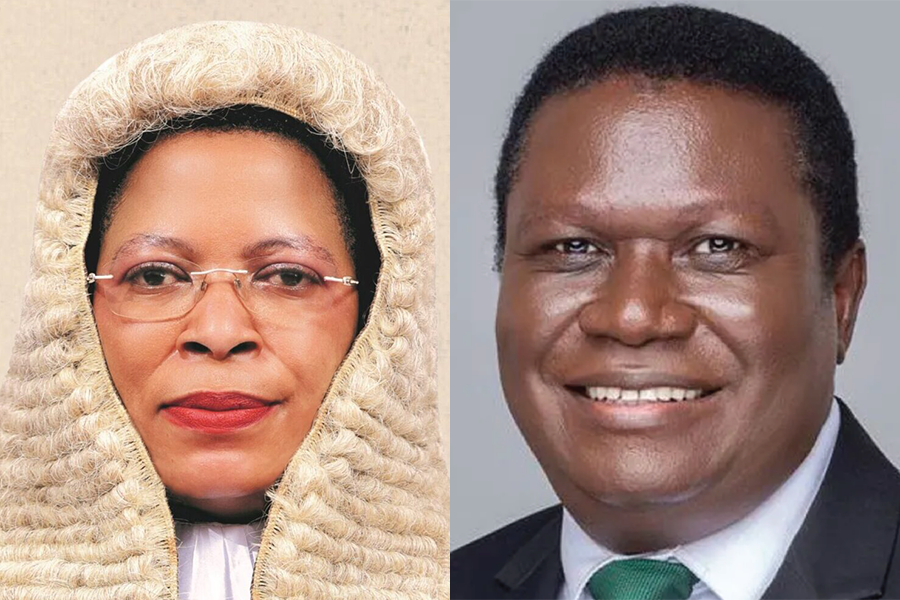
A sharp political exchange has intensified debate over leadership and influence in Uganda’s Parliament, as senior figures clash over the future of the Speakership in the 12th Parliament. Justice Minister Norbert Mao began the criticism of Speaker Anita Among, prompting a stinging intervention by former intelligence chief Gen David Sejusa.
“This is not just bad politics. It is bad manners,” Mao said in response to Among’s earlier remarks. “Only the head of the family has the final word on who can access which room in the home. He doesn’t need lectures from a recently adopted child. Above all, when you insult your father’s visitors, you’ve insulted your father.”
Mao’s comments were interpreted as both a rebuke of Among’s tone and a subtle assertion of political hierarchy within Uganda’s ruling establishment. His reference to a “recently adopted child” sparked speculation about lingering tensions between political actors within and beyond the NRM.
The remarks come amid an emerging contest for the Speakership of the 12th Parliament. While Anita Among currently occupies the position, having assumed office after the death of former Speaker Jacob Oulanyah, Mao is among those openly campaigning for the same role.
Mao has previously described Among as an “accidental Speaker,” a label referencing the circumstances under which she rose to the position following Oulanyah’s death. Although Among has consolidated her authority, rivals continue to question her legitimacy and readiness to lead.
Among’s initial remarks, which triggered the dispute, centered on the cooperation between the ruling National Resistance Movement (NRM) and other political actors, particularly Mao’s Democratic Party. She drew a distinction between collaboration and positions reserved for party insiders.

“We do cooperate with other political parties,” she said, “but it does not mean that if we are cooperating you come up to my bedroom; you remain in the compound. The bedroom this time round is the Speakership. You cannot cooperate to the tune of Speakership.”
The metaphor of the “bedroom” was intended to signify positions of influence, suggesting that some roles, such as the Speakership, are reserved for trusted party members, not allies from cooperating opposition parties.
Gen David Sejusa, however, rejected Among’s analogy, delivering a striking counterpoint. “Parliament is not the bedroom of NRM,” he said. “It is the dining room where eaters gather.”
Sejusa’s remark gained rapid traction in the public sphere, resonating with Ugandans skeptical of political institutions. By recasting Parliament as a “dining room,” he invoked a critique of the institution as a space where elites consolidate resources rather than prioritize service to citizens.
The phrase “eaters gather” carries strong political connotations in Uganda, often used to describe patronage networks and the distribution of benefits among those with access to power. Sejusa’s intervention went beyond metaphorical rebuttal—it questioned the integrity of Parliament itself.
The exchange highlights both personal rivalries and broader political tensions within Uganda’s leadership, emphasizing the high stakes surrounding the Speakership of the 12th Parliament.
Among’s position as Speaker is under scrutiny, with Mao challenging her both rhetorically and through political maneuvering. The debate reflects the intersection of hierarchy, loyalty, and ambition in Uganda’s parliamentary politics.
Domestic metaphors—bedrooms, compounds, and dining rooms—have made the conversation highly accessible to the public while conveying serious questions about control and access to power.

Observers note that the battle for the Speakership is not only a contest between individuals but also a reflection of how Uganda’s political system balances party loyalty with broader parliamentary governance.
The vivid imagery used by both Mao and Sejusa highlights the tension between inclusive governance and restricted access, raising questions about transparency and fairness in political appointments.
While Mao emphasizes hierarchy and procedural authority, Sejusa’s intervention underscores the notion that Parliament should serve as a space for all lawmakers, not just insiders or party loyalists.
This debate over metaphors has also drawn attention to how leadership disputes are framed in Uganda, with language used strategically to shape public perception and influence political outcomes.
Political analysts suggest that this clash could shape public sentiment ahead of the election of the 12th Parliament’s Speaker, potentially influencing both party dynamics and alliances.
As the contest continues, the public remains attentive to the interplay of rhetoric, personal rivalry, and party politics, watching closely who will ultimately control the Speakership and the direction of parliamentary authority in Uganda.
Ultimately, the Sejusa-Mao-Among exchange underscores the enduring tension between power, ambition, and public accountability, highlighting the challenges of leadership in Uganda’s evolving political landscape.