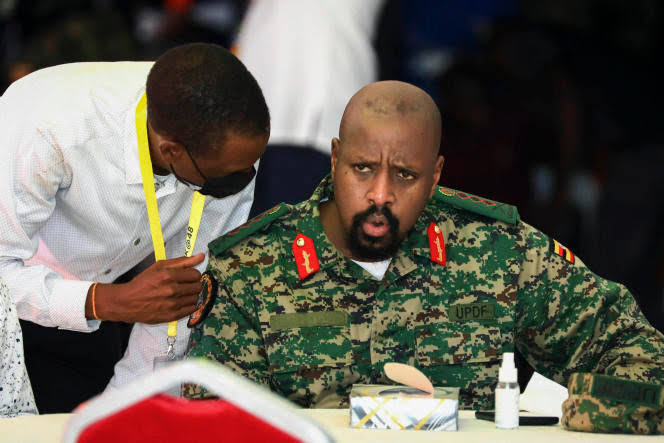
Gen. Muhoozi Kainerugaba, Commander of the Uganda People’s Defence Forces (UPDF) and son of President Yoweri Museveni, has recently made a statement that has reverberated across Uganda and attracted international attention.
In his declaration, Muhoozi reflected on his tenure as Commander of the Defence Forces (CDF), describing the role as one that “only those touched by God” could manage effectively. His phrasing underscored a profound sense of personal confidence and accomplishment.
He went further, stating that all former CDFs would “from now and forever more stand up and salute” him, asserting his seniority over them, with the exception of Salim Saleh, also known as Afande Saleh, whom he acknowledged as ranking above him.
This bold statement has sparked widespread discussion about leadership, authority, and hierarchy within Uganda’s military structures, as well as in the broader political landscape.
Many observers note that Muhoozi’s remarks reflect the intertwining of personal pride with formal military hierarchy. Military leadership is often associated with discipline, respect, and adherence to established norms. Muhoozi’s words, however, highlight a more individualistic approach to rank and recognition.
By framing his tenure as divinely sanctioned, Muhoozi places his authority in a spiritual context, suggesting that his ability to lead was not only earned through training and experience but also guided by destiny.
The spiritual framing of his statement has drawn attention because it links leadership success to perceived divine favor, a concept that resonates in a country where faith often intersects with politics.

At the same time, demanding acknowledgment from predecessors challenges traditional norms, where respect is generally mutual and grounded in cumulative service and experience.
Some commentators have praised Muhoozi’s confidence, suggesting that his self-assuredness demonstrates decisiveness and authority—qualities valued in military leadership.
Others, however, question whether the tone risks undermining the collegiality and respect expected among top military figures, particularly former commanders who hold institutional memory and experience.
The debate highlights the tension between personal achievement and collective recognition in hierarchical organizations like the military, where past leaders’ contributions are typically honored regardless of current rank.
Beyond internal military circles, Muhoozi’s statement also illustrates the modern dynamics of public communication. Leaders today can broadcast messages directly to citizens via social media, bypassing traditional channels of information.
While this allows for immediacy and direct engagement, it also magnifies scrutiny. Bold statements can quickly attract both support and criticism, shaping public perception in real time.
In Uganda, where military and political spheres are closely intertwined, Muhoozi’s declaration may influence how both citizens and military personnel perceive leadership, authority, and ambition.

Some analysts interpret his remarks as a demonstration of assertiveness, meant to signal strength and deter challenges to his leadership both within the UPDF and politically.
Others see it as a provocative statement that blurs the line between personal pride and professional decorum, raising questions about humility and the etiquette of rank acknowledgment.
The broader public has engaged vigorously with the statement, generating debates on social media and in traditional media about the appropriate balance between confidence and respect for predecessors.
Political commentators note that statements like these reflect the evolving culture of leadership communication, where direct, unfiltered messaging increasingly shapes narratives about authority and power.
Ultimately, Muhoozi’s words have sparked a national conversation, forcing both the military and the public to consider what leadership, recognition, and hierarchy truly mean in contemporary Uganda.
Whether viewed as a declaration of divine favor, a call for respect, or an assertion of authority, the statement underscores the delicate balance leaders must navigate between pride, power, and professional decorum.
As Uganda continues to witness a generation of leaders asserting their vision, Muhoozi’s bold declaration serves as both a reflection of personal ambition and a lens into the country’s broader discourse on authority, hierarchy, and leadership culture.
–