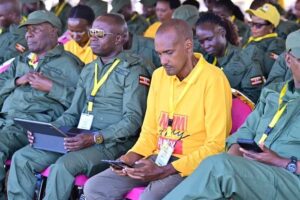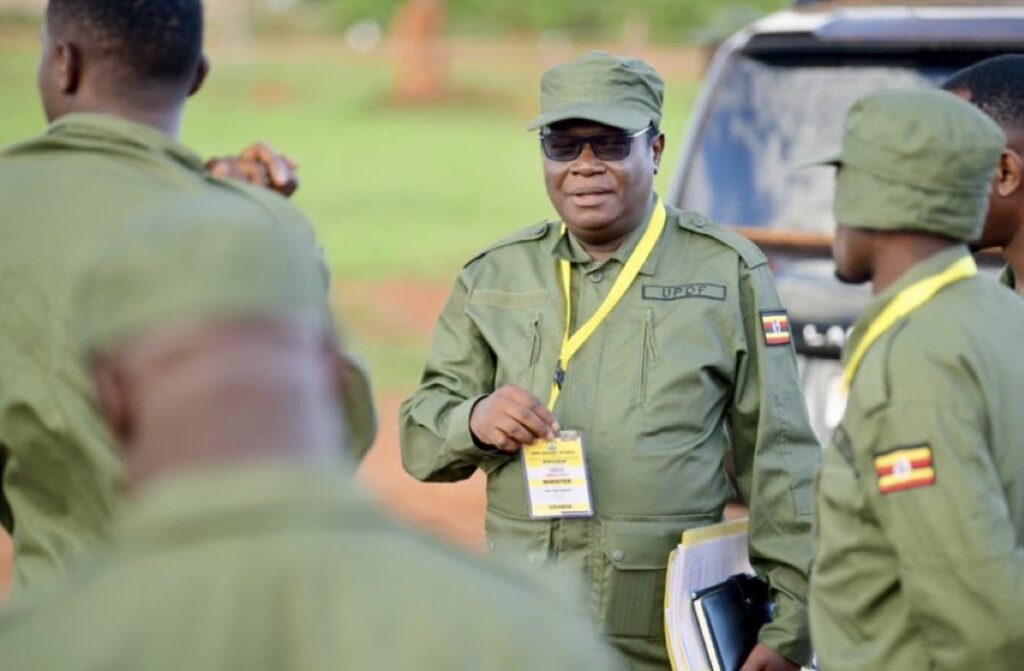
Tensions have reached new heights within Uganda’s political circles following an unexpected turn of events at the National Resistance Movement (NRM) parliamentary retreat in Kyankwanzi. Justice Minister Norbert Mao and renowned political commentator Andrew Mwenda both found themselves barred from speaking at the event, a move that has raised eyebrows and deepened the already intense political divisions surrounding the ongoing race for the position of Speaker of Parliament. The incident has also brought to light the growing conflict between Mao and Speaker Anita Annet Among, whose recent remarks have been widely criticized.
The standoff started when Mao, a prominent political figure and the leader of the Democratic Party (DP), was invited to the retreat under a cooperation agreement with the ruling NRM party. He had reportedly been scheduled to address the delegates but was struck off the program without any prior explanation.
Mao, who is an advocate for political reform and has been a vocal critic of some of the ruling party’s practices, expressed his shock and disappointment over his exclusion, viewing it as an attempt to silence voices that question the status quo, particularly in the highly contested Speaker race.
“I was actually shocked to see the holder of such a dignified office going to the gutters,” Mao responded, referring to Speaker Anita Among’s recent comments, which had sparked controversy. In a statement, Among had likened the Speakership to a “bedroom” reserved exclusively for NRM insiders, a remark that many viewed as undermining the integrity of the parliamentary process. Mao did not mince words, calling the comparison demeaning and beneath the dignity of someone holding such a significant office.
“To suggest that my aspiration amounts to trespassing in the NRM bedroom is beneath the dignity of the Speaker,” Mao emphasized, framing the exclusion of himself and Mwenda as a broader strategy to limit dissenting voices and alternative perspectives within the NRM’s ranks. This incident has drawn attention to the increasing tension in the Speaker’s race, with Mao positioning himself as a reform candidate advocating for merit-based leadership rather than political exclusivity.
Andrew Mwenda, a well-known journalist and outspoken critic of Speaker Among, was also reportedly blocked from addressing the retreat. Mwenda has been a vocal critic of Among, accusing her of corruption and monopolizing power within Parliament.
His exclusion, alongside Mao’s, further reinforced perceptions of a shrinking space for alternative views and free speech within the retreat. Both men, who have long been regarded as influential voices within Uganda’s political landscape, have made no secret of their opposition to what they see as a consolidation of power within the NRM.
Mao, while addressing the situation, made it clear that he viewed his exclusion as a direct challenge to his legitimacy within the NRM. “I’m a guest of the National Chairman of the NRM. I’m not an intruder,” he remarked, referring to President Yoweri Museveni, who invited him to join the government as a cabinet minister. Mao, who has long been a key figure in Ugandan politics, argued that his role in the government was not to be questioned by anyone within the NRM, especially not by those who seek to maintain a narrow hold on power.
His comments did not stop there. Mao pointed out that, as a guest in the ruling party’s fold, he should be treated with the same respect and dignity that is afforded to any visitor. “In our society, guests are highly respected. And anybody who insults a guest insults the host,” he said, invoking cultural norms that place great importance on hospitality and respect for outsiders. Mao’s use of this cultural reference was aimed at reinforcing the idea that his position within the NRM was legitimate and backed by the president’s authority.
The incident has not only created a rift between Mao and Among but has also amplified political fault lines within the Kyankwanzi retreat itself. The retreat, which gathers NRM and NRM-leaning Members of Parliament (MPs), has become the center of a fierce contest over the Speakership, with different factions within the party jostling for influence.
Mao, who has positioned himself as a candidate for the Speaker’s office, has emphasized the need for a clean contest focused on merit rather than political machinations. His exclusion from speaking, along with Mwenda’s, is seen as an attempt to suppress voices that challenge the established power dynamics.
“Let us keep this thing clean. The rules forbid campaigning. What we should do is speak about our qualifications, which I have,” Mao asserted, referring to the established rules of the NRM retreat, which forbid formal campaigning during the proceedings.
He maintained that the race for the Speakership should be about discussing the qualifications of the candidates and not about party loyalty or power games. Mao’s statement reflects his desire for a more transparent and inclusive process, one where the best candidate is chosen based on merit rather than political favoritism.
Mao’s criticism of Speaker Among, however, went beyond the issue of his exclusion from the retreat. The conflict between the two has escalated following Among’s controversial remarks about the Speakership being a “bedroom” reserved for NRM insiders. These comments were widely interpreted as an attempt to close off the competition for the Speakership, effectively sidelining any potential challengers. The remarks have not only alienated Mao but have also sparked outrage among other political figures who view the comments as undemocratic and contrary to the principles of a fair electoral process.
Mao’s decision to frame his exclusion as part of a broader attempt to limit dissent has added fuel to the fire. The Justice Minister is clearly positioning himself as a champion of reform, calling for a fairer and more transparent political environment. His exclusion from the retreat is seen as an indication that the powerbrokers within the NRM are unwilling to entertain any challenge to the status quo, particularly in the lead-up to the Speakership election.
Mao’s remarks have struck a chord with those who feel that the political landscape is becoming increasingly polarized and controlled by a small clique of elites.

Despite the sharp rhetoric surrounding his exclusion, Mao has called for unity and reconciliation within the NRM and the broader political community.
In a conciliatory tone, he urged the members of the retreat to remember that after the contest for the Speakership is over, the country will still need to come together to build a stronger Uganda. “After the contest, we need each other to build our country,” Mao said, acknowledging the importance of collaboration and unity in the aftermath of the election.
The blocking of both Mao and Mwenda’s speeches has also drawn attention to the deepening divisions within the NRM. With over 400 NRM and NRM-leaning MPs in attendance, the retreat has become a battleground for political influence ahead of the 12th Parliament.
The contest for the Speakership has become a proxy war for larger ideological battles within the party, with Mao’s calls for merit-based leadership clashing with the entrenched political networks that seek to maintain their dominance.
As the retreat continues and tensions rise, the political implications of this incident are still unfolding. Mao’s exclusion and his outspoken criticism of Speaker Among are likely to further deepen the divisions within the NRM as the race for the Speakership heats up.
The contest for the Speaker’s office is no longer just about parliamentary leadership but has become a symbolic struggle for control of the party and the direction of Uganda’s political future.
In conclusion, the blocking of Norbert Mao and Andrew Mwenda’s speeches at the Kyankwanzi retreat has only added to the already intense political drama surrounding the race for Speaker of Parliament. Mao’s criticism of Speaker Among and his calls for a merit-based election process have struck a nerve within the NRM, with his exclusion being seen as part of a broader effort to silence dissenting voices.
The incident highlights the deepening political fault lines within Uganda’s ruling party and sets the stage for a contentious and unpredictable contest for the Speakership in the coming months.