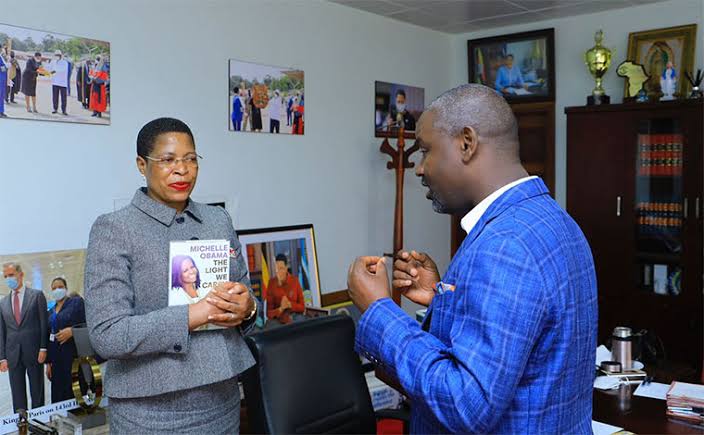
Deputy Speaker of Parliament, Thomas Tayebwa, has sparked wide public discussion after making strong remarks about harmony within the current leadership of Parliament.
While speaking about his working relationship with Speaker Anita Among, Tayebwa said this is the first time in history that Uganda has a Speaker and Deputy Speaker who are not constantly fighting each other.
Tayebwa explained that he and Speaker Anita Among are “on the same ticket,” meaning they share the same vision, understanding, and approach to leadership.
According to him, this unity has helped Parliament function more smoothly and reduced internal conflicts that previously affected the institution.
He contrasted the current situation with what he described as troubled relationships between former Speakers and their Deputies. Tayebwa said that in the past, disagreements at the top of Parliament created serious tension that even reached the President.
In a striking statement, Tayebwa claimed that President Yoweri Museveni used to suffer headaches caused by constant quarrels between previous Speakers and their Deputies. He added that the President would sometimes be forced to take painkillers because of the stress brought on by those leadership disputes.
Tayebwa painted a vivid picture of how bad the situation once was. He said that when he visited State House in the past, he would find the Speaker sitting in one waiting room and the Deputy Speaker in another, clearly showing how divided the leadership had become.

According to Tayebwa, such scenes were signs of deep mistrust and rivalry. He suggested that instead of focusing on serving the country, some past leaders spent too much time fighting each other, which weakened Parliament’s effectiveness.
He stressed that the current leadership has deliberately chosen a different path. Tayebwa said he and Anita Among made a commitment to work together, communicate openly, and resolve disagreements privately rather than turning them into public battles.
The Deputy Speaker emphasized that unity at the top is important because Parliament plays a critical role in governance. When leaders fight, he said, it slows down work, affects decision-making, and creates unnecessary tension within government.
Tayebwa also noted that harmony between the Speaker and Deputy Speaker helps Parliament maintain a respectful relationship with the Executive. He said the current leadership does not seek to create unnecessary conflict with the President or other arms of government.
His comments were seen by some as praise for Speaker Anita Among’s leadership style. Tayebwa appeared to credit her with promoting cooperation and teamwork rather than competition and division.
Supporters of the current Parliament leadership welcomed the remarks, saying they reflect maturity and responsibility. They argue that leadership should be about service and results, not personal power struggles.
However, some critics felt Tayebwa’s comments were unfair to former Speakers and Deputies. They argued that disagreements are sometimes part of healthy debate and should not always be portrayed as personal fights.
Others questioned whether unity alone is enough, saying Parliament must also remain independent and bold in holding the Executive accountable. They warned that too much harmony could be mistaken for silence or fear.
Despite the criticism, Tayebwa stood firm on his message. He insisted that unity does not mean weakness, but rather strength built on mutual respect and shared purpose.

He added that disagreements still happen in the current Parliament, but they are handled with dialogue and understanding. According to him, leaders do not need to embarrass each other to prove a point.
Tayebwa’s remarks have sparked renewed debate about leadership culture in Uganda. Many people are now discussing whether cooperation should be prioritized over confrontation in public institutions.
Some political observers say the statement highlights a shift in how Parliament relates to the Presidency. They believe the current leadership prefers consultation and coordination rather than open conflict.
Others feel the comments reflect generational change, with younger leaders choosing teamwork over rivalry. They say this could help stabilize institutions and improve public trust.
For ordinary citizens, the idea of leaders working together without constant fighting is appealing. Many believe that unity at the top can lead to faster service delivery and better laws.
At the same time, Ugandans continue to watch closely to see whether this unity will translate into strong representation of public interests. People want cooperation, but not at the cost of accountability.
In the end, Thomas Tayebwa’s remarks have added a new chapter to the discussion about leadership in Uganda. Whether praised or criticized, his words have clearly highlighted the importance of harmony, communication, and mutual respect in governing the country.