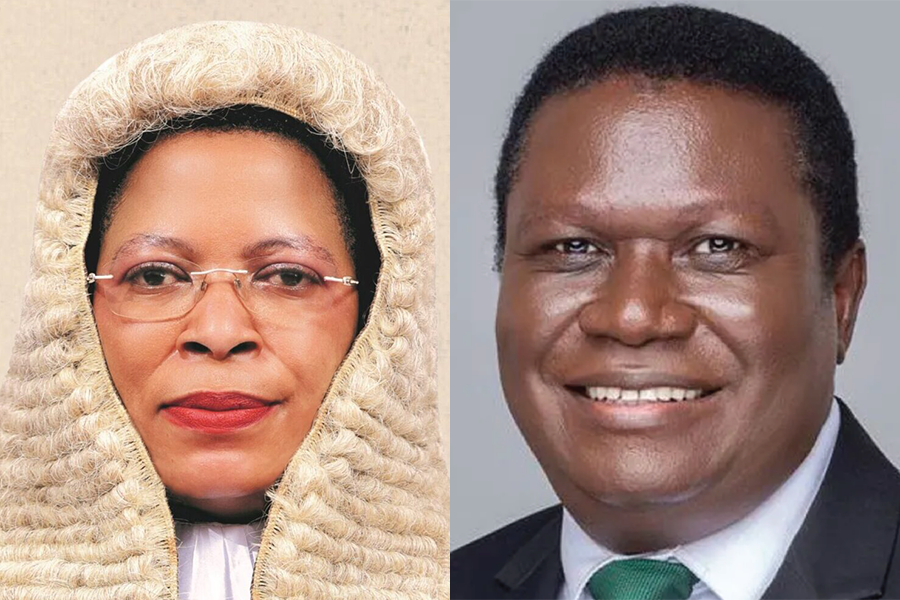
The political race for the Speaker of Uganda’s 12th Parliament has taken a dramatic turn, with Norbert Mao, Minister of Justice and Constitutional Affairs, publicly responding to remarks made by incumbent Speaker Anita Among.
The controversy stems from Among’s metaphorical statement during discussions about political cooperation. She told Mao to “stay away from the NRM bedroom” and “remain in the compound,” emphasizing the limits of opposition participation within ruling party structures.
Mao, newly elected Member of Parliament for Laroo-Pece, immediately fired back, framing her comments as a personal affront and a challenge to established political decorum.
“This is not just bad politics. It is bad manners!” Mao declared, adding that only the head of the household determines access to rooms, metaphorically referring to leadership and decision-making in the political space.
He went further, suggesting that Among, whom he described as a “recently adopted child,” had overstepped by instructing him on boundaries. “When you insult your father’s visitors, you’ve insulted your father,” Mao said, maintaining the domestic metaphor while signaling the seriousness of her perceived offense.
The exchange has captured national attention, highlighting both the intensity of the speakership race and the symbolic language politicians often use to frame competition.
Mao’s comments also serve as a reminder that metaphors are a common feature of Ugandan political rhetoric, allowing leaders to convey criticism and assert authority while softening the literal impact of their words.
The timing of the spat is critical. With MPs yet to elect the Speaker of the 12th Parliament, tensions are high, and competition among aspirants is fierce. Mao’s response signals that he is positioning himself as a strong contender in this contest.
Anita Among assumed the speakership in 2022 following the death of former Speaker Jacob Oulanyah, and her leadership has not been without controversy. Critics sometimes refer to her as an “accidental speaker,” a label Mao has previously used.
Her comments about the NRM “bedroom” appear intended to reinforce boundaries between the ruling party and opposition, reflecting the delicate nature of cooperation agreements in Uganda’s multi-party system.
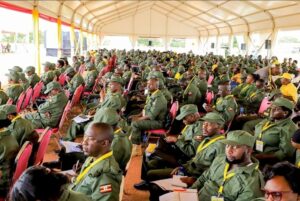
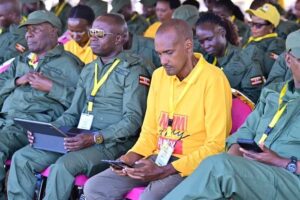
Mao attended the National Resistance Movement (NRM) retreat at Kyankwanzi, which has been a flashpoint in the debate. His presence was tied to the cooperation agreement between his Democratic Party and the ruling party, suggesting he may have NRM support despite being an opposition figure.
Observers note that Mao’s popularity among some NRM MPs reportedly skeptical of Among could influence the speaker race, making his response to her comments both a political and symbolic maneuver.
The exchange also underscores the broader context of political alignments in Uganda. Cooperation agreements like the one between DP and NRM often create friction within ranks, as party members navigate loyalty, ambition, and strategy.
Mao’s challenge to Among’s statement reflects not only personal ambition but also a critique of her tone and approach, suggesting he sees the metaphor as diminishing his political legitimacy.
Adding complexity to the race, Mao’s election as MP for Laroo-Pece is currently under legal challenge. Former NRM candidate Tonny Kitara has filed a petition seeking to nullify Mao’s victory, alleging voter bribery, misuse of state resources, and campaign irregularities.

If the petition succeeds, it could directly affect Mao’s eligibility for the speakership, introducing further uncertainty into the political contest.
The leadership battle is not confined to Mao and Among. Other figures, such as DP secretary general Gerald Siranda, have shifted allegiances, illustrating the fluid nature of political support and coalition dynamics.
Calls have even emerged suggesting that President Museveni appoint Mao as vice president to remove him from the speaker race in favor of Among, reflecting the intertwining of political maneuvering and executive influence in parliamentary leadership decisions.
Amid the back-and-forth, the public has weighed in on the issue, with social media amplifying both criticism and support for Mao and Among. The debate illustrates how political rhetoric now intersects with public perception and digital discourse.
Analysts argue that the metaphorical framing of the spat—using household language to discuss political boundaries—reveals both creativity and tension in Uganda’s political communications, serving as a lens to understand broader power struggles.
The conflict between Mao and Among is emblematic of the high stakes in parliamentary leadership, highlighting how individual ambitions, party alliances, and historical legacies intersect in the contest for one of Uganda’s most powerful political positions.
As the 12th Parliament approaches its speaker election, observers will be watching closely to see how this exchange shapes alliances, influence, and ultimately the outcome of the race, as both Mao and Among navigate the complex terrain of ambition, protocol, and political etiquette.