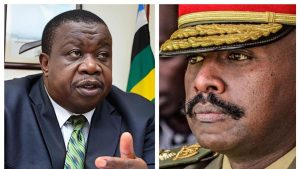
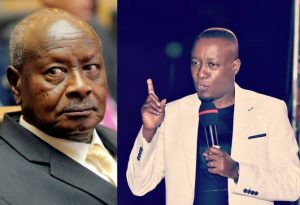
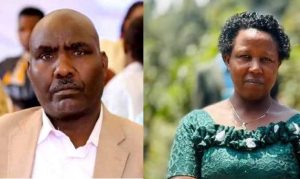
Government Chief Whip Hamson Obua recently stirred political debate with bold remarks about the future of Uganda’s ruling party, the National Resistance Movement (NRM).
Speaking with confidence, Obua declared that the NRM is built to last and will remain a dominant force in Uganda’s politics for generations. His statement was meant to project stability, continuity, and strength within the party’s leadership structure.
Obua emphasized that the NRM is not like the Uganda People’s Congress (UPC), a party that once held power but later weakened over time.
By drawing this comparison, he was highlighting what he believes is a key difference — that the NRM has deeper roots, stronger systems, and a long-term plan to remain relevant in national leadership.
At the center of his remarks was President Yoweri Museveni, who has led Uganda since 1986. Museveni’s long rule has shaped the country’s political, economic, and security landscape.
Obua’s message suggested that Museveni’s leadership is part of a wider legacy rather than an individual era that will end without succession.
The Government Chief Whip went further to name Gen. Muhoozi Kainerugaba, Museveni’s son and a senior military officer, as a future leader. This statement reinforced ongoing public discussion about Muhoozi’s growing visibility in national matters and his perceived political ambitions. Obua framed Muhoozi as part of a planned transition rather than a sudden replacement.

In an even more striking comment, Obua said Muhoozi’s children could also lead Uganda in the future. This introduced the idea of generational leadership within the NRM, suggesting a political lineage that extends beyond one transition. For supporters, this signals continuity; for critics, it raises questions about democracy and leadership selection.
Obua’s statement came at a politically sensitive time, as he later lost the Ajuri County parliamentary seat to UPC’s Fred Jalameso. This outcome added an ironic twist, since his speech had compared NRM’s strength to UPC’s past decline. The election result showed that political competition remains active at the grassroots level.
Despite the loss, Obua’s message was clearly meant to reassure NRM supporters. It aimed to show that the party’s future does not depend on one person alone, but on a structure that he believes is solid and enduring. In political communication, such assurances are often used to calm fears about leadership transitions.
The idea of political succession has long been a topic in Uganda. As Museveni’s time in power stretches over decades, many citizens wonder what the country’s leadership will look like in the future. Obua’s remarks attempted to answer that question directly, pointing to a clear line of continuation.
However, the suggestion of leadership within one family can be controversial. Uganda is a republic where leaders are chosen through elections, and many citizens value open competition. Statements that appear to favor family-based succession often spark strong public debate.
Supporters of the NRM argue that experience, stability, and historical contribution matter. They see the movement as a liberation force that brought peace after years of instability. From this perspective, continuity in leadership is seen as protecting the gains made over time.
On the other hand, opposition supporters believe leadership should rotate more frequently and through broader participation. They argue that democracy grows stronger when different leaders and ideas have a chance to govern. Obua’s remarks therefore touched on deeper issues about governance and political culture.
The loss of Obua’s seat to a UPC candidate also shows that local politics can differ from national narratives. While national leaders speak about long-term dominance, voters at the constituency level may focus on service delivery, local development, and direct representation.
Still, the NRM remains the largest and most organized political force in Uganda. It has structures across the country and a long history of mobilization. Obua’s speech was likely aimed at reinforcing confidence within these structures, especially at a time when political discussions about succession are increasing.

Muhoozi Kainerugaba himself has been in the spotlight in recent years, both for his military career and his public statements. His growing presence in national conversations makes him a central figure in debates about Uganda’s future leadership.
The mention of Muhoozi’s children was symbolic of a long-term vision, though actual leadership in Uganda depends on constitutional processes and elections. Political statements like Obua’s often blend symbolism with strategy, aiming to shape how people think about the future.
For many Ugandans, the key concern remains governance, jobs, healthcare, and education. Political succession matters, but everyday issues often influence how citizens judge leaders and parties. Strong words alone may not guarantee political success without visible results.
Obua’s speech also shows how political messaging is used to project strength even during uncertain times. Leaders often speak confidently about the future to maintain unity among supporters and discourage internal divisions.
At the same time, democracy thrives on open debate. Statements like these invite discussion about leadership, institutions, and the direction of the country. Different voices and opinions are part of a healthy political environment.
Whether Obua’s vision of long-term NRM leadership becomes reality will depend on many factors — public support, political reforms, generational change, and national priorities. Uganda’s political journey continues to evolve with each election cycle.
In the end, the remarks reflect the ongoing conversation about Uganda’s future. They reveal hopes, fears, and differing views about continuity and change. As politics moves forward, citizens will ultimately shape the path through their participation and choices.