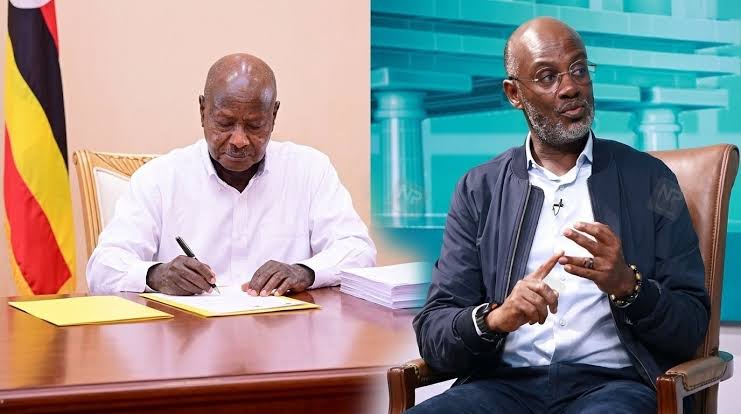
Political commentator Andrew Mwenda has stirred intense public debate after coming to the defense of former Speaker Anita Among, arguing that the controversy surrounding her should not simply be viewed through the lens of corruption allegations.
Speaking during an appearance on the Uganda Broadcasting Corporation political talk show Behind the Headlines, Mwenda claimed that Among’s greatest contribution was not personal enrichment but strengthening President Yoweri Museveni’s political control within Parliament.
Mwenda argued that many critics misunderstand how power operates within Uganda’s political system, insisting that Among’s influence extended far beyond ordinary parliamentary leadership.
According to him, the former Speaker became one of the ruling establishment’s most effective political mobilizers, capable of controlling parliamentary dynamics and ensuring government business moved smoothly.

He claimed that before Anita Among assumed the Speakership, President Museveni frequently struggled to manage Members of Parliament and maintain unity within the House during sensitive legislative processes.
Mwenda alleged that in previous years, State House often had to organize retreats and meetings aimed at persuading lawmakers to support government positions on controversial bills and policies.
During those engagements, he said, MPs reportedly received transport facilitation, financial support, refreshments, school fees assistance and other forms of political mobilization intended to secure loyalty and cooperation.
According to Mwenda, Among changed that entire political arrangement after becoming Speaker by assuring Museveni that she could internally manage Parliament without requiring constant direct intervention from State House.
He suggested that her leadership style reduced pressure on the President by centralizing influence within the Speaker’s office and ensuring that parliamentary support for government business remained stable.
Mwenda further claimed that the money allegedly associated with Among represented only a “small fraction” compared to the political value she delivered to the ruling establishment over time.

In his view, Among’s methods were not centered on personal luxury alone but on building networks, rewarding loyalty and maintaining alliances within Uganda’s political elite.
He described her as someone who deeply understood “electoral college politics,” arguing that her real political strength lay in relationship-building and strategic influence rather than mass public popularity.
Mwenda maintained that Among’s ability to consolidate support among legislators and powerful political actors made her an important figure within Museveni’s broader political machinery.
His comments come at a time when Anita Among is facing mounting public scrutiny and investigations over allegations of corruption, illicit enrichment and abuse of office during her tenure as Speaker.
In recent weeks, anti-corruption agencies and security operatives have reportedly intensified investigations into her financial dealings, property acquisitions and management of parliamentary resources.
Authorities are said to have conducted coordinated searches at properties linked to Among in Kampala and other locations as investigators continue examining allegations surrounding misuse of public funds.

Reports indicate that security teams allegedly seized luxury vehicles, electronics, financial records and other materials believed to be relevant to the ongoing investigations.
Mwenda’s defense of Among has triggered mixed reactions among Ugandans, with some agreeing that politics often operates through patronage systems while others insist that misuse of taxpayer money cannot be justified under any political circumstances.
Critics argue that regardless of political strategy or loyalty-building, public funds must remain protected and transparent, especially within institutions expected to uphold accountability and integrity.
As investigations continue and public pressure grows, Mwenda’s remarks have added another controversial dimension to the national conversation about power, corruption, political survival and the hidden mechanics behind Uganda’s parliamentary politics.