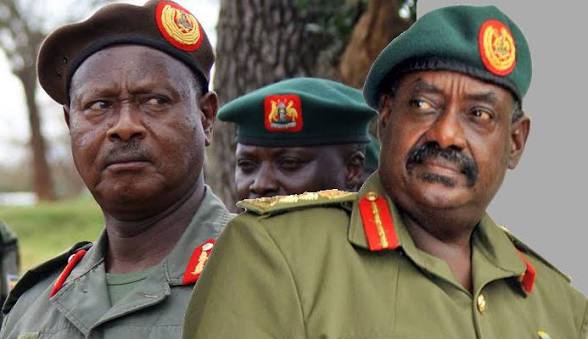
Former Ugandan intelligence chief and retired army general, David Sejusa, popularly known as Tinyefuuza, has once again stirred debate in the country by calling for a constitutional amendment that would require the president-elect to be sworn into office within just one week after election results are declared.
His comments have reignited discussions about the effectiveness and timing of Uganda’s electoral and governance processes.
Sejusa argues that the current system creates a prolonged period of “absentee government” following elections, during which citizens are left without visible leadership and newly elected officials remain inactive.
In his view, the gap between election results and inauguration delays government action and undermines accountability.
The former spymaster pointed to real-life examples to illustrate his point, citing the visit of the Kabaka of Buganda, Ronald Muwenda Mutebi, to victims of a fire at Katwe Market in Kampala.
He noted that government officials were absent during the aftermath, despite the capital having numerous ministers, members of parliament, and local leaders.
“What disturbed me most,” Sejusa said, “was that the Kabaka was the first government figure to visit the victims. How many ministers, mayors, and the executive director of KCCA were there? None. This highlights the vacuum between election declaration and actual governance.”

In Sejusa’s analysis, the vacuum exists because newly elected leaders have not yet assumed office, while outgoing officials may be hesitant, disengaged, or distracted, especially if they lost their positions. This, he argued, creates a scenario in which no one is fully accountable for responding to citizens’ needs.
He explained that the current arrangement allows for months of uncertainty, using the example of the mayoral office in Kampala, where the outgoing mayor remains in office until the swearing-in of the successor. During this period, critical government functions can stagnate, leaving citizens underserved.
Sejusa stressed that the problem extends beyond just local leadership. Ministers and other government officials are often uncertain whether they will continue in their positions, which can delay decision-making and reduce responsiveness to urgent issues.
“The executive director may be lobbying for a position in the new government, ministers are unsure if they are returning, and the mayoral transition leaves services in limbo. Meanwhile, the people suffer,” Sejusa noted with concern.
Drawing on his experience as a former member of Uganda’s Constituent Assembly, Sejusa recalled that the debate over the timing of presidential inaugurations was contentious.
He himself opposed provisions that allowed for long gaps between election declaration and swearing-in, arguing that such delays could be disruptive.
He explained that some members of the Constituent Assembly, including the late Justice Kanyeihamba and others, pushed the idea through by arguing that Uganda should model itself after systems like the United States, where inauguration follows months after elections. Sejusa now believes this approach is ill-suited to Uganda.
In his view, a five-month gap between election results and presidential inauguration is unnecessary and harmful. “It is a great waste of time, resources, and governance potential,” he said, emphasizing that urgent national matters often go unaddressed during this period.
Sejusa proposes that the constitution be amended to mandate that the president-elect be sworn in within one week of the declaration of results. He believes this would reduce governance vacuums and ensure continuity in government operations.
The retired general has also raised broader concerns about accountability and transparency within Uganda’s political system. He has previously warned that extended transitions leave the country vulnerable to inaction and can erode public trust in elected leaders.
In addition to governance concerns, Sejusa is well known for making explosive claims about political maneuvering within Uganda’s leadership. He has publicly alleged plots to manipulate succession in favor of certain individuals, including Muhoozi Kainerugaba, and has criticized perceived nepotism at the highest levels of government.

Sejusa has also made startling revelations about safety and fear in government institutions, claiming that cabinet, high command, and parliamentary meetings are sometimes conducted in an atmosphere of suspicion, with officials fearing attempts at poisoning or other covert threats.
His comments often spark national debate because they touch on both procedural issues and sensitive political dynamics, highlighting challenges in Uganda’s political culture and governance practices.
While some see his proposals as practical solutions to a governance problem, others argue that quick swearing-in periods could also present risks, especially if electoral disputes remain unresolved, raising concerns about legitimacy and stability.
Sejusa’s advocacy for rapid presidential inauguration is part of a broader push to modernize and streamline Uganda’s governance processes, ensuring that elected officials can immediately begin serving their constituents without unnecessary delay.
Public reaction to Sejusa’s statements has been mixed, with some praising his frankness and attention to government inefficiencies, while others criticize his proposals as politically motivated or impractical in the current legal and institutional framework.
Regardless of differing opinions, Sejusa’s remarks underscore an enduring debate about the balance between procedural formalities, governance efficiency, and the urgent needs of citizens, highlighting the ongoing struggle to ensure responsive and accountable leadership in Uganda.
Ultimately, Sejusa’s call for constitutional amendment reflects his long-standing commitment to challenging what he perceives as structural flaws in Uganda’s political system, using his platform to advocate for reforms that would reduce governance vacuums and enhance the visibility and effectiveness of elected leaders.