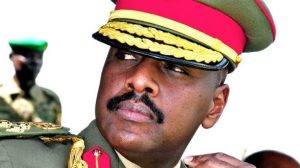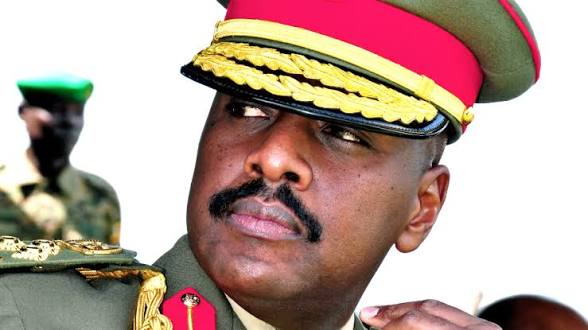
In a deeply personal and thought-provoking statement, General Muhoozi Kainerugaba, Uganda’s senior military officer and the son of President Yoweri Museveni, expressed his unwavering stance on peace and religious values, particularly in the context of international relations.
Muhoozi, who has been at the center of Uganda’s political and military leadership, made a bold declaration that his faith would never allow him to fight against fellow Christians, specifically referring to the United States, which he described as his “brothers in Christ.”
“My religion forbids me from fighting fellow Christians,” Muhoozi declared, drawing a clear line between political or military conflict and his personal religious convictions. “I can never fight the USA. Those are my brothers in Christ,” he added, highlighting the deep spiritual connection he feels with Christians, especially those in the United States, and the moral imperative he feels to preserve peace between Christian nations.
The General’s statement is significant for several reasons. First, it underscores the role that personal beliefs — especially religious convictions — play in shaping the worldview of political and military leaders. Gen Muhoozi’s comments offer a glimpse into how his faith influences his actions and decisions, particularly in matters of international diplomacy and potential military conflicts.
His declaration that he cannot fight against fellow Christians positions him firmly against the idea of engaging in war with countries where Christianity is a dominant religion, notably the United States.
The relationship between Uganda and the U.S. has had its ups and downs over the years, particularly concerning human rights issues, democratic freedoms, and the Uganda government’s policies on various international matters.
However, Muhoozi’s statement serves as a stark contrast to the often-contentious diplomatic discourse, focusing instead on the commonality of shared Christian faith as a bridge for peace and mutual understanding between the two nations.
“I can never fight the USA,” Muhoozi reiterated, emphasizing his belief that the United States, as a predominantly Christian nation, should not be seen as an adversary. The general’s words seem to reflect a call for unity among Christians across national borders, pushing for cooperation and understanding rather than conflict.
This is especially poignant given the political and military pressures that come with leading a nation like Uganda, which has faced both internal and external challenges related to its foreign policy.
The General’s stance on this issue may also be viewed as part of his broader approach to international relations, which often centers on the idea of peace and cooperation over confrontation. This is consistent with his father, President Museveni’s, long-standing policy of non-alignment and diplomacy, where Uganda seeks to balance relationships with both Western and Eastern powers while maintaining sovereignty and independence.
However, Muhoozi’s emphasis on religious values adds a personal and moral layer to his father’s broader diplomatic framework.
Muhoozi’s faith-based perspective may resonate with many Ugandans, especially those who share his Christian beliefs. Uganda is a country where Christianity, particularly Roman Catholicism and Anglicanism, holds significant sway in shaping the values and actions of its citizens.
For a large portion of the population, Muhoozi’s comments may strengthen his image as a leader who aligns his actions with his moral compass, ensuring that his decisions are not just politically or militarily motivated, but also ethically grounded in religious principles.
However, Muhoozi’s comments could also be seen in a broader, more strategic context. By invoking Christianity as a key factor in shaping international policy, he could be signaling to both the West and the broader global community that Uganda — and by extension, the Museveni family — maintains a moral and spiritual connection with Western powers, particularly Christian-majority nations like the United States.
This is especially important for Uganda, which continues to navigate the complexities of its international relationships, balancing between Western interests and its own national priorities.
Gen Muhoozi’s public assertion also touches on the moral dilemma often faced by political and military leaders: how to reconcile religious beliefs with the sometimes harsh realities of statecraft.
The idea of fighting against fellow Christians may be difficult for many to imagine, particularly when considering the deep connections that have historically existed between the West and the global Christian community. His refusal to engage in conflict with Christian nations may appeal to those who believe that shared values, such as love and peace, should always come before war.
Yet, it remains to be seen how this personal declaration will influence Uganda’s foreign policy or its relationship with countries such as the United States. While Muhoozi’s words emphasize peace, they may also draw attention to the potential for further cooperation between Uganda and the U.S., especially in areas where both countries have overlapping interests, such as counterterrorism, regional security, and economic development.
It could also serve to reaffirm Uganda’s commitment to maintaining a peaceful and neutral stance on global conflicts, especially in a world where tensions between major powers are often high.

Muhoozi’s comments come at a time when the world is facing numerous challenges, from conflicts in the Middle East to rising political instability in various regions. His statement could be seen as an appeal for more nations to reflect on their shared religious values and to consider peace as a viable alternative to war.
The idea that religious solidarity can serve as a tool for diplomacy and conflict resolution is a powerful one, and Muhoozi’s public commitment to peace may serve as a beacon for those who hope to see more leaders embrace nonviolent solutions.
In addition to fostering goodwill with the U.S., Muhoozi’s words may also resonate with other Christian-majority nations, encouraging greater interfaith dialogue and cooperation. By highlighting the importance of Christian unity, Muhoozi is positioning himself as a leader who seeks to unite, rather than divide, nations through shared beliefs. This could enhance Uganda’s diplomatic standing in the international community, particularly with other countries that share similar religious foundations.
However, some critics may argue that Muhoozi’s position is overly simplistic in a world where geopolitics is rarely defined by religious lines alone. While religious affiliation may provide a moral framework, international relations often hinge on economic, political, and strategic considerations. Critics could contend that while Muhoozi’s approach is noble, it may not always align with the practical realities of statecraft, where national interests often clash regardless of shared religious values.
In conclusion, General Muhoozi Kainerugaba’s assertion that his religion forbids him from fighting fellow Christians and his declaration of solidarity with the United States as “brothers in Christ” is a profound and personal statement that reflects his deeply held beliefs about peace and religious unity.
His words offer insight into how personal faith can influence foreign policy, particularly in a world where religious identity plays a crucial role in shaping both national and international relations. Whether his stance will reshape Uganda’s foreign policy or strengthen its diplomatic ties with the United States remains to be seen, but it certainly adds a moral and spiritual dimension to the ongoing discussions about Uganda’s place in the global community.