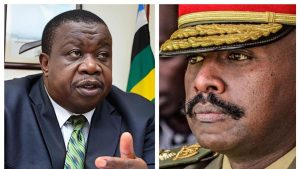
Gen. Muhoozi Kainerugaba, Uganda’s Chief of Defence Forces and Senior Presidential Advisor, has been making waves on social media with a strong accusation against opposition leader Robert Kyagulanyi Ssentamu, popularly known as Bobi Wine.
In a post shared recently on Twitter, Muhoozi claimed that Bobi Wine fled Uganda just 11 days after the controversial elections on January 26, 2026.
This bold statement has sparked a fresh wave of debate on the state of Ugandan politics, the legitimacy of Bobi Wine’s leadership, and his choice to seek international support in the United States.
Muhoozi’s accusation didn’t stop at simply stating the date of Bobi Wine’s departure; he took a further jab at the opposition leader by implying that Bobi Wine had abandoned his followers during a crucial time.
Muhoozi criticized Bobi for spending his time in the United States, “eating Big Macs,” while his supporters remained in Uganda, many of them facing imprisonment or persecution.
This comment underscores the broader political tensions between the ruling government and the opposition, where accusations of betrayal and cowardice often surface.
In his post, Muhoozi also mocked a widely circulated photograph of Bobi Wine taken on Capitol Hill, Washington D.C. The image, which showed Bobi Wine engaged in political meetings, became the subject of intense mockery from the ruling government.

Muhoozi referred to Bobi as “Uncle Tom,” a derogatory term that implies a subservient figure who caters to foreign powers rather than representing the true interests of the people.
This sharp criticism was a direct attempt to paint Bobi Wine’s political actions as driven by external influence, questioning his commitment to Uganda’s sovereignty.
For Bobi Wine, the decision to leave Uganda and seek international support has been framed as a necessary step in his political journey. He has argued that by engaging with the international community, he is raising awareness about the struggles faced by Ugandans under an increasingly authoritarian regime.
Bobi’s social media posts about his meetings with U.S. lawmakers and activists suggest that he views these international engagements as vital to gaining global recognition for the opposition’s cause.
However, Muhoozi’s comments have sparked a backlash from some political commentators and activists. His remarks about Bobi Wine’s U.S. trip have been interpreted by many as an attempt to undermine the opposition leader’s legitimacy and to accuse him of abandoning his people for personal gain.
For Muhoozi and many in the ruling government, Bobi Wine’s decision to engage with Western powers is seen as a sign of weakness, an indication that the opposition leader lacks the ability to challenge the government from within Uganda.
In contrast, Bobi Wine’s supporters view his efforts to seek international backing as a strategic move to put pressure on the Ugandan government. They argue that Western governments have a responsibility to hold the Ugandan leadership accountable for its treatment of political opponents and human rights abuses.
By building relationships with foreign powers, Bobi Wine is seen as opening doors for diplomatic intervention and global attention to Uganda’s political crisis.
The political drama has also caught the attention of other influential figures. Kenyan political activist Miguna Miguna weighed in on the debate, criticizing Bobi Wine for his choice of Washington D.C. as a platform for his international engagements. Miguna referred to Washington as “the headquarters of imperialism, genocide, war crimes, and human rights violations,” expressing his belief that no true Pan-African or freedom fighter should seek support from such a place.
His words have added fuel to the fire, with some questioning whether Bobi Wine’s strategy is flawed and whether it could have unintended consequences for the Ugandan opposition movement.
Despite the criticism, Bobi Wine has continued to defend his decision to travel to the U.S., stating that the meetings he has had in Washington D.C. are an essential part of his mission to challenge the Ugandan government. For Bobi, these engagements are not about aligning himself with imperialist powers but rather about shining a light on the injustices faced by the Ugandan people.
His meetings with U.S. lawmakers and human rights organizations are meant to showcase the struggle for democracy and freedom in Uganda, aiming to garner international solidarity for the opposition’s cause.
The debate over Bobi Wine’s international engagements is not only about his actions but also about the broader question of Africa’s relationship with the West. While some believe that Western involvement in African political affairs is a necessary evil to challenge authoritarian regimes, others view it as a form of neo-colonialism that undermines the continent’s sovereignty.
This ideological divide has been a recurring theme in African politics, with leaders like Muhoozi and Bobi Wine representing opposing views on how best to address the challenges facing the continent.
Muhoozi’s criticism of Bobi Wine, therefore, should be seen in the context of a larger struggle over the future of Uganda’s political system. The ruling government, led by President Yoweri Museveni, has been in power for decades and has faced growing opposition in recent years. Bobi Wine’s rise as a political figure has galvanized many Ugandans who are dissatisfied with the current leadership.
However, the government has used various means, including the military and security forces, to maintain control, suppress opposition, and restrict political freedoms.
In this context, Muhoozi’s remarks about Bobi Wine’s departure and his international engagements reflect the anxiety within the ruling government about the growing influence of the opposition. For the government, Bobi Wine’s actions represent a threat to the status quo, and they have taken every opportunity to discredit his leadership.
Muhoozi’s online posts are part of a larger strategy to undermine Bobi Wine’s credibility and to convince Ugandans that the opposition leader is not a serious contender for leadership.
Bobi Wine’s trip to the U.S. also raises questions about the role of the international community in supporting political movements in countries like Uganda. Should foreign governments intervene to support democratic forces, or is it better for African nations to resolve their own political issues without outside interference? These questions have been at the heart of many debates on African democracy and sovereignty, and they continue to divide opinion across the continent.
While some view Bobi Wine’s engagement with the West as a necessary move, others believe that it could backfire. There is a fear that relying too heavily on foreign powers could alienate local supporters who view such alliances as a sign of weakness.

The challenge for Bobi Wine, therefore, is to strike a balance between building international support and maintaining a strong, independent political base within Uganda.
At the same time, Muhoozi’s comments also reveal the government’s fear of losing control. The ruling party has used a combination of media manipulation, legal restrictions, and military force to maintain its hold on power.
Bobi Wine’s rise has been seen as a direct challenge to this control, and the government’s response to his political activities has been one of skepticism and hostility. The question now is whether the Ugandan people will continue to support Bobi Wine’s calls for change or whether they will side with the government’s claim that sovereignty must be preserved at all costs.
In the end, the political showdown between Muhoozi and Bobi Wine is more than just a personal dispute; it represents a fundamental clash over the future of Uganda and the direction the country should take.
Will the Ugandan people continue to support the ruling government’s claim to power, or will they embrace the opposition’s call for a more democratic and accountable system? These questions will likely shape the nation’s political landscape for years to come.
As the battle between the two political giants continues, it is clear that Uganda’s political future is uncertain. The question of whether Bobi Wine’s international engagements will bear fruit or whether Muhoozi’s criticisms will prevail remains to be seen.
But what is undeniable is that the stakes are high, and the outcome will have lasting implications for Uganda’s democracy and its place in the wider African and global political arena.