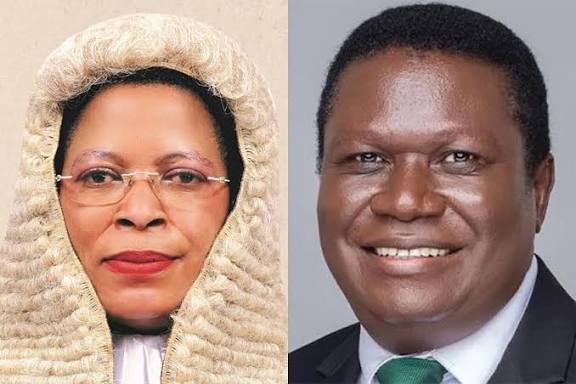
Political debate in Uganda has intensified after veteran journalist and political commentator Andrew Mwenda made controversial claims about the growing influence of the Speaker of Parliament, Anita Among.
During a recent discussion, Mwenda alleged that it has become extremely difficult for individuals to win a legal case against the Speaker in Ugandan courts.
According to Mwenda, the situation is linked to what he described as the Speaker’s growing influence within key national institutions.
He claimed that some judges in the country may feel constrained when dealing with matters that involve the Speaker of Parliament.
Mwenda suggested that this situation could be connected to the process through which certain officials within the judicial system are vetted.
In Uganda, several public officials are vetted by committees connected to the Parliament of Uganda before they assume their positions.
Because the Speaker presides over Parliament, Mwenda argued that her role in the broader parliamentary structure may indirectly influence such processes.

According to Mwenda’s claims, some judges who passed through these vetting procedures may feel political pressure when dealing with sensitive cases.
He further alleged that the Speaker’s political influence extends beyond the legislative chamber.
Mwenda claimed that part of this influence is linked to employment opportunities within Parliament itself.
The journalist argued that the parliamentary administration controls thousands of jobs across various departments and offices.
According to his claims, more than 2,000 people are employed within the parliamentary system.
Mwenda suggested that such employment opportunities can sometimes create networks of loyalty around powerful offices.
He alleged that some individuals may benefit directly or indirectly through relatives or friends who secure jobs within the institution.
Because of this, Mwenda argued that certain people within government structures might feel politically aligned with the Speaker.
However, it is important to note that these claims remain allegations made during political commentary.
There has been no official confirmation that the Speaker directly controls judges or court decisions.
Uganda’s judiciary operates under its own structure, with the Judiciary of Uganda responsible for handling court matters independently.
Legal experts often stress that judges are expected to make decisions based strictly on the law and available evidence.

Nevertheless, Mwenda’s remarks have sparked fresh debate about power, influence, and institutional independence in Uganda.
Some political observers say the comments highlight broader concerns about the concentration of power within political systems.
Others argue that such claims should be approached carefully unless supported by verified evidence.
Supporters of Speaker Anita Among have previously defended her leadership, stating that her influence simply reflects the authority of her office.
They also argue that public institutions have clear legal procedures that guide appointments and decision-making processes.
As these debates continue, Mwenda’s statements have once again brought attention to the complex relationship between politics, law, and governance in Uganda.