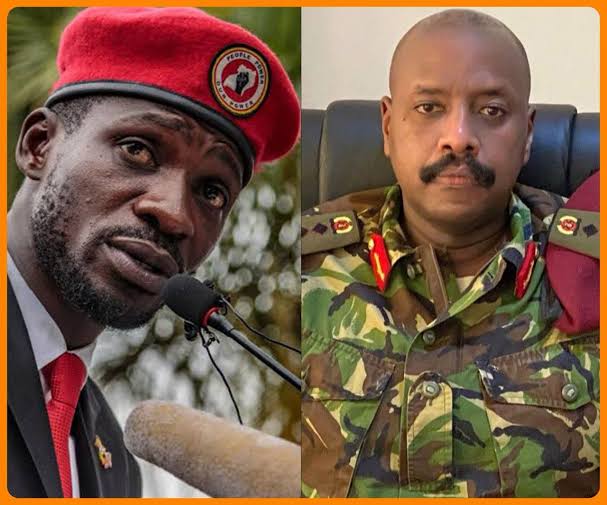
Uganda’s political conversation has once again been stirred by strong remarks reportedly made by General Muhoozi, this time directed at the family of opposition leader Bobi Wine.
The statement, which referenced Bobi Wine’s son Solomon Kampala, has drawn attention not only because of the language used but also because it brings a political dispute into the space of family.
When political leaders mention relatives of their rivals, the public often reacts strongly. Families are usually seen as separate from direct political competition. That is why comments involving children or spouses of politicians tend to create emotional responses among citizens.
The remark followed a post said to have been written by Solomon Kampala, Bobi Wine’s son. Young people in political families sometimes share their opinions publicly, especially in today’s age of social media. However, when their views attract the attention of national leaders, the situation can quickly become serious.
Many Ugandans see this as another sign of how tense the political environment has become. Instead of debates staying between leaders on policy and governance, personal exchanges and harsh words are now part of the public conversation.
Bobi Wine, as a prominent opposition figure, has long been at the center of political disagreements. His activism, speeches, and public appearances often place him in direct opposition to government leadership. This ongoing rivalry creates a background where even small incidents can turn into national issues.
The involvement of his son in the discussion highlights how political pressure can extend beyond the individual leader. Children of public figures sometimes grow up under intense public attention, and their statements can easily become politicized.

Strong language from leaders can have a wide impact. Some supporters may see it as a sign of confidence and boldness, while critics view it as unnecessary and harmful. Words spoken by powerful figures often carry more weight than those from ordinary citizens.
Social media plays a big role in spreading such remarks. Within minutes, a statement can be shared thousands of times, creating heated debates across the country. Reactions online often become emotional, with people taking sides quickly.
For many neutral citizens, the main concern is not the exchange of insults but the overall direction of political dialogue. They worry that when discussions become personal, important national issues like the economy, health, and education receive less attention.
Respectful political engagement is often seen as a sign of democratic maturity. Even when leaders disagree strongly, the way they speak to or about each other can influence public behavior. Harsh words at the top can encourage harsh words at lower levels.
The situation also raises questions about the role of young people in politics. Many youths in Uganda are politically aware and active. When a young person speaks out, it can be seen as bravery by some and provocation by others.
Families of political leaders often face pressure they did not directly choose. Being connected to a public figure can mean living under constant attention, praise, or criticism. This can be challenging, especially for younger members.
Observers note that political competition should ideally focus on ideas, leadership ability, and national plans. When it turns personal, it risks deepening divisions among citizens who already hold strong views.

Public reactions to the statement show how divided opinion can be. Some people defend the General’s right to respond strongly, while others believe leaders should set an example of calm and respectful communication.
Moments like this often become part of a larger pattern of political tension. They reflect how heated the atmosphere has become and how easily disputes can move from policy matters to personal territory.
Community leaders and civil society groups usually call for calm during such times. They remind the public that political differences should not lead to hatred or hostility among citizens.
The international community also tends to observe the tone of political discourse in different countries. Strong personal remarks can shape how a nation’s political culture is viewed from outside.
For Bobi Wine’s supporters, the comment may strengthen their belief that their leader is under constant attack. For government supporters, it may simply appear as a sharp response in a heated political battle.
Ultimately, political leaders are not only judged by their actions but also by their words. Language can build unity or create deeper divides, depending on how it is used.
As Uganda continues to navigate its political journey, many citizens hope for a shift toward calmer and more issue-focused discussions. While disagreements are normal in politics, the desire for peace, respect, and stability remains shared by most people.