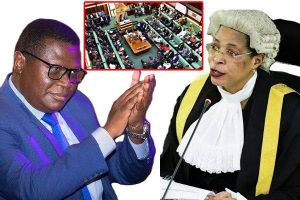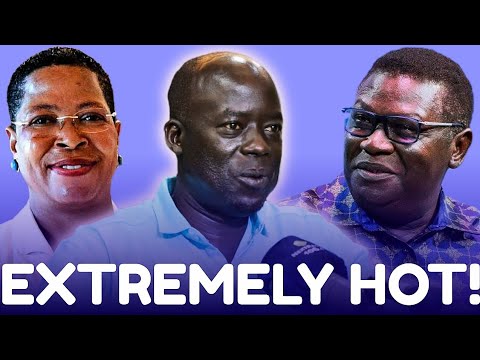
Ugandan politics has once again taken a dramatic and emotional turn after remarks made by Norbert Mao during a heated media interaction and subsequent press briefing in Kampala.
Mao, who serves as Minister for Justice and Constitutional Affairs, found himself at the center of controversy following a verbal exchange with fellow politician Odonga Otto, who recently made critical comments about his financial status.
The tension reportedly escalated after Otto appeared on television and suggested that Mao’s political decisions were driven by financial pressure and personal survival.
In response, Mao addressed journalists at the Democratic Party headquarters, where he spoke at length about the accusations and the broader political environment.
Although he did not directly name Otto in every statement, Mao made it clear that he was responding to remarks made by a “talkative politician” who had publicly criticized him.
He rejected the idea that he joined government purely for financial gain, insisting that his decision-making is guided by principle rather than poverty.
Mao admitted that he is aware of perceptions surrounding his ministerial role, but said such interpretations are shallow and misleading.
He explained that his appointment to cabinet had been under consideration long before it was officially announced, suggesting that his entry into government was not sudden or desperate.
According to Mao, he took time before accepting the ministerial position because he was carefully weighing his responsibilities and commitments.
He also acknowledged that government positions come with financial benefits, but strongly denied that money was his primary motivation.
In a striking tone, Mao said he has lived with poverty since childhood and is therefore not afraid of it in adulthood.
He added that his life experiences have shaped his resilience and made him less vulnerable to financial intimidation or political pressure.

The discussion then shifted into more heated territory as Mao responded to continued personal criticism from his opponents.
He warned that those who attempt to undermine him politically should also expect strong responses in return.
Mao suggested that if provoked further, he could reveal damaging information about individuals who attack him.
He used highly symbolic language, saying that when he chooses to respond fully, it would be in a way that publicly exposes the personal weaknesses of his critics.
His comments included vivid imagery, indicating that political reputations could be seriously damaged if the conflict escalates further.
Observers say this reflects growing tension within Uganda’s political space, especially among senior figures competing for influence ahead of the next parliamentary cycle.

The remarks have sparked debate on social media, with some people viewing them as political bravado, while others see them as evidence of deepening internal rivalries.
Political analysts suggest that such exchanges highlight the increasingly personal nature of political competition in the country.
As discussions continue, attention remains on how these tensions may affect relationships within Parliament and among senior government officials.
Despite the controversy, Mao has maintained that his focus remains on governance, justice, and shaping the future of Parliament.
For now, the political atmosphere remains charged, with both supporters and critics closely watching what happens next in this unfolding confrontation.