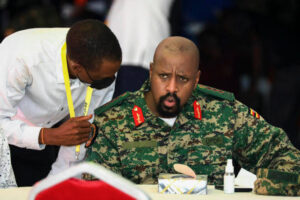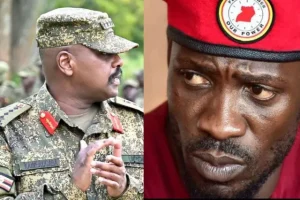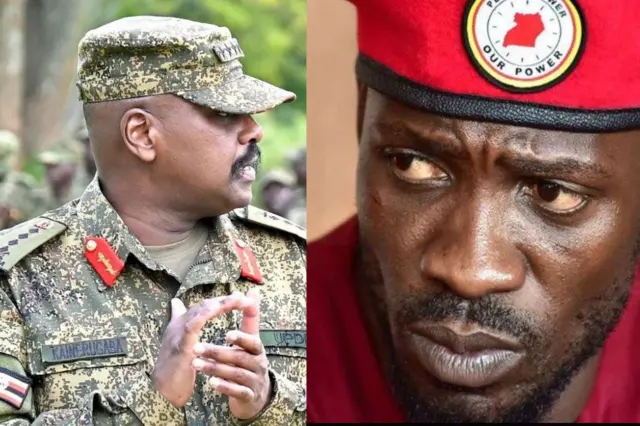
Gen. Muhoozi Kainerugaba, Commander of the Uganda People’s Defence Forces (UPDF) and son of President Yoweri Museveni, has made controversial remarks regarding opposition leader Robert Kyagulanyi, popularly known as Bobi Wine, sparking debates about Uganda’s political climate.
In a public statement, Gen. Muhoozi suggested that differing approaches exist within Uganda’s leadership concerning the opposition, noting that President Museveni has opted for a more measured strategy in dealing with political rivals.
Mzee wants to keep him Bobi Wine alive as his toy. I want to kill him as a nuisance- Says Gen Muhoozi
The general described Bobi Wine as a figure who attracts significant attention among the youth, highlighting the challenges that opposition politics present in Uganda’s evolving political landscape.
Observers note that Gen. Muhoozi’s remarks underline a generational and strategic divide within Uganda’s leadership, particularly regarding approaches to opposition engagement.
While his language was sharp, analysts stress that his comments reflect broader concerns about political management, public perception, and the influence of opposition figures in Uganda.

The Commander emphasized the importance of maintaining stability, suggesting that handling opposition politics requires balancing firmness with careful political strategy.
Gen. Muhoozi acknowledged that Bobi Wine’s popularity among urban youth presents both a challenge and a potential influence on national political dynamics.
He reiterated the need for vigilance in Uganda’s political environment, stressing that leadership must anticipate and address challenges posed by high-profile opposition figures.
The statement comes amid ongoing debates about democratic processes, electoral competition, and political dissent in Uganda.
Political analysts argue that such remarks highlight the tense relationship between Uganda’s ruling establishment and the opposition, particularly in the context of upcoming electoral cycles.
Gen. Muhoozi’s comments also drew attention to how political discourse in Uganda is often framed in terms of loyalty, influence, and control over public narratives.
Observers suggest that the general’s remarks signal the ruling party’s continued awareness of Bobi Wine’s symbolic and political significance in mobilizing youth engagement.
The UPDF’s involvement in political matters, or commentary on opposition figures, has historically been a sensitive issue, reflecting the intersection of military influence and political authority in Uganda.

Gen. Muhoozi’s remarks have sparked responses across social media, with supporters of both the ruling party and opposition engaging in discussions about political strategy and governance.
Experts caution that statements from military leaders regarding political figures can be interpreted in multiple ways, impacting public trust and international perceptions of political freedom.
While the tone of Gen. Muhoozi’s comments was confrontational, political commentators emphasize the importance of framing them within the context of political rhetoric rather than direct threats.
The statement reflects the broader challenges faced by Uganda in balancing political stability with democratic processes, particularly when high-profile opposition leaders are involved.
Analysts note that rhetoric from influential figures often serves as a signal to party members, supporters, and critics about the leadership’s strategic priorities.
Gen. Muhoozi’s remarks also underscore the enduring tension between Uganda’s ruling elite and emerging political movements that seek to reshape the national political landscape.
As political discourse continues to evolve, the statement is likely to remain a focal point in discussions about Uganda’s approach to opposition, leadership, and the management of political dissent.