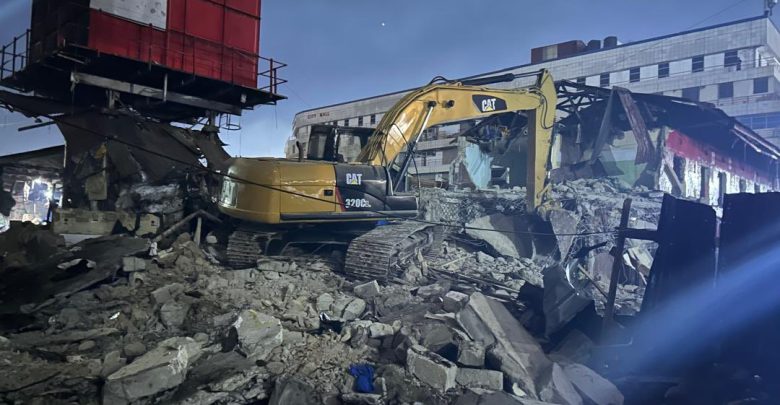
Kampala businessman Hamis Kiggundu, popularly known as Ham, has revealed that traders whose shops were demolished at St Balikuddembe Market, commonly called Owino Market, were compensated before the exercise took place.
The demolition occurred on Saturday night along Sebana Road, a few meters from the Nakivubo Channel in central Kampala.
The structures were removed as part of redevelopment works aimed at improving drainage along the Nakivubo corridor.
The demolition sparked protests from some traders who claimed that the lock-ups were their main source of livelihood.
However, Kiggundu explained that all affected occupants had been paid compensation prior to the exercise.
According to Kiggundu, a total of 48 traders operated in the demolished structure.
Each trader received Shs3 million to support relocation and movement of their merchandise before the buildings were pulled down.

“Besides the Shs3 million which we gave each person to help in relocating their merchandise, we have resolved to give each individual a lock-up in the new modern shops that we are planning to set up, without paying any rent for one year,” Kiggundu said.
Several traders confirmed receiving compensation. Robert Mukalazi, one of the affected business owners, said most of the occupants had already collected their money and were assured of receiving lock-ups in the new structure once it is completed.
“We were many, and the majority of us have already received the money. We are also assured of getting the lock-ups on the new modern structure once it’s accomplished,” Mukalazi said.
Another trader, Mahad Ssali, acknowledged that his business was affected during the demolition but confirmed that compensation had been paid.
Kiggundu defended the redevelopment project, saying it is necessary to improve drainage and sanitation along the Nakivubo Channel. He said the area had become a dumping site and a hideout for criminals, which required urgent intervention.
“Uganda, to develop regardless of political differences, needs such steps. People need to know that Nakivubo had turned into a criminal hideout and a dumping site for garbage,” he said.
The businessman added that the project would also support improvements around Nakivubo Stadium, which has faced criticism for failing to meet international standards.
Officials from the Confederation of African Football (CAF) reportedly advised that the stadium cannot meet international requirements while open drainage channels remain around it, prompting the redevelopment initiative.
Kiggundu said the redevelopment plan aims to modernize the market environment, improve sanitation, and provide traders with better facilities.
The compensation and relocation plans were designed to minimize disruption to traders’ businesses and livelihoods while ensuring compliance with urban development objectives.

Meanwhile, Kampala Capital City Authority (KCCA) clarified its position regarding the demolition. KCCA spokesperson Daniel NuweAbiine said that police had been tasked to investigate the circumstances under which the demolition occurred.
“Our trust is now in police, which is currently investigating the matter. As of now, the situation is under control,” NuweAbiine said.
KCCA had earlier criticized the demolition for being carried out without a demolition permit, calling it “reckless” and “in blatant disregard of the law.”
However, the authority confirmed that Kiggundu has an approved redevelopment plan for the Nakivubo Channel corridor, meaning the project itself is legal and authorized.
The demolition exercise and the compensation payments have sparked mixed reactions among traders and the public, with some praising the initiative and others concerned about the handling of the process.
Kiggundu emphasized that the redevelopment is part of broader efforts to improve infrastructure and create a modern business environment while maintaining fairness for traders affected by the works.
As construction of the new facilities progresses, affected traders are expected to move into the modern lock-ups and resume operations, with the aim of boosting business activity and sanitation in the central market area.