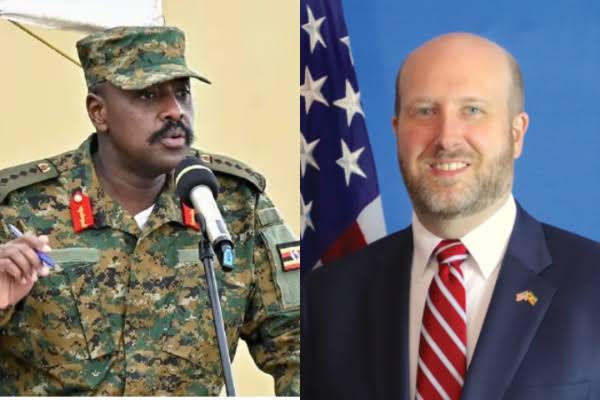
Uganda’s Chief of Defence Forces, General Muhoozi Kainerugaba, has formally apologised to the United States following a series of tweets that had raised concerns about bilateral military cooperation. The apology signals a significant move to calm diplomatic tensions between Kampala and Washington.
Gen Muhoozi’s earlier posts had accused the U.S. Embassy in Uganda of undermining military operations and even suggested, without evidence, that an opposition leader’s disappearance was coordinated with the embassy. These statements sparked immediate concern among international partners and drew widespread media attention.
In a statement posted on X on Friday morning, the CDF confirmed that he had deleted his prior posts after realizing the information he had relied on was inaccurate. “I want to apologise to our great friends the United States for my earlier tweets that I have now deleted,” he wrote.
He further explained that the misinformation had been fed to him by unreliable sources. After clarifying the facts, Gen Muhoozi held direct discussions with the U.S. Ambassador to Uganda, confirming that military relations remained intact.
“I was being fed with wrong information. I have spoken with the U.S. Ambassador to our country and everything is okay. We are going to continue our military cooperation as usual,” he added. The public apology reflects an effort to restore confidence in Uganda’s longstanding security partnerships.
The initial tweets had suggested a complete suspension of Uganda People’s Defence Forces cooperation with the U.S. mission, including joint activities related to Uganda’s role in Somalia. Such statements alarmed both domestic and international observers due to Uganda’s pivotal regional security role.
Uganda has long been one of the largest contributors to the African Union mission in Somalia (AMISOM), where U.S. support has been critical. The American partnership provides logistics, training, and intelligence assistance, essential components for regional counterterrorism and peacekeeping operations.

The controversy raised concerns that the earlier statements could have disrupted operations critical to regional stability. Analysts noted that any suspension of cooperation, even temporarily, could have far-reaching consequences for Uganda’s commitments in Somalia and its broader security obligations.
By publicly retracting his earlier statements, Gen Muhoozi reassured both domestic audiences and international partners that Uganda’s defence posture remains unchanged. His clarification highlights the government’s commitment to continuity and stability in military affairs.
The apology also underscores the importance of accurate information in public discourse. Misinformation, even when unintended, can create unnecessary panic, affect diplomatic relations, and cast doubt on strategic partnerships.
Political analysts described the move as a necessary correction, emphasizing that Gen Muhoozi’s quick engagement with the U.S. Ambassador helped prevent escalation. Direct diplomatic communication is often essential in sensitive situations to ensure misunderstandings are cleared swiftly.
Social media played a central role in the controversy. The rapid spread of Gen Muhoozi’s initial claims amplified their impact, showing how modern platforms can turn statements into international news almost instantly. This episode highlights the power — and risk — of using social media to address delicate security matters.
Ugandan officials have repeatedly emphasized that their cooperation with the United States is strategic and mutually beneficial. The apology reinforces that message and signals a return to a stable trajectory in bilateral relations.
Observers also noted that Gen Muhoozi’s apology could restore confidence among Ugandan citizens, particularly those concerned about potential disruptions to national security and regional operations. It demonstrated transparency and accountability at a high level.
Despite the controversy, neither the U.S. Embassy in Kampala nor Uganda’s Ministry of Defence had issued formal statements at the time of publication. However, the apology is widely expected to calm any diplomatic unease caused by the previous posts.

The incident reflects the delicate balance between national pride, security concerns, and international diplomacy. Leaders must weigh the urgency of responding to perceived threats against the risk of miscommunication and the broader consequences of public statements.
Many observers praised the CDF for moving quickly to correct the record. By acknowledging the error and apologizing publicly, Gen Muhoozi may have prevented further misunderstandings that could have affected military operations or strained diplomatic ties.
This episode also highlights the interconnectedness of domestic politics and international relations. Missteps in one sphere can quickly reverberate in the other, emphasizing the need for careful communication by public officials.
In the end, Gen Muhoozi’s actions demonstrate a willingness to admit mistakes and prioritize Uganda’s strategic interests over personal or political pride. His apology to the United States serves as a reminder of the importance of accountability and transparency in leadership.
For now, Uganda and the United States appear to have moved past the temporary tension. Cooperation in Somalia and other joint military initiatives is expected to continue without interruption, reaffirming the strong security partnership that has endured for years.
The swift resolution of the controversy suggests that both Uganda and the U.S. are committed to maintaining a stable, reliable relationship. In a region where security challenges are constant, such stability is crucial for national and regional peace.