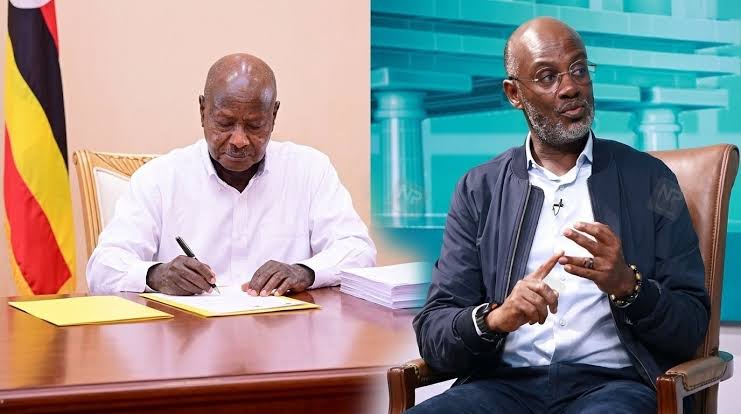
A fierce political and ideological confrontation has erupted in Uganda after Yoweri Museveni launched a blistering response against veteran journalist Andrew Mwenda following remarks that allegedly described the president as senile and incapable of making sound judgments.
In a strongly worded statement, Museveni rejected the accusations and declared that despite his age, he remains fully capable of defending both himself and Uganda. He boldly stated that at 82 years old, he still possesses the strength to fight using “the Bible, the AK-47 and the pen.”
The president accused Mwenda of behaving like a propagandist rather than a professional journalist. He questioned why Mwenda had failed to directly investigate Ugandan innovators and industrialists whom Museveni believes are transforming the country through local production and scientific advancement.
Museveni specifically pointed to individuals such as Magoola, Senfuka, Tugume, and Professor Muranga, urging Mwenda to visit their factories, farms, and projects instead of dismissing them publicly. According to the president, these innovators represent the future of Uganda’s economic independence.

One of Museveni’s strongest attacks focused on Kiira Motors Corporation, which he described as a symbol of African industrial progress and a source of embarrassment for what he called neo-colonial agents. He accused Mwenda and like-minded critics of deliberately avoiding discussions about the project because it contradicts their negative narrative about Uganda’s capabilities.
The Ugandan leader argued that critics who constantly attack government industrial projects fail to appreciate the importance of adding value to African raw materials. According to Museveni, Uganda can never achieve true economic liberation while remaining dependent on exporting unprocessed products.
To emphasize his argument, Museveni cited the difference between exporting raw gold and refined gold. He explained that Africa loses enormous amounts of money by exporting minerals before refining them locally, calling the practice a continuation of colonial economic exploitation.
He also highlighted the coffee sector, noting that raw coffee exports earn Uganda significantly less than processed coffee products sold internationally. To Museveni, industrialization and value addition remain essential pillars of Uganda’s long-term prosperity.
The president proudly defended his government’s decision to ban the export of unprocessed minerals, revealing that Uganda now hosts multiple gold refineries and has significantly increased export earnings from refined products.
Museveni further criticized Mwenda for allegedly ignoring government poverty eradication initiatives such as the Parish Development Model and other economic empowerment funds aimed at helping ordinary citizens improve household incomes.

According to Museveni, these programs have already contributed to major agricultural growth across Uganda, especially in the coffee sector where production reportedly rose from three million bags to nearly nine million bags annually.
The president accused Mwenda of attempting to discourage national development efforts by publicly attacking government programs instead of helping improve them. He argued that patriotism requires constructive engagement rather than constant negativity.
Museveni also claimed that some individuals are uncomfortable with Uganda’s growing economy because they prefer maintaining foreign dependence and neo-colonial structures that benefit external interests over African self-reliance.
The longtime leader accused Mwenda of deliberately leaking internal government discussions and cabinet matters to social media in order to scare away investors and development partners. He suggested that such behavior harms Uganda’s international reputation.
In another explosive claim, Museveni linked Mwenda to past controversies surrounding Uganda’s electricity sector, accusing him and others of sabotaging the Bujagali hydropower project during negotiations with AES in the early 2000s.
Using a traditional proverb, Museveni dismissed his critics by saying the curses of a chicken cannot kill a kite. The statement symbolized his confidence that opposition voices cannot derail Uganda’s development agenda.

The president went on to list several industries he believes have flourished despite criticism, including dairy farming, palm oil production, fruit processing, steel manufacturing, coffee growing, and banana farming across various regions of Uganda.
According to Museveni, critics like Mwenda consistently oppose industrialization projects but later benefit from the same economic transformation they once condemned. He insisted that Uganda’s progress has continued despite persistent resistance.
The veteran leader also reflected on his history as a freedom fighter, saying that persistence and learning from failure are key ingredients for national success. He recalled failed attacks during the liberation struggle, emphasizing that setbacks should inspire determination rather than surrender.
Concluding his remarks, Museveni compared Uganda’s industrial journey to a child learning how to walk. He argued that patriots encourage progress even after mistakes, while ill-wishers mock every failure. In his view, Uganda must continue pursuing industrial transformation regardless of criticism from opponents and skeptics.