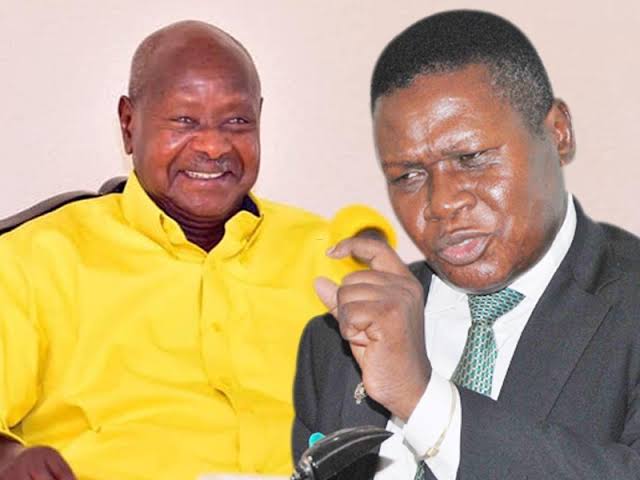
Democratic Party Vice President has intensified criticism against his party president , accusing him of weakening the Democratic Party through personal political decisions and controversial cooperation with the ruling National Resistance Movement.
Mbidde’s latest remarks have once again exposed deepening divisions within Uganda’s oldest political party as disagreements over the NRM-DP cooperation agreement continue to create tension among party members.
Speaking openly about the current state of the Democratic Party, Mbidde claimed that President has strategically absorbed influential opposition figures from different political parties in order to strengthen the ruling establishment.
Using a mechanical metaphor that quickly attracted public attention, Mbidde said the NRM takes “people from different places to solve its problems,” arguing that several opposition parties have gradually lost important members to the ruling system.

According to him, parties such as the Uganda People’s Congress and the National Unity Platform have already lost “limbs” to the NRM, referring to influential individuals and supporters who crossed political lines.
However, Mbidde argued that the Democratic Party suffered an even greater loss because, in his words, Museveni “took the engine,” referring directly to Norbert Mao and his cooperation with government.
The outspoken DP vice president suggested that Mao represented the party’s political driving force and that his move into government significantly weakened the Democratic Party’s identity and influence.
Mbidde further claimed that despite taking DP’s “engine,” the ruling establishment has not meaningfully used or empowered the party within the cooperation arrangement.
“He is not using it, he has nowhere to put it,” Mbidde stated, a remark many interpreted as criticism of both the government and Mao’s current political standing.
The comments come amid growing frustration among sections of the Democratic Party over the cooperation agreement signed between Mao and the ruling NRM in 2022.
At the time, the agreement generated major political controversy because many opposition supporters believed it compromised DP’s independence and weakened opposition unity.
Mao later accepted appointment as Minister for Justice and Constitutional Affairs, a move that intensified accusations from critics who claimed the cooperation deal mainly benefited individuals rather than the party institution.
Mbidde revealed that many DP members initially supported the cooperation arrangement because they believed it would help push important constitutional and electoral reforms in Uganda.
According to him, the party hoped the agreement would lead to stronger protection of human rights, improvements in governance, and reforms to create a more credible and independent Electoral Commission.
However, Mbidde now argues that those expectations have not been fulfilled and that the Democratic Party has instead emerged weaker, divided, and politically isolated.
He accused Mao of making major party decisions without adequate consultation, saying centralized leadership had left many DP members frustrated and sidelined.
The DP vice president warned that the party risks further political decline if it continues operating under what he described as personal political arrangements rather than collective party structures.
He also hinted at plans to chart a new political direction for the Democratic Party as internal resistance against Mao’s leadership continues to grow ahead of the next election cycle.
Political analysts say the growing disagreements within DP reflect broader struggles facing traditional opposition parties trying to remain relevant in Uganda’s changing political environment.
Some observers believe the cooperation agreement fundamentally changed public perception of the Democratic Party, especially among younger opposition supporters who viewed the move as political betrayal.
Others argue that Mao’s decision was strategic and aimed at influencing reform from within government rather than remaining permanently in opposition.

Supporters of Mao maintain that engagement with government institutions can create opportunities for dialogue, legal reforms, and national stability if handled properly.
Critics, however, insist that the agreement weakened opposition solidarity while delivering very few visible political gains for DP supporters and the wider reform agenda.
The latest comments by Mbidde have therefore reignited debate about the future of the Democratic Party and whether it can rebuild internal unity before the next major political contest.
As internal tensions continue rising, many political observers are now closely watching whether the disagreements between Mbidde and Mao will lead to major restructuring, defections, or a wider rebellion within the party.