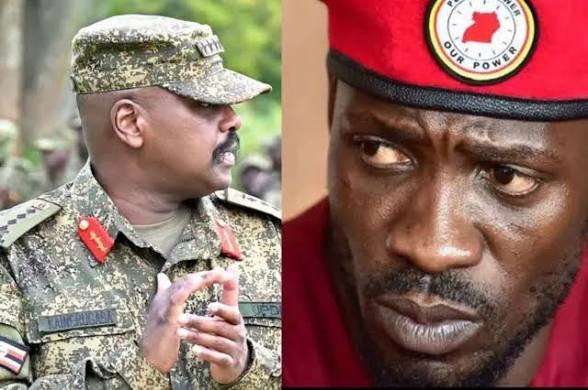
Chief of Defence Forces Gen Muhoozi Kainerugaba has once again stirred debate on social media after making fresh remarks about opposition leader , popularly known as Bobi Wine.
In a post shared on X, formerly Twitter, Gen Muhoozi appeared to mix humor, sarcasm, and political rivalry in comments that quickly attracted widespread public attention across Uganda.
The General stated that he “missed” Bobi Wine and wanted him to return, wording the message in a controversial manner that immediately sparked heated reactions online.
His comments rapidly spread across social media platforms, with screenshots being shared widely by both supporters and critics.

Many users interpreted the remarks as another chapter in the long-running public exchanges between the two influential figures who have often clashed politically over the years.
Bobi Wine, whose real name is Robert Kyagulanyi, remains one of Uganda’s most recognizable opposition leaders and has consistently criticized the government and security establishment on issues of governance, democracy, and human rights.
Gen Muhoozi, on the other hand, has increasingly become a dominant voice on social media, frequently commenting on political matters and responding directly to critics and opponents.
The latest statement stood out because of its unusual tone, blending mockery with what some users described as playful political provocation.
Supporters of Gen Muhoozi defended the remarks as satire and banter aimed at political rivals, arguing that the General often uses humor and exaggerated language online.
However, critics argued that some parts of the statement were inappropriate and risked normalizing aggressive or insensitive expressions in political communication.

Several commentators noted that the exchange reflects how political rivalries in Uganda are increasingly being fought through social media posts rather than traditional political platforms.
The remarks also reignited discussion about the strained relationship between the ruling establishment and opposition movements in Uganda.
Some online users viewed the statement as an indication that Bobi Wine remains politically significant and influential enough to continue drawing attention even when outside the country.
Others argued that repeated references to opposition figures by senior state officials show the extent to which Uganda’s political environment remains deeply polarized.
Political analysts noted that Gen Muhoozi’s online presence has become a major talking point in Uganda’s political discourse due to his blunt language and unpredictable style of communication.
The latest comments generated mixed reactions, with some people laughing at the wording while others expressed discomfort with the nature of the comparison used in the statement.
Human rights advocates and critics of inflammatory rhetoric cautioned that leaders and public officials should communicate carefully, especially when their words can influence public attitudes and national conversations.
Meanwhile, supporters of Bobi Wine used the moment to criticize what they described as unnecessary obsession with opposition figures by members of the ruling establishment.

Others simply saw the exchange as part of the continuing political theater that increasingly dominates Ugandan social media discussions.
The statement once again demonstrated the enormous influence social media now holds in shaping political narratives, controversies, and public debate in Uganda.
For many observers, the incident highlighted how political communication has evolved into a mix of entertainment, confrontation, sarcasm, and ideological competition.
As reactions continue to pour in from different corners of the political divide, the remarks have once again placed both Gen Muhoozi and Bobi Wine at the center of Uganda’s online political conversation.