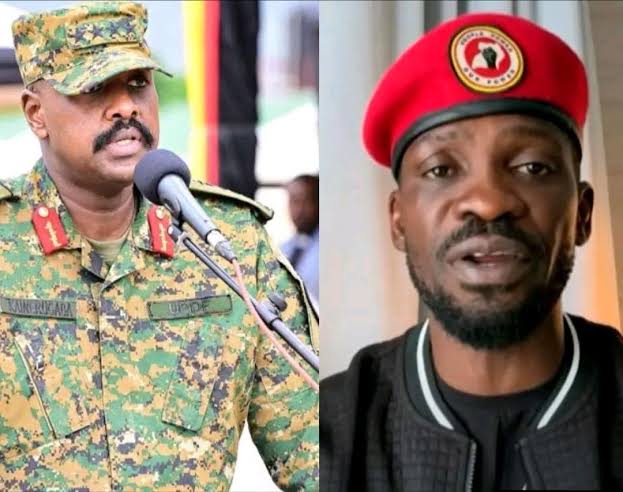
National Unity Platform (NUP) president Robert Kyagulanyi, widely known as Bobi Wine, has once again underscored his unwavering commitment to his political mission in Uganda, insisting that any return to his home country must occur under conditions of freedom and dignity.
In a recent interview, Bobi Wine stressed that while his party remains open to dialogue, neither his personal liberty nor the legitimacy of NUP is negotiable.
His statements come amid growing reports of behind-the-scenes engagements between the opposition party and the Ugandan government.
Asked about alleged mediation by the United States Ambassador to Uganda, William Popp, Bobi Wine maintained a cautious stance.
He neither confirmed nor denied the existence of these discussions but emphasized that any engagement must be principled rather than transactional.
“First and foremost, I am not going to negotiate my freedom. My freedom must be guaranteed,” Bobi Wine told reporters, highlighting the importance of personal liberty as a non-negotiable condition for political dialogue.
The opposition leader further clarified that NUP’s legitimacy as a political party is grounded in law and cannot be subjected to bargaining. “We don’t [need] any negotiation for our party to be officially recognised. The law is the law, and according to Ugandan and international law, we are a legitimate political party,” he said.

Observers interpret these remarks as a clear message: dialogue is possible, but it must respect legality, rights, and mutual respect, rather than serve as a transactional tool for political compromise.
Recent developments, including the withdrawal of security personnel from Bobi Wine’s home in Magere and the release on bail of some NUP supporters, have fueled speculation that quiet discussions between the government and the opposition may be ongoing.
Despite this speculation, Bobi Wine emphasized that dialogue must not undermine the principles of freedom and dignity. He drew a firm line against any engagement that could be perceived as coercive or manipulative.
“We have never been disagreeable to dialogue. We are for dialogue, but we don’t believe in transactional dialogue. We believe in constructive and principled dialogue,” he stated, reinforcing the party’s commitment to ethical political engagement.
The opposition leader also addressed concerns about his return to Uganda amid sustained political hostility, including tensions with President Museveni’s son, Gen. Muhoozi Kainerugaba. Bobi Wine confirmed that he intends to return to Uganda to continue his work.
“Absolutely I intend to go back to my country. My fight, my work is in Uganda. My citizenship is in Uganda,” he said, emphasizing that his political mission is inseparable from his presence in the country.
However, he reiterated that any return must be on his own terms—as a free citizen, not someone who must plead or negotiate for liberty. “I must be in Uganda as a free citizen, not someone who must beg for his freedom,” he emphasized.
Political analysts note that Bobi Wine’s statements strike a delicate balance: showing openness to dialogue while asserting non-negotiable principles that protect both personal and party rights.
Supporters of the opposition view the comments as a reaffirmation of Bobi Wine’s consistent stance on principled politics, reinforcing his image as a leader who prioritizes legality and human rights.

Critics, however, may interpret his measured openness as an acknowledgment that some engagement behind the scenes could be underway, even if it is not formally recognized.
The France 24 interview adds nuance to Uganda’s tense political climate, suggesting that while the standoff between the government and opposition continues, avenues for dialogue may exist if approached on fair and lawful terms.
Observers emphasize that the distinction Bobi Wine draws between transactional and principled dialogue is significant. Transactional dialogue, in his view, risks undermining legitimacy, whereas principled engagement strengthens governance and political accountability.
Bobi Wine’s insistence on freedom as a precondition for return underscores the ongoing challenges faced by opposition leaders in Uganda, where political participation often occurs under intense scrutiny and pressure.
Analysts suggest that his remarks may also be strategic, signaling to both domestic and international audiences that any negotiation must respect the rule of law and the rights of citizens.
As Uganda navigates its political landscape, Bobi Wine’s position serves as a reminder that dialogue, while necessary, must not come at the cost of fundamental freedoms or democratic principles.
Whether this marks the beginning of a more constructive phase in opposition-government relations or remains a firm assertion of principle, Bobi Wine’s statements clarify that any engagement will occur only under conditions of freedom, dignity, and mutual respect.