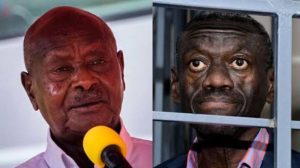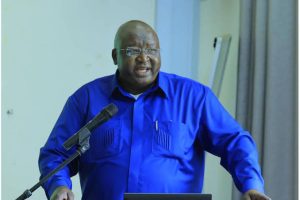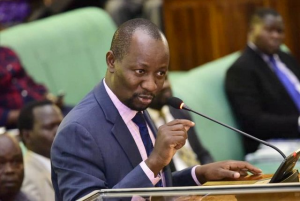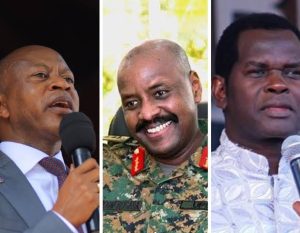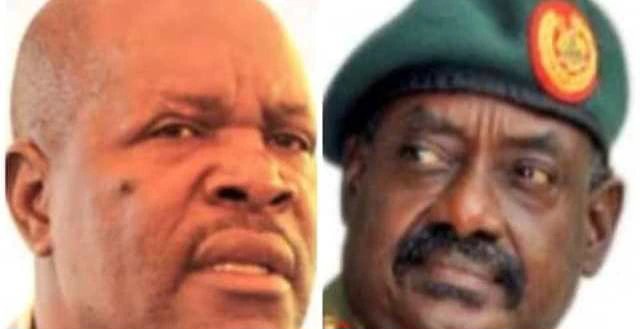
Former intelligence chief General David Sejusa and political commentator Ofwono Opondo have been engaged in a heated public exchange over the contest for the Ugandan parliament speakership. The argument centers on whether Norbert Mao or incumbent Anita Annet Among is better suited for the role.
Norbert Mao, MP-elect for Laroo-Pece and the Democratic Party president, has announced his bid to unseat Anita Among, the Bukedea District Woman MP.
Mao’s candidacy has sparked debate across Uganda’s political circles.Ofwono Opondo, the MP-elect representing older persons in eastern Uganda, has expressed full support for Anita Among.
He has dismissed Mao’s candidacy as irrelevant, claiming the speakership should remain with the incumbent.In contrast, Gen Sejusa has defended Mao’s bid, warning that underestimating the Democratic Party leader would be a mistake. He emphasizes that Mao brings unique political and regional dynamics to the race.
“This speakership contest is something I have avoided talking about,” Sejusa wrote on X. “Mainly because it’s a debate about personalities, not ideology or political philosophy.
But Mao brings in a new dimension that many, including Opondo, fail to see.”Sejusa highlights two major factors that make Mao’s candidacy significant: the opposition constituency he commands and the Northern Uganda regional factor.

He argues that these make Mao a more complex and influential contender than his critics admit.Regarding the opposition factor, Sejusa says Mao’s entry could help consolidate or manipulate opposition influence to the advantage of the ruling NRM-O.
He notes that Mao’s presence may attract opposition votes in a way that Anita Among, already aligned with NRM-O, cannot.“Who will help NRM-O dismantle opposition influence more effectively: the one already inside or the one coming in from the outside with a chunk of opposition?”
Sejusa asked, highlighting the strategic advantage Mao could offer.On the Northern Uganda factor, Sejusa stresses the importance of regional balance in Uganda’s leadership. He notes that most senior positions are already held by people from the West and East, leaving the North underrepresented.
“The second equation is regional balance. Those dismissing Mao’s candidature are poor students of Ugandan history and political algebra,” Sejusa wrote. “Who now represents the North? Gen Moses Ali? Regional balance matters.”Opondo responded to Sejusa with a sharp rebuttal, questioning Mao’s ability to bring a significant constituency beyond NRM or Museveni’s influence.
He also recalled Sejusa’s controversial past, including his 1997/98 attempt to leave the UPDF.Sejusa fired back, telling Opondo: “Go slow on my affairs, my friend. Yesterday’s UPC needs to be humble!” He reminded Opondo of his past achievements as a top general and State House speaker.
Opondo, not taking the jibe lightly, told Sejusa that his historical arrogance no longer has relevance in Uganda today. “Your brazen arrogance of 30 years ago has no place in modern Uganda,” Opondo wrote.Sejusa maintained his assertive stance, asserting that Opondo cannot fully grasp his past experience or political insight.
“After all that you quote, I gave a speech in State House as a top General; fathom the meaning of that? Of course, you can’t!” he said.Observers note that the exchange blends historical grievances with contemporary politics, reflecting long-standing tensions among Uganda’s political elites.

Norbert Mao, meanwhile, insists that Anita Among’s speakership was accidental, invoking the legacy of late Speaker Jacob Oulanyah in his campaign. Mao’s candidacy remains a subject of national interest.
Rumors have circulated that President Museveni is considering Mao for a future vice-presidential role, adding another layer of intrigue to the speakership contest.
Sejusa has also been active in proposing constitutional reforms, including a recommendation that the president-elect be sworn in within a week of results, reflecting his continued involvement in Uganda’s political discourse.
Analysts suggest that the Sejusa-Opondo exchange underscores a mix of personal history, political strategy, and regional considerations in Uganda’s leadership contests.
As the speakership race unfolds, all eyes remain on Mao, Among, and the strategic maneuvers of political veterans like Sejusa and Opondo.
The public debate highlights that Uganda’s political battles are shaped as much by personality, history, and strategic thinking as by party lines or ideology.
Ultimately, the Sejusa-Opondo confrontation illustrates how Uganda’s political landscape continues to evolve, with emerging leaders, historical figures, and regional dynamics all influencing key decisions like the parliamentary speakership.