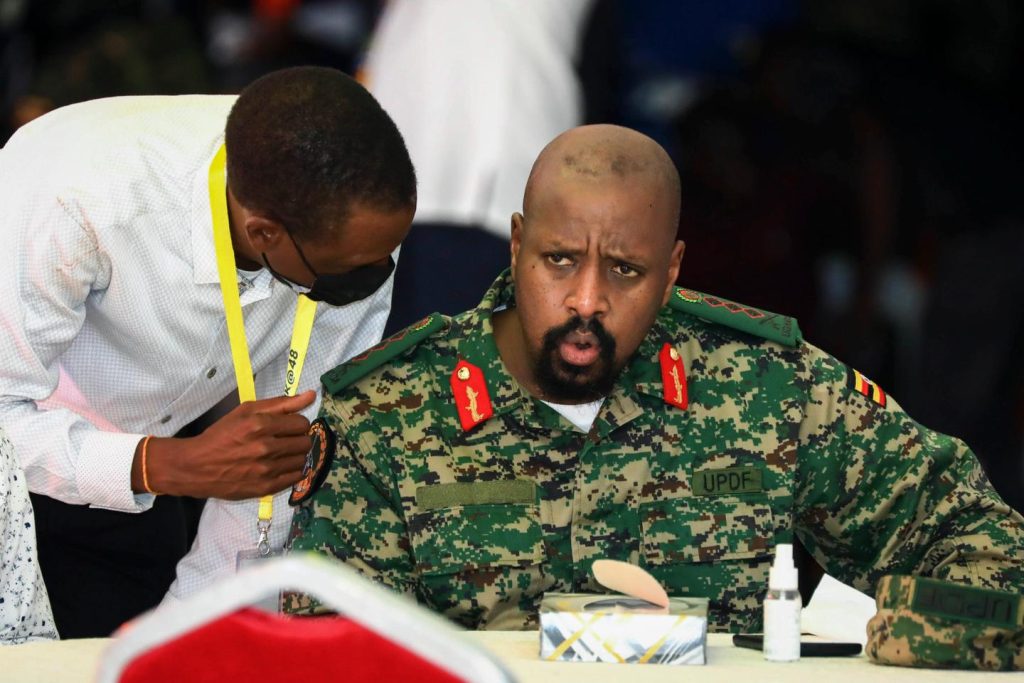
Chief of Defence Forces Muhoozi Kainerugaba has once again sparked political discussion after declaring that members of the Patriotic League of Uganda (PLU) are not driven by the desire for government jobs but are instead committed to transforming the country and improving the lives of citizens.
Muhoozi made the remarks in response to ongoing public debate surrounding Cabinet appointments and expectations that several PLU members would receive ministerial positions in President Yoweri Museveni’s newly announced government.
“In PLU, we do not look for government jobs. Our primary interest is the transformation of our country and people,” Muhoozi stated, a message that quickly gained attention across political circles and social media platforms.
His comments appear aimed at redefining the image and mission of the Patriotic League of Uganda by presenting the movement as one focused on national service, patriotism, and long-term transformation rather than personal political gain.

The Patriotic League of Uganda has in recent years emerged as one of the country’s most visible political and mobilization groups, especially among young people who have increasingly participated in its nationwide activities and campaigns.
PLU supporters have often described the movement as a platform intended to inspire patriotism, youth empowerment, national unity, and social transformation through active citizen engagement and leadership development.
Muhoozi’s latest statement comes shortly after discussions emerged online questioning why some prominent PLU figures were not included in the new Cabinet despite their growing public influence and political visibility.
The army commander’s comments therefore appeared intended to dismiss suggestions that the movement’s primary goal is securing government appointments for its members.
Political analysts say the statement could also be interpreted as an attempt to position PLU as a broader ideological and mobilization force rather than simply another political grouping seeking access to state power.
Over the past few years, Muhoozi has repeatedly used public platforms to emphasize themes of patriotism, youth involvement, discipline, national unity, and social transformation through collective action.

His remarks have helped expand PLU’s visibility, particularly among younger Ugandans who see the movement as representing a new style of political engagement centered on activism and organization.
Supporters of PLU argue that meaningful national transformation cannot be achieved solely through ministerial positions but requires organized mobilization, ideological commitment, and direct engagement with communities across the country.
Some members of the movement have consistently maintained that their activities are intended to complement national development efforts rather than compete for traditional political offices.
Critics, however, remain skeptical and argue that the increasing political visibility of PLU and its leaders inevitably places the organization within Uganda’s broader political succession discussions.
Muhoozi’s growing political influence has continued attracting national attention because of his frequent public statements on governance, youth leadership, patriotism, and Uganda’s political future.
His latest comments have therefore fueled further debate about the long-term direction and ambitions of the Patriotic League of Uganda within the country’s evolving political environment.

Observers note that by distancing PLU from the pursuit of government jobs, Muhoozi may be attempting to strengthen the movement’s image as a grassroots national platform focused on service rather than political reward.
The statement also reflects ongoing efforts by PLU leaders to present the organization as a people-centered movement concerned with solving social and economic challenges affecting ordinary Ugandans.
For many of Muhoozi’s supporters, the remarks reinforce the belief that patriotism and transformation should take precedence over personal political ambition and competition for government positions.
As discussions continue across Uganda’s political landscape, Muhoozi’s message has once again highlighted the growing influence of youth mobilization movements and their potential role in shaping the country’s future political direction.