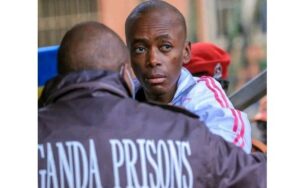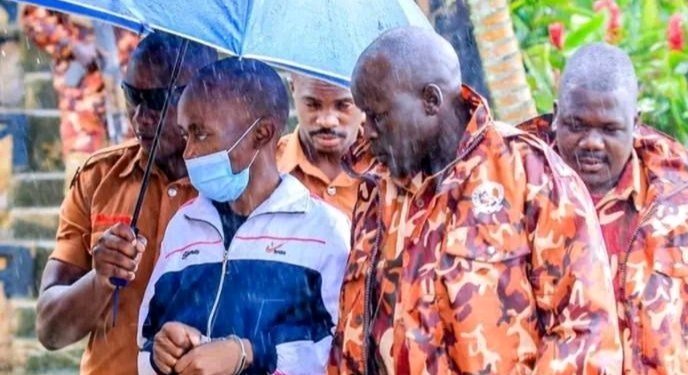
In a dramatic turn of events in the ongoing trial for the Ggaba school murders, Christopher Okello Onyum, the suspect accused of killing four toddlers at Ggaba Early Childhood Development Centre, has made a bold request to the court. Onyum has asked the court to summon doctors from Butabika National Referral Hospital to testify about his mental health history, claiming that he may not have been mentally fit at the time of the murders.
This demand for a mental health inquiry is central to Onyum’s defense strategy, as he attempts to argue that he was not in full control of his actions when he allegedly carried out the brutal killings.
Okello, who has pleaded not guilty to the charges of murder, filed his request during the ongoing mobile High Court session at Ggaba Community Church grounds. The case, which has shocked the nation, revolves around the events of April 2, when Okello allegedly entered the daycare center under the pretext of paying school fees for his child, only to later attack the children with knives, killing four and injuring several others.
Okello’s defense team has been working to present a case that could explain his actions, and now, they are leaning heavily on the argument that his mental health may have played a significant role in the tragedy.

The defense introduced the issue of Okello’s mental health through testimony from his elder brother, who claimed that Okello had been admitted to Butabika Hospital in January 2020. The brother, whose identity and residence were kept confidential on the orders of the court, explained that he had learned of Okello’s hospitalization after an unspecified incident.
The witness told the court that he had been searching for his brother since December 2019 and, upon inquiring at Butabika, discovered that Okello had been admitted there, though he was not given any details about the reason for his hospitalization.
“When I followed up at Butabika, I learned that he had been admitted there following an incident that had happened,” the brother testified. He added that despite his attempts to identify himself as Okello’s relative, the hospital staff refused to provide any further details regarding his brother’s condition. This revelation has added an intriguing layer to Okello’s defense, with his legal team now arguing that there may be a history of mental health issues that could have impacted his capacity to commit the crimes he is accused of.
In response to this testimony, Okello’s defense lawyer, Richard Kumbuga, filed an application requesting that the court order Butabika’s medical staff to testify about Okello’s mental health. Kumbuga argued that the court needed to conduct an inquiry into Okello’s mental condition, particularly to determine whether he had been treated at Butabika for mental health issues and whether he was mentally fit to stand trial.
“There should be an inquiry about the health status of the accused person. The doctors should tell this court whether it is true that the accused has even been in this hospital for people with mental challenges,” Kumbuga said. He further emphasized that the hospital’s records could provide crucial information about Okello’s mental health history and whether his condition might have impaired his ability to understand the charges against him or participate in his defense.
The defense team’s request to summon doctors from Butabika is a critical part of their strategy to introduce the possibility of an insanity defense. If the court agrees to the application, the Butabika doctors could testify to Okello’s mental state, potentially influencing the outcome of the case. This could help establish that Okello was not fully aware of the consequences of his actions at the time of the murders or that he was suffering from a mental health condition that made him unable to control his behavior.

This could either lead to a reduction in the severity of his charges or a different legal outcome altogether, such as an acquittal on the grounds of mental incapacity.
However, the prosecution has vehemently opposed this request, arguing that it was raised too late in the trial. According to the prosecution, the application for a mental health inquiry should have been filed earlier, particularly before the defense started presenting its case. The prosecution reminded the court that at the start of the trial, Okello had clearly stated that he understood the charges against him and had entered a plea of not guilty, which they argued indicated that he was mentally fit to stand trial and defend himself.
The prosecution also pointed out that Okello had not raised the issue of his mental health at the outset of the trial, and now, after already presenting part of his defense, it was too late to introduce this argument.
“The section cited is about the capacity of the accused to stand trial or give his defense. An application under this section should be brought before and not after the defense has started giving their defense,” the prosecution argued.
They also stressed that Okello’s prior plea and his ability to follow proceedings indicated that he had the mental capacity to understand what was happening and participate in his defense, further weakening the defense’s argument that he had been mentally unfit at the time of the murders.
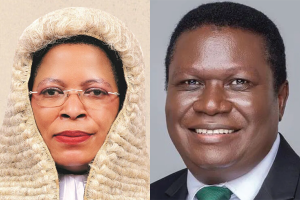
The objection from the prosecution has thrown a wrench into Okello’s defense strategy, and it remains to be seen whether the court will agree to the late application. Justice Alice Komuhangi Khaukha, who is presiding over the trial, has not yet ruled on whether Butabika doctors will be summoned to testify, leaving the matter in suspense. If the court decides not to allow the application, it could severely limit the defense’s ability to present a mental health argument. Conversely, if the court agrees to the request, it could significantly alter the course of the trial and introduce new evidence that may influence the outcome.

The ongoing trial has garnered widespread attention, and this latest development is sure to keep the public and legal community on edge. The Ggaba school murders, which have left the nation in shock, are among the most high-profile criminal cases in Uganda this year. The request for a mental health inquiry adds a new layer of complexity to an already emotionally charged case, as the nation grapples with the tragic loss of young lives and the question of whether Okello’s actions were the result of a mental health condition or whether he is simply guilty of premeditated murder.
For the families of the victims, the trial has been an emotional rollercoaster, with each new development bringing a mix of hope and frustration. The idea that the man who killed their children might have been suffering from mental health issues is difficult to accept, but it also raises important questions about the extent of Okello’s responsibility for his actions. The families are seeking justice for their children, and they are watching closely to see how the court will handle the issue of Okello’s mental state.
As the case continues, both the defense and prosecution will have to navigate this new challenge. The decision on whether Butabika doctors will testify is just one of many obstacles that Okello’s legal team must overcome in their quest for a lighter sentence or acquittal. The court’s ruling on this issue will set a precedent for how mental health defenses are handled in high-profile murder cases in Uganda, and it could have significant implications for future cases involving similar arguments.
Ultimately, the question of Okello’s mental fitness to stand trial will likely play a central role in determining the outcome of this case. Whether he is found guilty or acquitted on the grounds of mental incapacity, the trial will be remembered as a pivotal moment in the ongoing conversation about the intersection of mental health and criminal responsibility in Uganda’s legal system.