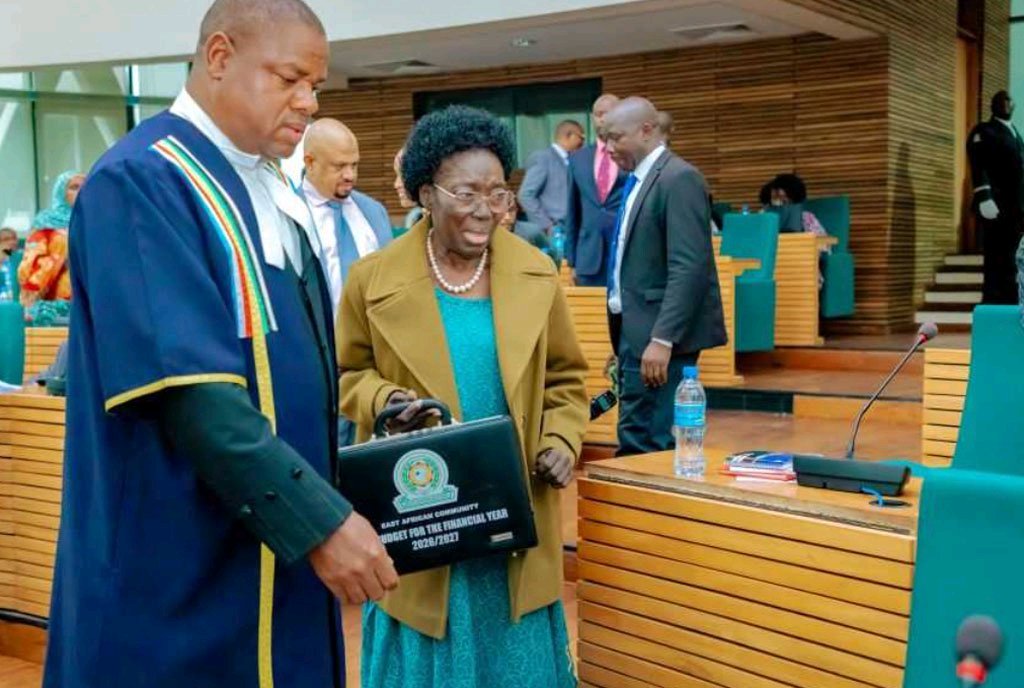
The East African Community (EAC) has presented a $110 million (about Shs410 billion) budget for the 2026/2027 financial year, outlining an ambitious regional agenda focused on deepening integration, boosting trade, and strengthening institutional capacity across member states. The budget was tabled in Arusha, Tanzania, before the East African Legislative Assembly by Rebecca Kadaga, in her capacity as Chairperson of the EAC Council of Ministers.
The financial plan comes at the beginning of the bloc’s Seventh Development Strategy (2026/27–2030/31), which seeks to accelerate regional cooperation and enhance economic self-reliance. Kadaga noted that the new framework introduces reforms aimed at improving funding sustainability and ensuring that partner states take greater ownership of integration programmes under the East African Community.
Economic indicators presented alongside the budget showed that the region recorded 5.8 percent growth in 2025, surpassing global and continental averages. Intra-regional trade expanded by 28 percent to $19.3 billion, while total external trade rose to $156.6 billion. Export performance also strengthened significantly, helping reduce the regional trade deficit from $13 billion to $2.6 billion within a year.The EAC reported major progress in addressing trade bottlenecks, with 35 non-tariff barriers resolved across partner states. A key innovation introduced was the EAC Customs Bond, a digital financial guarantee system designed to simplify cross-border trade procedures and enhance efficiency for businesses operating within the common market.
On political cooperation and governance, the bloc said consultations are ongoing toward the development of a proposed East African Political Confederation Constitution. The EAC also continued its involvement in peace and security initiatives, particularly in eastern Democratic Republic of Congo, while deploying election observation missions to support democratic processes across the region.Beyond governance, the integration agenda extended into tourism, health, and innovation. The bloc launched a regional tourism campaign branded “Visit East Africa – Feel the Vibe,” aimed at positioning the region as a single destination.
In health, nine centres of excellence trained hundreds of postgraduate students and thousands of medical professionals, while over 12,500 patients benefited from specialised care including advanced procedures.Infrastructure development remained a central pillar, with ongoing progress in road networks, border post modernization, and railway expansion. The East African Crude Oil Pipeline surpassed 80 percent completion, and funding was secured for feasibility studies of the 39MW Nsongezi Hydropower Project along the Uganda–Tanzania corridor, reflecting continued investment in regional energy and connectivity.Budget allocations also revealed key institutional funding priorities, with $59.8 million directed to the EAC Secretariat, $19.2 million to the East African Legislative Assembly, and $5 million to the East African Court of Justice.
Other regional bodies, including research, education, health, and environmental institutions, also received allocations. Kadaga reaffirmed that the budget is designed to strengthen trade, industrial growth, infrastructure, peace, and institutional resilience, with the ultimate goal of delivering broader prosperity for East African citizens.