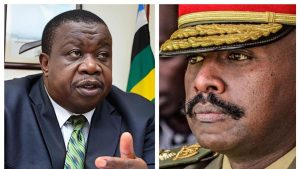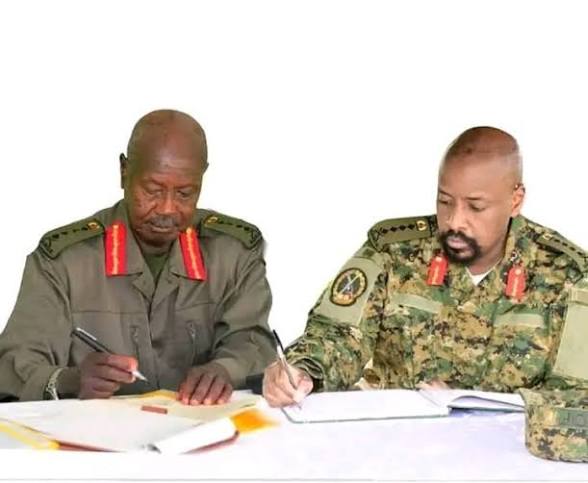
Gen Muhoozi Kainerugaba has once again stirred national conversation after making a bold statement regarding Uganda’s foreign policy, asserting that only President Yoweri Museveni and himself play a decisive role in shaping the country’s international relations.
The remarks, shared through his preferred communication channels, immediately attracted widespread attention from political observers, diplomats, and members of the public.
He argued that the country’s diplomatic direction is ultimately determined by a small circle led by President Museveni, whom he described as the principal architect of Uganda’s engagement with the international community.
The outspoken military officer emphasized the central role his father has played in shaping Uganda’s foreign policy over the decades.

According to Muhoozi, President Museveni’s experience, regional influence, and long-standing relationships with leaders across Africa and beyond have made him the dominant voice in matters concerning diplomacy and international cooperation.
Muhoozi went further by claiming that he also plays a significant role in the country’s external engagements. He implied that his growing involvement in regional and international affairs has positioned him as one of the key figures influencing Uganda’s diplomatic priorities and strategic partnerships.
The statement quickly generated mixed reactions among Ugandans, with supporters praising Muhoozi for what they viewed as honesty about how major decisions are made within government.
Others interpreted his remarks as evidence of his increasing confidence and visibility on issues that traditionally fall within the mandate of established state institutions.
Political analysts noted that the comments are likely to reignite debate about the concentration of power in Uganda’s governance structures.
Some observers argued that foreign policy is ordinarily developed through consultation among multiple institutions, including the Ministry of Foreign Affairs, Cabinet, Parliament, and diplomatic missions abroad.

Others pointed out that Uganda’s foreign policy framework is officially guided by national interests and implemented through various government agencies.
They contend that while the President undoubtedly holds significant influence, diplomacy remains a collective responsibility involving several actors within the state.
The remarks also attracted attention because of Muhoozi’s growing profile in regional politics. In recent years, he has frequently commented on international affairs, held meetings with foreign leaders, and engaged in diplomatic initiatives that have often generated public interest and media coverage.
Supporters of the General argue that his involvement in regional diplomacy has at times helped strengthen Uganda’s relations with neighboring countries.
They cite instances where his engagements appeared to contribute to easing tensions and fostering dialogue between governments.
Critics, however, have questioned whether such statements risk overshadowing formal diplomatic channels. Some believe that foreign relations are most effective when conducted through established institutions rather than through individual personalities, regardless of their influence or status.
The latest declaration comes at a time when Uganda continues to pursue strategic partnerships aimed at boosting trade, security cooperation, infrastructure development, and regional integration. These priorities remain central to the country’s interactions with both African nations and global partners.
Observers note that Uganda occupies an important position within the East African region and regularly participates in initiatives focused on peace, economic growth, and cross-border cooperation. As a result, decisions concerning foreign policy carry significant implications for the country’s future development.
Muhoozi’s comments have also fueled renewed speculation about his political ambitions and future role in national leadership. For years, discussions about his potential political trajectory have remained a recurring topic within Uganda’s political landscape.
Although he did not elaborate on specific policy decisions in his statement, his remarks appeared designed to underscore his belief that he occupies a prominent place in Uganda’s strategic decision-making process. This perception has continued to shape public discourse around his influence.
Several commentators observed that the statement reflects the confidence with which Muhoozi increasingly addresses matters of national importance. His public interventions frequently attract attention because they often touch on sensitive political, security, and diplomatic issues.
Meanwhile, some diplomats and governance experts have urged caution in interpreting the remarks literally, emphasizing that statecraft typically involves broad consultation and institutional processes. They argue that successful foreign policy depends on coordination among multiple stakeholders.

Others believe the comments were intended more as a political message than a technical explanation of how foreign policy is formulated. In their view, the statement serves to reinforce Muhoozi’s image as a key player within Uganda’s current power structure.
The debate generated by his remarks highlights the enduring public interest in questions surrounding leadership, succession, and decision-making within government. It also reflects the influence that high-profile statements can have on political conversations both inside and outside the country.
As discussions continue, attention is likely to remain focused on how Uganda balances strong executive leadership with institutional governance in managing its international relations. The country’s diplomatic agenda remains crucial to its economic and security objectives.
Whether viewed as a declaration of influence, a political signal, or a reflection of existing realities within government, Muhoozi’s statement has once again succeeded in placing him at the center of national debate, reinforcing his status as one of the most closely watched figures in Uganda’s contemporary political landscape.