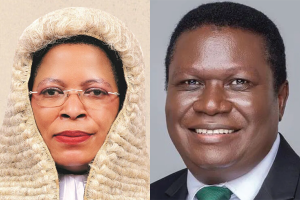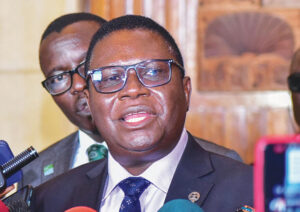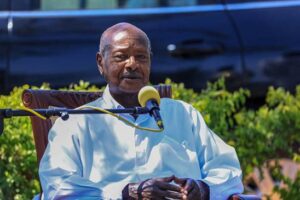
Speaker of Parliament, Anita Among, has set tongues wagging across Uganda after making a bold declaration during a recent event, stating, “I will spend whatever it takes to get what we want.” Her comments have ignited a fresh debate on the country’s political future, especially regarding the role of the opposition and the ruling party’s strategy in Parliament.
These remarks were made during a dinner organized by Michael Nuwagira, the Vice Chairman of the Patriotic League of Uganda (PLU), which was held at the Protea Hotel Skyz. The dinner was part of the lead-up to Gen. Muhoozi Kainerugaba’s 52nd birthday run, a high-profile event set to culminate in a nationwide charity run.
Addressing the Members of Parliament present at the gathering, Among exuded confidence about the ruling party’s control in Parliament, saying, “I will spend whatever it takes to get what we want.” She went on to add, “For your information, members, I can proudly say we didn’t have opposition in the 11th Parliament, and for the 12th Parliament, it’s going to be walloped.
This is going to be the easiest Parliament.” These strong words have since caused a stir, with both supporters and critics interpreting them in vastly different ways.
Among’s comments regarding the lack of opposition in the 11th Parliament and her prediction for an even more dominant 12th Parliament were seen by many as an indication of the ruling party’s growing political strength. The Speaker seemed to imply that the opposition had been ineffective in the previous Parliament and would continue to be outclassed in the next legislative term.
While she described the 12th Parliament as “the easiest,” her statement has left many questioning whether this suggests the stifling of political competition or the diminishing influence of the opposition.
The timing of her remarks, delivered during a gathering connected to the Patriotic League of Uganda, an organization linked to Gen. Muhoozi Kainerugaba, added further weight to the political context.
The PLU has gained significant traction in recent months, particularly in its efforts to rally support for the broader political agenda associated with Gen. Muhoozi, son of President Yoweri Museveni. PLU has been using various public events, charity initiatives, and social gatherings to strengthen political alliances and bolster the visibility of ruling party figures.
The Speaker’s comments, while intended to showcase the ruling party’s organizational strength, have led to mixed reactions across Uganda’s political landscape. Supporters of the ruling establishment viewed the statement as a sign of confidence, acknowledging the significant influence of the ruling party in the current Parliament. Some even saw it as a testament to the success of the party’s mobilization strategies, which have ensured dominance in the legislature.
On the other hand, critics argue that Among’s remarks highlight an increasingly hostile and monopolistic political environment in Uganda, where space for opposition is shrinking.
These remarks have sparked a larger conversation about the state of Uganda’s multiparty system, particularly as the country heads into the next election cycle. Analysts have warned that the Speaker’s statement may reflect the ruling party’s growing efforts to consolidate power and diminish the role of opposition voices. Some observers see Among’s confidence as a direct challenge to the competitive nature of Uganda’s democratic system, in which opposition parties are supposed to play an active role in holding the government accountable.

Beyond the political rhetoric, there is growing concern about the future of parliamentary democracy in Uganda. Critics suggest that the Speaker’s statement could set the stage for more aggressive tactics to neutralize opposition parties, potentially paving the way for an environment where alternative voices are marginalized.
These concerns are compounded by the increasing visibility and political engagement of the PLU, which is perceived by some as a political vehicle for Gen. Muhoozi’s ambitions and a significant part of the ruling party’s ongoing efforts to consolidate control across the political spectrum.
In an era when democracy and the role of the opposition are central to the political discourse in many African countries, Among’s remarks appear to signal a shift in Uganda’s political landscape. The absence of a strong opposition in Parliament, as Among proudly claimed, is indicative of the ruling party’s deepening influence, which could significantly reshape the political dynamics in the country.
While this may be seen as a positive development for those aligned with the ruling party, it raises concerns for those who believe that a vibrant democracy requires the active participation of diverse political voices.
The political implications of Among’s statement also raise questions about the future of political alliances in Uganda. With political stakeholders, including MPs and other political figures, continuously vying for influence and power, the Speaker’s words may signal an even greater push toward consolidating the ruling party’s hold on power. Critics, however, are concerned that such consolidation comes at the cost of healthy democratic competition, which can only thrive in a politically pluralistic environment.
Public reaction to Among’s comments on social media has been swift and divided. Supporters of the ruling party hailed her remarks as a strong affirmation of Uganda’s political stability, while critics decried her dismissal of the opposition as an undemocratic stance. On platforms like X (formerly Twitter), the debate has been particularly heated, with some users accusing Among of undermining the very principles of democracy by dismissing opposition voices in Parliament.
In response to the backlash, Among took to her official X account to clarify her intentions. She thanked the Members of Parliament who attended the dinner and reiterated her commitment to national duty, praising Gen. Muhoozi Kainerugaba for his service to the country.
The Speaker’s post, which also highlighted the charity run organized to benefit vulnerable communities, underscored her continued engagement in public service. However, her comments on the political balance of Parliament continued to dominate the conversation, overshadowing her praise for the Chief of Defence Forces and the upcoming charity event.

Among’s remarks come at a time when political positioning in Uganda is intensifying ahead of the next general elections. As PLU’s activities continue to gain momentum, with political leaders closely associated with the group engaging in public events, the ruling party’s efforts to secure its dominance are becoming more visible. The Speaker’s comments suggest that the ruling party is gearing up for an intense political showdown, with the opposition expected to be sidelined or further weakened.
Despite the controversy surrounding her remarks, Among’s statement has undoubtedly shifted the conversation about Uganda’s political future. As the country prepares for future elections, the role of opposition parties, as well as the strength of the ruling party, will play a crucial role in shaping the nation’s political landscape.
Whether Among’s words will serve as a rallying cry for the ruling party or further alienate the opposition remains to be seen, but one thing is clear: the 12th Parliament will be a defining chapter in Uganda’s political history.
As the political dynamics unfold in the coming months, all eyes will be on the actions of the ruling party and its efforts to assert its dominance. With the Speaker’s confidence, the question now is whether the opposition will be able to rise to the challenge or whether Uganda’s democracy will continue to face growing constraints on political pluralism.