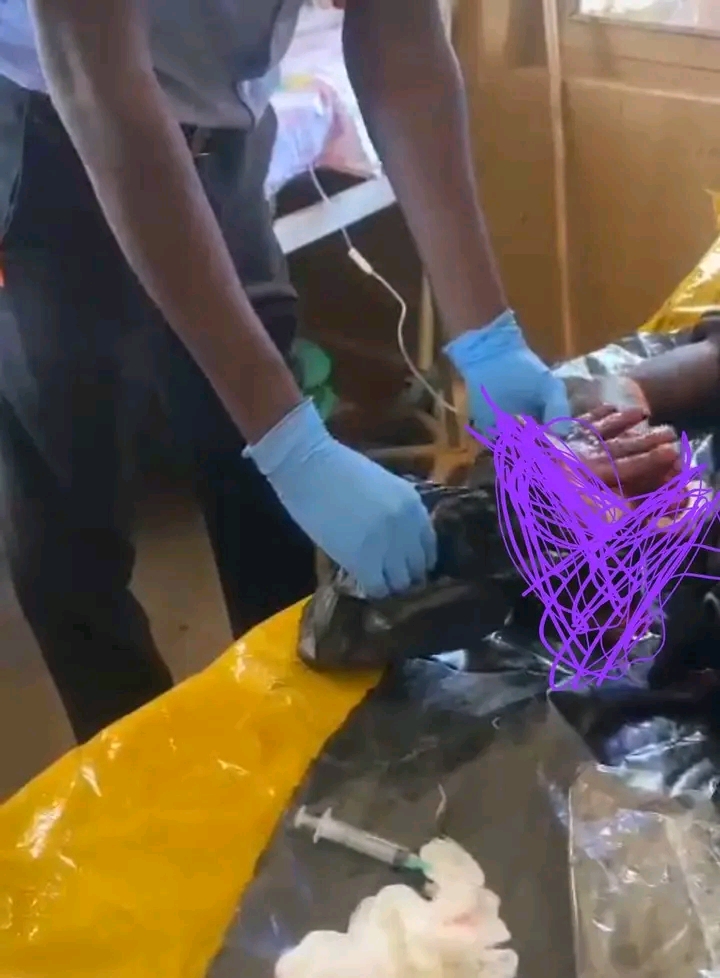
In a horrifying incident that has left the Masaka region in shock, a young man has lost both his hands after a brutal attack by angry locals who accused him of stealing coffee beans from their gardens.
The shocking attack took place in the early hours of the morning, and authorities are still investigating the details surrounding the event.
What was supposed to be a peaceful day quickly turned violent after the man was confronted by a group of residents who took the law into their own hands.
According to initial reports from local authorities, the young man, whose identity has yet to be confirmed, was allegedly caught by the owners of several coffee plantations in the region.
The residents accused him of stealing coffee beans, a crime that has become increasingly common in the area due to the rising demand for coffee. It is unclear whether the accusations were valid, but the community’s response was swift and brutal.
The situation escalated quickly as the accused man was surrounded by a large group of angry individuals. Reports suggest that the residents, enraged by the perceived theft, decided to take extreme action and punish the man.
In a shocking act of violence, the residents reportedly used sharp tools, including machetes and axes, to sever both of his hands.

The horrific nature of the attack left the man in excruciating pain, with his hands completely shattered and severed from his body.
Doctors who arrived on the scene after the attack were unable to save the man’s hands. Despite their best efforts, they were unable to reattach the severed limbs due to the extent of the injuries.
Medical professionals confirmed that the hands had been completely shattered, making it impossible for any kind of reattachment or surgical reconstruction.
The man was rushed to the hospital, where he is receiving treatment for shock and other life-threatening injuries.
This brutal act has sparked outrage and concern among local residents and human rights organizations alike. Many are questioning the motives behind such a violent and extreme response, especially considering the fact that the man had not been formally tried or convicted of any crime.
While theft is a serious issue in many rural areas, the use of mob justice has been widely condemned for its brutality and lack of due process.
Eyewitnesses to the attack have expressed shock at the speed with which the situation escalated. One resident, who asked to remain anonymous, described the scene as chaotic, with people shouting and throwing objects at the accused man.
“It was as if the community was consumed by anger,” the witness said. “There was no time to stop and question if he was actually guilty. They just wanted him to pay for the supposed crime.”
Local authorities have condemned the actions of the residents and vowed to investigate the incident thoroughly.
The police have launched a manhunt to identify and arrest those responsible for the attack, including the individuals who carried out the gruesome punishment.
“This is a gross violation of human rights, and we will ensure that those responsible face justice,” said a police spokesperson. “Mob justice has no place in our society, and we will take all necessary steps to prevent such incidents from happening in the future.”
The incident has raised questions about the prevalence of mob justice in Uganda and other parts of East Africa, where residents sometimes take the law into their own hands when they believe that authorities are not acting swiftly enough.
While community members argue that mob justice is necessary in some cases, especially when they feel that their property and livelihoods are at risk, human rights groups have consistently called for reforms to ensure that people receive a fair trial and legal representation.
A local community leader expressed deep concern over the incident, emphasizing the need for education on proper conflict resolution and the importance of respecting the rule of law. “We understand that people are frustrated and angry when they believe they have been wronged,” said the leader. “But violence is never the solution. We need to teach our people how to seek justice through the proper channels.”
The incident also highlights the increasing problem of theft in coffee-growing areas, where the valuable crop is often targeted by thieves looking to make quick profits. Coffee is one of Uganda’s major exports, and the theft of the beans can result in significant financial losses for farmers. In recent years, there has been a rise in incidents of theft across the country, with some areas seeing an increase in violent encounters between residents and suspected thieves.
In Masaka, a region known for its lush coffee gardens, the theft of coffee beans has become a serious problem. However, despite the challenges faced by farmers, many are calling for the community to address the issue through more sustainable and peaceful means.
Some have suggested that local leaders establish better security measures or work with law enforcement to improve monitoring in coffee-growing areas to prevent theft without resorting to violence.

Human rights activists have weighed in on the matter, expressing their concern about the increasing frequency of mob justice in Uganda. They argue that this type of justice system undermines the rule of law and leads to serious human rights abuses.
“The actions of the residents in Masaka are not only illegal but also morally wrong,” said a spokesperson for a local human rights organization. “No one should be subjected to such violence, especially without any proper investigation or trial.”
The man who was attacked is still in a critical condition at the hospital. Medical professionals are working to stabilize his condition, but the psychological trauma he has endured will likely be just as devastating as his physical injuries. The loss of both hands has left him severely disabled, and it is unclear how he will be able to support himself in the future.
As investigations into the incident continue, there is hope that this tragedy will serve as a wake-up call to the dangers of mob justice and the importance of upholding the rule of law. In the coming days, authorities will likely make more arrests as they continue to identify those responsible for the brutal attack.
The horrific incident in Masaka serves as a reminder of the dangers of allowing anger and frustration to dictate our actions. While theft is a serious crime that should not be taken lightly, it is equally important to remember that everyone deserves a fair trial and the opportunity to defend themselves in a court of law.
As the community grapples with the aftermath of this brutal act, there is hope that lessons will be learned, and steps will be taken to prevent such violence in the future.
For now, the family of the victim is left to cope with the devastating consequences of this incident. They are calling for justice and hoping that those responsible for the attack will be held accountable for their actions. The entire Masaka community, along with the rest of Uganda, is waiting for justice to take its course.