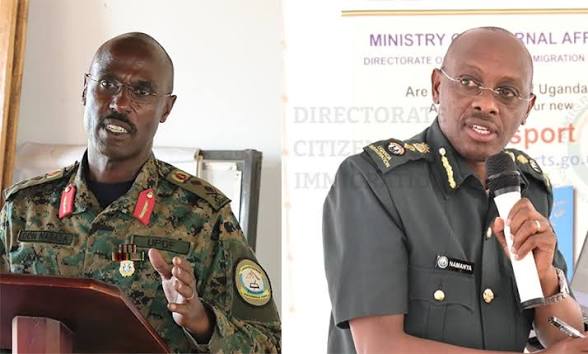
Breaking developments have emerged from Uganda’s military establishment, drawing national and regional attention. Reports indicate that two senior officers of the Uganda People’s Defence Forces (UPDF) have been taken into custody under circumstances that remain unclear. The arrests mark a significant moment within the armed forces and raise questions about internal accountability.
Major General Don William Nabasa and Brigadier General Johnson Namanya Abaho are the officers at the center of this unfolding situation. Both men have held influential roles within the UPDF and the broader security structure, making their detention particularly noteworthy. Their arrest signals a potentially serious issue within the military hierarchy.
According to available information, the two generals are currently being held at the Kasenyi military facility. This location is known for handling sensitive military matters, suggesting that the case may involve high-level concerns. However, no official explanation has been provided regarding the exact reasons for their detention.
The directive to arrest the officers reportedly came from the Chief of Defence Forces, General Muhoozi Kainerugaba. His involvement indicates that the matter is being treated with urgency and importance at the highest levels of military leadership. Nonetheless, the absence of detailed communication has left room for speculation.
Major General Nabasa has been serving as the Joint Staff for Policy and Strategy in the UPDF since early January 2025. This role places him at the core of military planning and long-term strategic development. His arrest, therefore, could have implications for ongoing policy initiatives within the force.
Before assuming his current position, Nabasa commanded the UPDF’s Third Infantry Division based in Moroto. His leadership in that role contributed to operations in a region that has historically required strong military presence. His experience has made him one of the more recognized figures in Uganda’s military ranks.
Brigadier General Johnson Namanya Abaho also has a notable background. Until recently, he served as the Commissioner of Citizenship and Passport Management within the Directorate of Citizenship and Immigration Control. His role extended beyond traditional military duties into civil administration.

Namanya’s recent recall from his position had already raised questions about his standing within the system. His subsequent arrest now adds a new layer of complexity to his situation. Observers are keen to understand whether the two developments are connected.
The arrests come amid broader efforts by the military leadership to reinforce discipline within the UPDF. General Muhoozi has been vocal in recent months about the need for professionalism and accountability among officers. This move may be part of that wider agenda.
Earlier actions, including the dismissal of Brigadier Abdul Rumayo from his role in military intelligence, suggest a pattern of restructuring. These decisions indicate that the leadership is actively addressing internal issues. However, the criteria for these actions remain largely undisclosed.
Despite the significance of the arrests, the UPDF has not released an official statement clarifying the situation. This silence has contributed to uncertainty and public curiosity. Many are awaiting confirmation of the charges or reasons behind the detentions.
The lack of transparency has also led to speculation about possible misconduct or internal disputes. Without verified information, it is difficult to determine the true nature of the allegations. This ambiguity underscores the sensitivity of the matter.
Within military institutions, such high-level arrests are rare and often signal serious concerns. They can reflect efforts to enforce standards or address breaches of conduct. In this case, the involvement of top leadership suggests a deliberate and calculated move.

The situation is being closely followed by analysts and observers both within Uganda and beyond. The outcome could influence perceptions of the UPDF’s stability and governance. It may also impact confidence in the institution’s leadership.
For the officers involved, the detention represents a dramatic shift from positions of authority to uncertainty. Their careers and reputations now depend on the findings of whatever process is underway. The stakes are undeniably high.
The broader context of military reform in Uganda adds further significance to this development. Efforts to modernize and strengthen the force have been ongoing. Actions such as these may be intended to support those reforms.
At the same time, such incidents can also create internal tensions if not handled transparently. Maintaining morale and trust within the ranks is crucial for any military organization. How this situation is managed will be closely scrutinized.
Public reaction has been mixed, with some viewing the arrests as a positive step toward accountability. Others, however, are concerned about the lack of information and potential implications. The balance between security and transparency remains a key issue.
As events continue to unfold, more details are expected to emerge. Official statements or investigations may shed light on the circumstances surrounding the arrests. Until then, much remains unknown.
Ultimately, the detention of these senior officers highlights the challenges of leadership and governance within military structures. It serves as a reminder of the importance of integrity and discipline at all levels. The coming days will be critical in determining the direction and impact of this development.