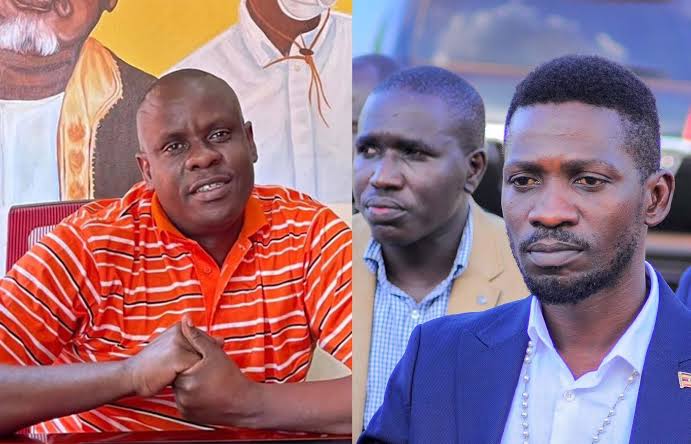
Uganda’s political tensions continue to rise as Minister Balaam Barugahara, a close ally of President Museveni’s administration, has sharply criticized opposition leader Robert Kyagulanyi Ssentamu, widely known as Bobi Wine.
In a recent interview with Uganda’s state broadcaster UBC, Minister Balaam made bold claims about Bobi Wine, accusing him of misleading the public with staged videos and portraying himself as a “movie star.”
These comments have sparked controversy and reignited the ongoing battle for political legitimacy between Uganda’s ruling government and its opposition.
Balaam’s most striking accusation involved videos that Bobi Wine has shared online, showing him eating jackfruit, or “fene” as it is known in Uganda. The minister alleged that these videos were old and made long before the 2026 elections.
“Bobi Wine has been lying to you, eating fene. Those are old videos he made… he is a movie star, he is a film star,” Balaam said, suggesting that Bobi Wine was merely putting on a performance for his followers rather than presenting an authentic image of himself.
This claim paints Bobi Wine’s social media presence, which has been crucial in his political campaign, as nothing more than a facade. For the opposition leader, social media has been a powerful tool for connecting with young Ugandans and raising awareness about the political issues that affect the country.

However, Balaam’s assertion that the videos of Bobi Wine eating jackfruit are staged puts a question mark over the authenticity of the opposition leader’s online persona.
Balaam’s comments have not only challenged Bobi Wine’s credibility but also cast doubt on the sincerity of his political message.
The minister suggested that Bobi Wine was not genuinely interested in Uganda’s struggles, but was instead using his status as a celebrity to manipulate his followers.
This notion has been a long-standing critique of Bobi Wine from the ruling party, which accuses him of prioritizing his fame over the country’s well-being.
For many of Bobi Wine’s supporters, his authenticity is one of the key reasons they have rallied behind him. They see him as a leader who came from humble beginnings and understands the struggles of ordinary Ugandans. Bobi Wine’s rise from a musician to a political figure has made him a symbol of hope for many, particularly among Uganda’s youth.
His videos, often showing him in rural settings eating traditional foods or interacting with everyday people, have contributed to this image of authenticity.
However, Balaam’s remarks challenge this perception, suggesting that Bobi Wine is playing a role rather than being true to himself.
By accusing Bobi Wine of staging these videos, the minister is implying that the opposition leader is no different from any other politician who uses media manipulation to sway public opinion.
This criticism is aimed at undermining Bobi Wine’s credibility and presenting him as a disingenuous leader, more focused on self-promotion than actual change.
The claim that Bobi Wine is a “movie star” or a “film star” is not just a rhetorical flourish; it is a deliberate attempt to discredit him by associating him with superficial fame rather than serious political leadership. Balaam’s language suggests that Bobi Wine’s celebrity status, particularly as a musician-turned-politician, is being used against him.
In Balaam’s eyes, Bobi Wine’s transformation from a popular artist to a political figure is less about fighting for democracy and more about leveraging his fame for personal gain.
Balaam’s comments reflect the ongoing attempts by the ruling government to diminish Bobi Wine’s political influence. Since Bobi Wine first entered politics, the government has been keen to paint him as an outsider and a threat to the status quo. His rise has been a challenge to the long-standing rule of President Yoweri Museveni, and the ruling government has fought to discredit him at every turn.
For those in power, Bobi Wine represents an existential threat, and his efforts to mobilize young people against the government have made him a key figure in Uganda’s political struggle.
However, Bobi Wine’s supporters reject Balaam’s characterization. They argue that his music, activism, and political campaign are all part of a broader effort to raise awareness about the challenges facing Uganda.
Bobi Wine’s rise has inspired many young Ugandans to engage with politics, something that was previously rare in a country dominated by a ruling elite. For these supporters, Bobi Wine’s success is a reflection of the people’s desire for change, and they see him as a symbol of hope, not as a celebrity playing a role.
Balaam’s comments also touch on the issue of Bobi Wine’s international engagements. The minister implied that Bobi Wine’s actions were not grounded in Uganda’s struggles but instead in building his own personal brand. This criticism comes as Bobi Wine has increasingly turned to international platforms to gain attention for his cause.
His meetings with U.S. lawmakers and human rights organizations have been framed as part of a strategy to draw global attention to Uganda’s political repression. However, critics like Balaam argue that this reliance on international support undermines Bobi Wine’s position at home.

The minister’s accusations are part of a broader political narrative within Uganda. The ruling government has long sought to portray opposition figures like Bobi Wine as unpatriotic and untrustworthy. By accusing Bobi Wine of staging his social media videos and pretending to be a man of the people, Balaam is trying to delegitimize the opposition leader’s political movement. For the ruling government, Bobi Wine’s celebrity status makes him an easy target for ridicule, and they have seized on every opportunity to discredit him.
This battle of narratives is central to the political struggle in Uganda. On one side, the government argues that Bobi Wine is a product of foreign influence and celebrity culture, while on the other, Bobi Wine’s supporters insist that he is a genuine leader who understands the struggles of ordinary Ugandans. The question of authenticity in politics has been a key issue in Uganda’s ongoing political battle, and Balaam’s remarks only serve to intensify the debate.
Balaam’s statement also reveals the deepening divide between Uganda’s youth and the older political establishment. Bobi Wine’s popularity among young Ugandans is undeniable, and his political message resonates with those who feel excluded from the country’s political system. For many young people, Bobi Wine represents a chance for change, and they have rallied behind him in large numbers. However, the ruling government sees this growing support for Bobi Wine as a threat to its control, and it has resorted to using every tool at its disposal to undermine his influence.
The debate surrounding Bobi Wine’s credibility is also intertwined with the question of Uganda’s future. Many Ugandans feel that the country has been ruled for too long by a single family, and they are eager for a change. Bobi Wine’s rise represents the possibility of a new kind of leadership, one that is not beholden to the old political structures. His supporters argue that his authenticity is key to his appeal, and they reject the narrative that he is simply using his fame for personal gain.
In the coming months, the political landscape in Uganda is likely to remain tense. Bobi Wine’s popularity continues to grow, and the government’s attempts to discredit him will likely continue. Balaam’s comments are just one example of the ruling party’s strategy to undermine the opposition, and the war of words between the two sides shows no signs of slowing down. The future of Uganda’s democracy will depend on how these battles play out, and whether the people of Uganda will continue to support the opposition or remain loyal to the government.
Balaam’s accusations against Bobi Wine represent a key moment in the ongoing political drama in Uganda. While the minister may believe that he is undermining the opposition leader’s credibility, Bobi Wine’s supporters view these attacks as further proof of the government’s desperation.
The opposition leader’s rise has challenged the long-standing political order, and the ruling government’s efforts to discredit him only highlight the stakes of this battle. As Uganda’s political future remains uncertain, one thing is clear: the struggle for the country’s democratic future is far from over.