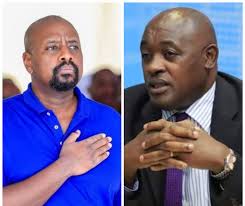
Uganda’s Information Minister, Dr. Chris Baryomunsi, has revealed the enormous challenges he faces in his role, particularly due to the unpredictable tweets and posts of the country’s Chief of Defence Forces, Gen. Muhoozi Kainerugaba.
Speaking during the Saturday edition of the popular Capital Gang radio program, Baryomunsi said he has directly informed President Yoweri Museveni about the difficulties he faces as the government’s chief spokesperson.
He described his position as “the hardest and most complicated portfolio in the entire Cabinet.”
Baryomunsi explained that the unpredictable nature of Gen. Muhoozi’s social media activity has made his work significantly more complicated.
Every time the CDF posts controversial statements, Baryomunsi is left to defend the government and reconcile conflicting narratives.
The Minister gave a concrete example during his appearance on Capital Gang. He recalled a recent BBC interview in which he tried to reassure the world that opposition leader Bobi Wine was free and not being pursued. At the same time, Gen. Muhoozi had publicly declared Bobi Wine a wanted man.
This contradiction created a serious challenge for Baryomunsi. Explaining to millions of international viewers how these statements could coexist logically proved extremely difficult, he admitted.

According to him, such moments undermine the credibility of the government in the eyes of both Ugandans and the international community.
Baryomunsi also noted that this is not a new problem. He said he has previously raised concerns with President Museveni, highlighting the challenges his office faces in managing government communications while Gen. Muhoozi continues to post freely on social media.
Despite the difficulties, Baryomunsi maintains a level of composure. He said he has “grown a thick skin” and is now accustomed to public scrutiny and abuse that comes with his role.
He added that he has learned to navigate these challenges while still performing his duties effectively.
The Information Minister stressed that Ugandans should learn to ignore Gen. Muhoozi’s tweets rather than take them seriously.
He cited past incidents, such as when Muhoozi mentioned setting a date for Dr. Kizza Besigye’s hanging, which ultimately did not happen.
However, other panelists on the program disagreed with this approach. They argued that ignoring such posts is not feasible, given Gen. Muhoozi’s high-ranking position and the influence his words carry. In some instances, what he calls “jokes” have real-world consequences.
Panelists reminded Baryomunsi that references to sensitive topics, such as the infamous “basement” associated with torture allegations, have been proven true in the past. Citizens who have experienced the basement have spoken publicly about their suffering, showing the gravity of such statements.
Baryomunsi acknowledged these points but maintained that he is committed to his role as Information Minister. He said he will continue in the position as long as President Museveni remains satisfied with his work, even under intense pressure.
The Minister also suggested that the government consider formally educating Gen. Muhoozi about the legal and administrative limits of social media use. He argued that laws which govern the use of platforms like X (formerly Twitter) should apply to everyone, including senior government and military officials.
Baryomunsi pointed out that while it is currently possible for Gen. Muhoozi to post provocative material and later delete it with an apology, there will come a time when this approach may no longer be tolerated, especially when international partners are involved.
He emphasized the dangers of posting content that demeans other countries, such as the recent controversial tweets about the United States. Such posts can escalate diplomatic tension and damage Uganda’s global reputation.
The Information Minister admitted that there is a need for systematic sensitization for Gen.

Muhoozi regarding the potential consequences of his online behavior. However, he did not specify which government agency would be tasked with this responsibility.
Panelists on the show advised that Baryomunsi engage more actively with Gen. Muhoozi. They suggested establishing regular consultations before the CDF posts content online to avoid contradictions and maintain a unified government message.
Baryomunsi explained that, as a practice, he consults widely with government agencies, including the army, police, ISO, ESO, and CMI, before making public statements. He stressed that this approach ensures consistency and that key positions are unified across government.
He added that many times, he also consults directly with the President to arrive at a consensus before making statements publicly. This helps ensure that government messaging is credible and defensible, even when dealing with challenging questions from foreign media.
Baryomunsi’s comments reflect the broader challenge of managing government communications in the age of social media. High-ranking officials with personal platforms can sometimes undermine coordinated messaging, leading to confusion among citizens and international observers alike.
Despite the difficulties, Baryomunsi appeared determined to continue his work. He underscored the importance of professionalism, saying that effective government communication requires both patience and resilience, particularly when colleagues act unpredictably.
In conclusion, the Information Minister’s revelations shed light on the unique pressures of his office. They also raise important questions about the intersection of social media, military authority, and government communications, highlighting the need for clear protocols and collaboration at the highest levels.