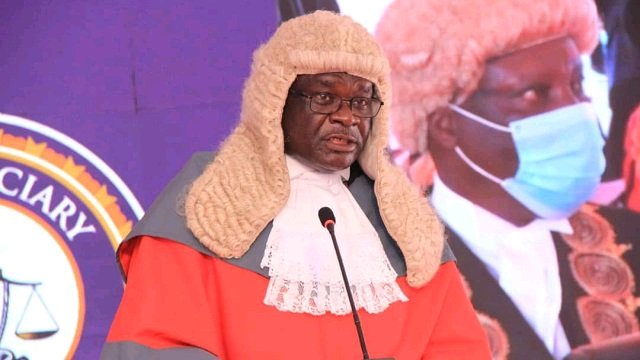
After decades of service in Uganda’s legal and political arenas, Chief Justice Alfonse Owiny-Dollo has officially stepped down from the nation’s highest judicial office, marking both the culmination of a 17-year judicial career and his 70th birthday. His retirement, effective Sunday, follows constitutional requirements mandating that justices of the Supreme Court and Court of Appeal, including the chief justice, step aside upon reaching the age of 70.
Owiny-Dollo’s departure comes at a delicate moment for the judiciary, with no immediate successor named. The Judicial Service Commission has submitted a list of potential candidates to President Yoweri Museveni, but the appointment process remains pending. Dr. Rose Nassali Lukwago, the commission’s permanent secretary, emphasized that while the process is ongoing, the new chief justice will be appointed soon.
Among the potential successors are Supreme Court Justices Mike Chibita, Catherine Bamugemereire, Monica Mugenyi, and Christopher Madrama, alongside Deputy Chief Justice Flavian Zeija. Each of these candidates brings a wealth of experience, leaving observers to speculate on who will inherit the challenging mantle of leading Uganda’s judiciary.
Born on January 18, 1956, in Agago district, Owiny-Dollo entered the judiciary as a High Court judge in 2008. He rose through the ranks, joining the Court of Appeal in 2015, becoming deputy chief justice in 2017, and ultimately assuming the role of chief justice in August 2020. Over his five-year tenure, he oversaw the judiciary’s budget nearly doubling from 199 billion shillings to 442 billion shillings, enabling expansion in infrastructure, staffing, and technology.
Despite these achievements, Owiny-Dollo’s leadership faced scrutiny. A notable controversy involved Supreme Court Justice Esther Kisaakye during the 2021 presidential election petition. Kisaakye accused him of withholding files that prevented her from reading a dissenting opinion. A tribunal was convened to investigate, but its findings have yet to be released, leaving questions lingering over judicial independence.
Before joining the bench, Owiny-Dollo had a distinguished career in law and politics. He was a member of the Constituent Assembly that drafted Uganda’s 1995 Constitution and represented Agago County in Parliament from 1996 to 2001. He also served as legal counsel during key peace negotiations with the Uganda People’s Democratic Movement in 1988 and the Lord’s Resistance Army between 2006 and 2008.
Owiny-Dollo’s academic background includes a Bachelor of Laws from Makerere University and a Master of Arts in conflict resolution from the University of Bradford in the United Kingdom. His career reflects a blend of legal expertise, political acumen, and involvement in national reconciliation efforts.
As Uganda anticipates the appointment of a new chief justice, the nation reflects on Owiny-Dollo’s legacy—a mixture of institutional growth, political challenges, and high-profile controversies. His departure leaves behind both achievements to be celebrated and questions that will continue to shape discussions on the independence and integrity of Uganda’s judiciary.