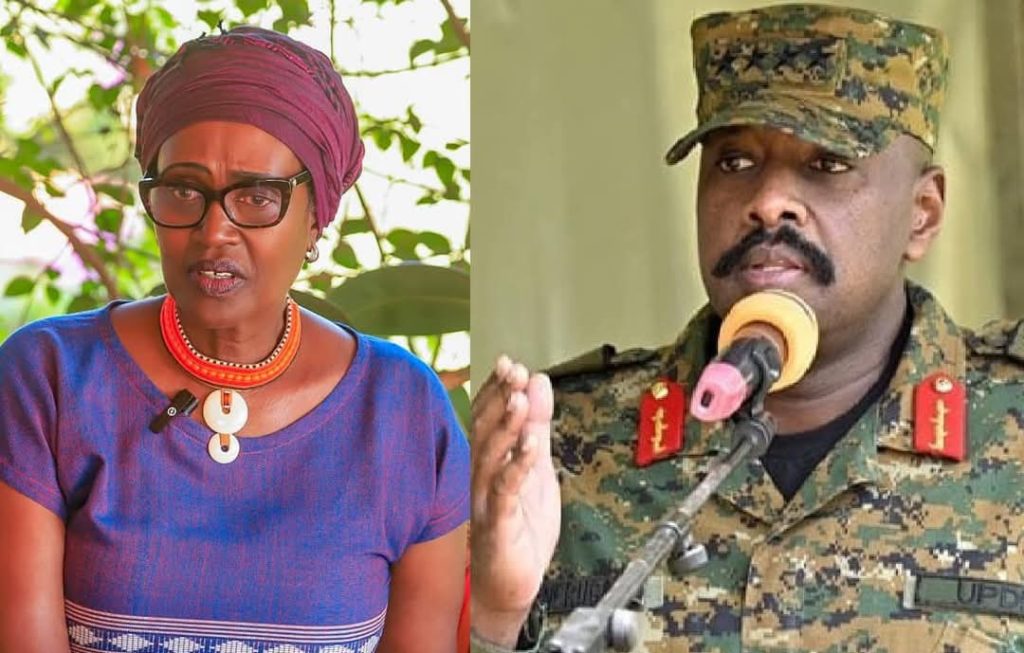
Reports circulating on social media platforms have triggered a wave of political debate after claims emerged that Uganda’s Chief of Defence Forces, Gen. Muhoozi Kainerugaba, made controversial remarks targeting veteran opposition figure Winnie Byanyima. The alleged comments have since drawn widespread attention both within Uganda and internationally due to their inflammatory nature and political sensitivity.
According to posts shared online, Gen. Muhoozi is said to have made statements on the social media platform X, which referenced historical political events and included personal threats directed at the opposition figure. These claims have not been independently verified in full, but screenshots and discussions have continued to circulate widely.
The remarks reportedly referenced the 1985–86 bush war period involving President Yoweri Kaguta Museveni and suggested controversial interactions involving political actors of that era. The historical references have added further sensitivity to the already heated political discourse.
Additional claims suggest that Gen. Muhoozi made statements implying the use of violence against Winnie Byanyima in response to her public criticism. These alleged remarks have been widely condemned by commentators who argue that they are inappropriate for a senior military officer.

The controversy intensified after Byanyima reportedly commented on regional security discussions, including reactions to earlier statements attributed to Muhoozi regarding international affairs and military ambitions. Her remarks were framed as a call for restraint and professionalism in handling matters of national security.
In response to her comments, social media users claim that Muhoozi issued strongly worded replies, which quickly went viral and sparked outrage among political observers, civil society groups, and human rights advocates.
Many critics argue that such exchanges, if accurately reported, risk undermining public confidence in national institutions, particularly the military, which is expected to remain neutral and professional in political discourse.
Human rights defenders have also expressed concern, stating that language perceived as threatening or violent contributes to an already tense political environment and may discourage open democratic debate.
Supporters of the government, however, have in some cases dismissed the controversy as exaggerated online interpretation, arguing that social media posts are often taken out of context or misrepresented.
Despite differing opinions, the incident has reignited longstanding discussions about the role of high-ranking officials in political communication, especially on public platforms such as X where messages spread rapidly and reach global audiences.
Political analysts note that Uganda’s public discourse has increasingly shifted to digital platforms, where political figures engage directly with critics and supporters, sometimes resulting in heated exchanges that escalate quickly.
Observers further argue that when senior officials engage in such exchanges, it blurs the line between formal institutional communication and personal opinion, creating challenges for public perception and diplomatic relations.
The situation has also drawn attention from international observers who monitor political communication trends in East Africa, particularly in relation to freedom of expression and responsible leadership conduct.
Some commentators have called for restraint from all parties involved, emphasizing that political disagreements should be handled through formal and respectful channels rather than personal confrontations on social media.
Others have suggested that institutions such as the military should issue clearer communication guidelines to prevent individual statements from being interpreted as official positions of the state.
Civil society voices have also urged accountability and professionalism, stressing that public trust in leadership depends heavily on the tone and conduct of those in authority.
As discussions continue online, the controversy has become part of a broader national conversation about political expression, leadership conduct, and the boundaries of acceptable speech in public office.

At the same time, some analysts warn that repeated cycles of online political confrontation risk deepening polarization and distracting from policy debates that affect ordinary citizens.
So far, there has been no comprehensive official statement addressing the full scope of the allegations, leaving room for speculation and competing narratives across different media spaces.
The incident underscores the growing influence of social media in shaping political narratives in Uganda, where statements—verified or not—can quickly become national talking points.
As the debate evolves, many observers are calling for calm, verification of facts, and a return to issue-based political engagement rather than personal attacks, in order to preserve stability and constructive public dialogue.