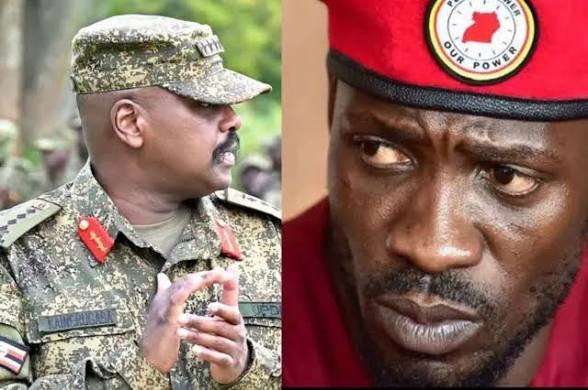
Gen Muhoozi Kainerugaba has once again stirred political discussion after making strong remarks directed at the National Unity Platform (NUP) and its leader Robert Kyagulanyi, also known as Bobi Wine. The comments, which were widely circulated on social media, have generated mixed reactions across Uganda’s political landscape.
In his statement, Gen Muhoozi suggested that opposition figures who previously underestimated his approach have since encountered what he described as a different level of political toughness. His remarks were framed in a confrontational tone that quickly drew attention from supporters and critics alike.
He claimed that some members of the opposition had previously perceived themselves as politically bold or fearless, but later realized they were dealing with a more forceful and unpredictable opponent in the political arena.
The comments were widely interpreted as being directed at Bobi Wine and the leadership of NUP, a party that has positioned itself as one of the strongest opposition movements in Uganda in recent years.

Supporters of Gen Muhoozi argued that his statement reflects confidence and assertiveness in responding to political criticism. They say such remarks demonstrate a willingness to confront opponents directly in a highly competitive political environment.
However, critics argue that the language used risks deepening political tensions between government-aligned figures and opposition groups. They caution that such statements can contribute to an already polarized political climate.
Political analysts note that Uganda’s political discourse has become increasingly heated in recent years, especially on social media platforms where leaders often communicate directly with the public without formal moderation.
They further observe that statements from high-profile figures tend to attract widespread attention and can shape public debate even when not delivered through official institutional channels.
The National Unity Platform, led by Bobi Wine, has grown into a major opposition force, particularly among young voters and urban populations. The party has frequently clashed with government institutions over governance, rights, and electoral processes.
Observers say that comments from senior military or political figures directed at opposition leaders often intensify political conversations and may influence perceptions among supporters on both sides.

Civil society organizations have repeatedly urged political leaders to exercise restraint in their public communication, emphasizing the importance of respectful dialogue in maintaining national unity.
At the same time, supporters of the government argue that political competition is normal in democratic systems and that strong rhetoric is often part of political engagement, especially during periods of heightened tension.
Security and governance experts have pointed out that Uganda’s political environment involves multiple actors with different communication styles, which can sometimes lead to misunderstandings when statements are taken out of context.
Some commentators believe the remarks may be intended to project strength and dominance in response to criticism from opposition figures rather than to signal any direct political action.
Others argue that such statements risk escalating rhetorical exchanges between rival political camps, which could further deepen divisions among supporters.
The comments have also reignited debate about the role of military leaders in political communication, with some analysts suggesting clearer boundaries may help reduce controversy.

Despite the backlash and support, there has been no official response from the National Unity Platform regarding the statement at the time of reporting. Political observers are watching closely to see whether the party will address the remarks publicly.
In Uganda’s current political environment, exchanges between ruling-aligned figures and opposition leaders often attract national attention and quickly dominate public discourse.
As reactions continue to emerge, Gen Muhoozi’s remarks have added to an ongoing conversation about political rivalry, communication style, and the increasingly direct nature of public statements by high-ranking figures.
The debate highlights the delicate balance between political expression and responsible communication, especially when addressing opponents in a highly sensitive and competitive political landscape.