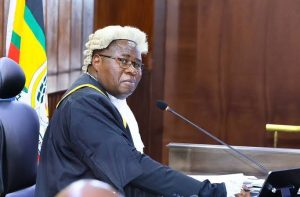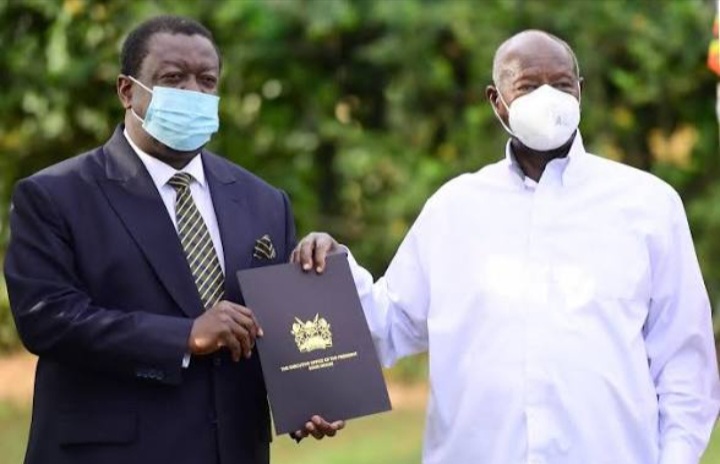
Outgoing State Minister for Foreign Affairs Henry Okello Oryem has expressed deep disappointment after being left out of President Yoweri Museveni’s latest cabinet reshuffle, marking the end of his long tenure in one of Uganda’s most sensitive foreign affairs positions.
Speaking after the announcement, Oryem admitted that, like any other person in public service, he felt disappointed by the decision but remained grateful for the opportunity to serve the country for more than two decades in the same ministry. He noted that such a long uninterrupted period in one portfolio was rare in government service.
Oryem had served in the Ministry of Foreign Affairs since 2004, making him one of the longest-serving ministers in Uganda’s cabinet history. During that time, he played a key role in representing Uganda in international diplomatic engagements across different continents.
In the latest reshuffle, he was replaced by Calvin Echodu, bringing an end to his long stay in the foreign affairs docket. The changes were part of a broader cabinet reorganisation by President Museveni affecting several ministries.

Another senior official from the Acholi sub-region, Kenneth Omona, the former State Minister for Northern Uganda Rehabilitation, was also dropped from cabinet. He has since been appointed ambassador, while Beatrice Akello Akori has taken over his former ministerial position.
Reflecting on his years in service, Oryem described his time in government as a unique opportunity that allowed him to engage with global leaders and represent Uganda’s interests at major international platforms such as the United Nations, African Union, and European Union.
He said the experience enabled him to build strong diplomatic networks and strengthen Uganda’s foreign relations over time. According to him, such engagements were crucial in promoting Uganda’s image on the global stage.
Despite leaving cabinet, Oryem stated that he remains willing to continue serving Uganda in any capacity, including advisory roles, consultancy, or further diplomatic assignments, noting that he is also professionally trained as a lawyer.
He further addressed concerns from parts of Northern Uganda regarding representation in cabinet, urging residents of the Acholi sub-region to remain patient and continue supporting development initiatives.
According to him, political representation should be viewed alongside broader national development goals, especially infrastructure growth and poverty reduction programmes.

He also acknowledged the growing support for the ruling National Resistance Movement (NRM) in Northern Uganda but encouraged communities to focus on long-term progress rather than immediate political positions.
The latest reshuffle by President Museveni retained several senior officials while introducing new faces into government, signalling what analysts describe as preparation for the next political cycle.
Among retained ministers from the Acholi sub-region are Hillary Onek, who was reassigned within the Office of the Prime Minister, and Norbert Mao, who kept his position as Minister of Justice and Constitutional Affairs.
Other officials who retained positions include Beatrice Atim Anywar and Lillian Aber, who continue to serve in their respective ministerial roles within government.
The reshuffle has generated mixed reactions among leaders and political observers in Acholi, with some praising the appointments while others expressed concern over regional balance.
Local leaders such as Alex Okoya welcomed the changes, arguing that leadership shifts were necessary and expressing support for the President’s decisions.

However, analysts like Arthur Owor offered a more critical perspective, suggesting that regional political divisions and competition may have influenced the allocation of cabinet positions.
Owor argued that while Acholi has increased its support for the ruling party, internal divisions among leaders have weakened the region’s ability to negotiate for stronger representation.
He also noted that other regions have benefited more by presenting unified political positions ahead of cabinet appointments.
Despite the changes, President Museveni retained several top officials, including Vice President Jessica Alupo, Prime Minister Robinah Nabbanja, and First Lady Janet Kataaha Museveni, who continues to serve as Minister of Education and Sports.