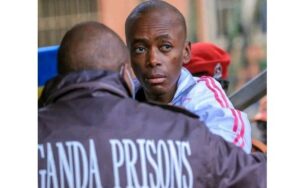
In a courtroom revelation that has left the public in shock, Christopher Okello, the prime suspect in the horrific Ggaba school murders, has admitted to attempting to rob a bank and even plotting to kill his brother’s entire family. His startling confession, made during his trial, has not only raised eyebrows but has also deepened the mystery surrounding his troubled past.
Okello, who has been accused of brutally killing several children at a school in Ggaba, shared the details of these dark activities that had remained hidden until now.
Okello’s confession came as a part of his defense during his trial for the Ggaba school murders, where he stands accused of orchestrating and carrying out the killing of several innocent children. However, his testimony took an unexpected turn when he revealed details of his past criminal actions, shocking the courtroom and everyone present.
The revelation that he had attempted to rob a bank and was also planning to murder his brother’s family paints a chilling picture of the suspect’s psyche and his willingness to commit extreme acts of violence.
The court was left in disbelief as Okello, in a calm yet chilling tone, spoke about his failed attempt to rob a local bank. According to his account, the robbery was planned meticulously, and he had intended to make a significant amount of money.

He described how he had gone as far as to purchase weapons and even case the bank, preparing for what he believed would be a successful heist.
However, despite his preparation, things went awry, and he was forced to abandon the robbery before it could be carried out. His failure, however, did not deter him from continuing his violent tendencies.
In his confession, Okello also described how he once plotted to kill his brother’s family. He explained that there had been ongoing issues within his family, including financial disputes and long-standing grudges. These tensions, he claims, pushed him to the brink of wanting to eliminate his brother’s entire family in a fit of rage.
He described how he had carefully planned the murders, intending to wipe out everyone in the household. Fortunately, for his brother and his family, Okello’s plans never materialized, and the act of murder was never carried out.
The courtroom was left stunned as the details of these past events were revealed. The fact that Okello had once been involved in such violent acts yet managed to avoid any serious repercussions raised many questions about his mental state and his capacity for violence. His actions, it seemed, were part of a larger pattern of disturbing behavior that had been simmering beneath the surface for years.
His failed robbery attempt and his near-murderous plan against his brother’s family demonstrated a chilling disregard for human life and a deep-seated anger that had festered within him for a long time.

The shock and disbelief in the courtroom were palpable as Okello continued his confession, detailing the extent of his violent tendencies. He admitted that he had always harbored feelings of resentment and hatred, and these emotions had driven him to commit increasingly dangerous acts. His failed bank robbery and murder plot were just the beginning of his descent into deeper criminal behavior.
The murders of the children in Ggaba, he explained, were the culmination of years of anger and frustration that had finally boiled over into a horrific act of violence.
As Okello spoke, his words painted a picture of a man who had been spiraling out of control for years. He described how he had always struggled with his emotions, often acting impulsively without thinking of the consequences. His violent outbursts had been a way for him to cope with the deep-seated issues he had been dealing with for much of his life. Unfortunately, this pattern of violence eventually led him to the tragic murders of the children at Ggaba School.
The families of the victims in the Ggaba murders, along with the general public, were left grappling with the implications of Okello’s shocking confession. The revelation that he had been involved in such a wide range of violent acts over the years raised questions about his mental health and the societal factors that may have contributed to his behavior. Was he a product of a broken system? Did his past experiences and unresolved issues push him toward committing such heinous crimes?
Experts in criminal psychology have since weighed in on Okello’s confession, suggesting that his violent tendencies may be linked to deep psychological trauma. It is possible that Okello’s failed attempts at robbery and the murder plot against his brother’s family were indicative of a larger pattern of criminal thinking. His inability to control his emotions and impulses, coupled with a history of anger and resentment, may have contributed to the horrific violence he later committed.
Some have argued that Okello’s violent behavior could be traced back to his upbringing and past experiences. Reports suggest that Okello had a difficult childhood, growing up in an environment marred by poverty and familial instability. It is possible that these early experiences shaped his outlook on life and contributed to his tendency to resort to violence as a means of dealing with his frustrations.

For the families of the Ggaba murder victims, Okello’s confession has added another layer of grief and confusion. The idea that the man responsible for the brutal killings had been involved in other violent acts in the past only deepens their pain. Many have expressed shock and disbelief, struggling to comprehend how someone could commit such horrific acts of violence, not just once, but multiple times over the course of his life.
As Okello’s trial continues, legal experts and psychologists will likely play a crucial role in understanding the full extent of his mental state and motivations. His confession has opened a door into the dark recesses of his mind, and the full story behind his violent actions may not be fully understood until the trial comes to a close. What remains clear, however, is that Okello’s actions have left an indelible mark on the lives of his victims, their families, and the wider community.
As the case continues to unfold, many will be watching closely to see what legal consequences Okello faces for his crimes. His shocking confession has already raised serious questions about the nature of criminal behavior and the factors that contribute to violent acts. The Ggaba murder case will likely serve as a key point of discussion in the ongoing debate about criminal justice and mental health in Uganda.
In the end, Christopher Okello’s confession has raised more questions than answers. It has highlighted the complex relationship between past trauma, violent behavior, and the actions that follow. As the trial moves forward, it remains to be seen how this new information will impact the case and what further revelations may emerge in the coming weeks.