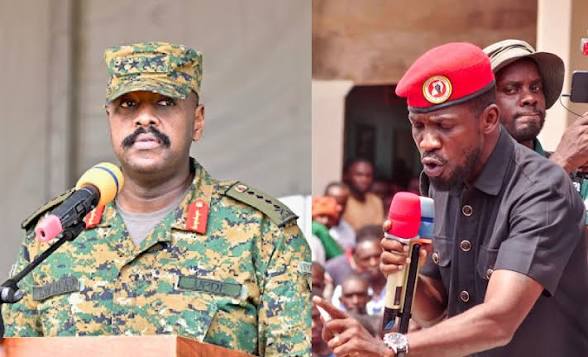
The political atmosphere in East Africa was recently stirred by strong and controversial remarks attributed to Muhoozi Kainerugaba.
His comments about Bobi Wine, also referred to as Kabobi in the statement, quickly spread across social media, drawing mixed reactions from the public.
The situation highlights how quickly words can travel and how deeply they can affect public discourse.
According to the statement, there was mention of a video allegedly showing Bobi Wine passing through Kigali airport. The claim immediately raised questions about its authenticity, with suggestions that it might have been generated using artificial intelligence.
In today’s digital age, such suspicions are becoming increasingly common, as technology makes it easier to manipulate images and videos.
Despite the uncertainty about the video, the comments went further, expressing hope that airport officials would disinfect Bobi Wine. This part of the statement was widely seen as offensive and degrading, especially given the implication that he had just come out of a pit latrine. Such language sparked strong reactions from supporters and critics alike.
For many observers, the issue goes beyond just one statement. It reflects the broader tensions between political figures in Uganda, where disagreements often turn personal.

The rivalry between Muhoozi Kainerugaba and Bobi Wine has been closely followed, with both figures representing very different political paths and ideologies.
Social media played a key role in amplifying the message. Within hours, the statement had been shared, reposted, and debated across platforms. This shows how powerful online spaces have become in shaping political narratives and influencing public opinion.
Some people dismissed the remarks as political rhetoric, arguing that harsh language is not uncommon in competitive political environments.
Others, however, viewed the comments as crossing a line, calling for more respectful and responsible communication from leaders.
The mention of artificial intelligence also adds another layer to the discussion. As AI technology becomes more advanced, it becomes harder to tell what is real and what is fake. This creates confusion and sometimes fuels misinformation, especially in politically sensitive situations.
For supporters of Bobi Wine, the statement was seen as an attempt to undermine his image and credibility.
They argued that such remarks are meant to distract from important political issues and shift attention to personal attacks instead.
On the other hand, some supporters of Muhoozi Kainerugaba defended him, suggesting that his comments were either misunderstood or taken out of context. This division in interpretation shows how political loyalty can influence how people perceive the same message.
The use of the name “Kabobi” also drew attention, as it appeared to be a deliberate alteration of Bobi Wine’s name. Many saw this as a sign of disrespect, adding to the controversy surrounding the statement.
Public figures hold a unique position in society. Their words carry weight, and even a single statement can influence thousands, if not millions, of people. This is why many believe that leaders should be careful with their language, especially in public spaces.
The incident also raises questions about accountability. Should public figures be held responsible for every statement they make online? Or should there be more understanding of the informal nature of social media communication?
In many ways, this situation reflects a larger global trend. Around the world, political debates are becoming more heated, and personal attacks are becoming more common. This shift has changed how people engage with politics and with each other.
Another important aspect is the impact on younger audiences. When they see leaders using harsh or insulting language, it can shape their own behavior and attitudes toward political discussion. This makes the issue even more significant.

The controversy also highlights the importance of verifying information. Before reacting to any video or claim, it is crucial to confirm whether it is real or fake. This helps prevent the spread of misinformation and unnecessary conflict.
Media outlets and independent observers also have a role to play. By providing accurate and balanced reporting, they can help the public understand the situation better and avoid being misled by false or exaggerated claims.
At the same time, the public’s reaction shows that people care deeply about respect and dignity in leadership. Many voices called for a more civil tone in political communication, emphasizing the need for unity rather than division.
The relationship between Muhoozi Kainerugaba and Bobi Wine continues to be a topic of interest. Their interactions, whether direct or indirect, often reflect the broader political climate in Uganda.
Looking ahead, it remains to be seen how such incidents will influence future political discourse. Will leaders choose more careful language, or will such controversies continue to be part of the landscape?
In conclusion, this situation serves as a reminder of the power of words. In a world where information spreads quickly, what leaders say can have lasting effects.
Whether real or based on speculation, statements like these shape conversations, opinions, and ultimately, the direction of public debate.